
Gold is the world’s oldest means of exchange and store of value. Gold’s rally began in 1999 and reached a new record high above the 1980 $875 per ounce level in 2008. Since then, gold has reached higher highs, trading near $4,350 per ounce, five times its 1980 peak.
In 2025, at $4,350, gold appreciated by over 64.7%, which is a significant commentary on money’s purchasing power, as gold is the ultimate means of exchange.
Why is gold so critical?
Gold’s role in the global financial system has increased in 2025 for the following compelling reasons:
- Central banks continued to purchase gold in 2025, adding to reserves.
- Governments, monetary authorities, and central banks validate gold’s role by classifying it as a reserve asset and a currency holding.
- Gold replaced the euro as the second-leading reserve asset.
- Gold’s value has increased against every global fiat currency in 2025. In U.S. dollar terms, it rose over 64% from $2,641 at the end of 2024 to over $4,350 per ounce as of December 29.
- Gold has a long history, thousands of years, as the world’s ultimate means of exchange and store of value.
- Gold is a rare metal with financial and industrial applications.
The bottom line is that gold is money.
The deterioration of fiat currency values
The following factors have contributed to the decline of fiat currency values:
- Inflation following the 2020 global pandemic has eroded currency values.
- Rising government debt levels have decreased the purchasing power of currencies.
- Currencies derive their values from the full faith and credit in the government that issues legal tender. The faith and credit have declined.
- The bifurcation of the world’s nuclear powers, sanctions, and trade barriers has weighed on currency values.
The bottom line is that the dollar, euro, pound, yen, and all other foreign currencies have lost value over the past years and in 2025.
The S&P 500 in dollars versus the index in gold terms
The United States remains the world’s wealthiest country, and the dollar is the world’s reserve currency. The S&P 500 index is the most diversified U.S. stock market index. At 6,900 on December 29, 2025, the S&P 500 has rallied over 17.3% since the end of 2024. However, gold has risen by more than 64%, meaning the S&P 500 in gold terms has declined in 2025.
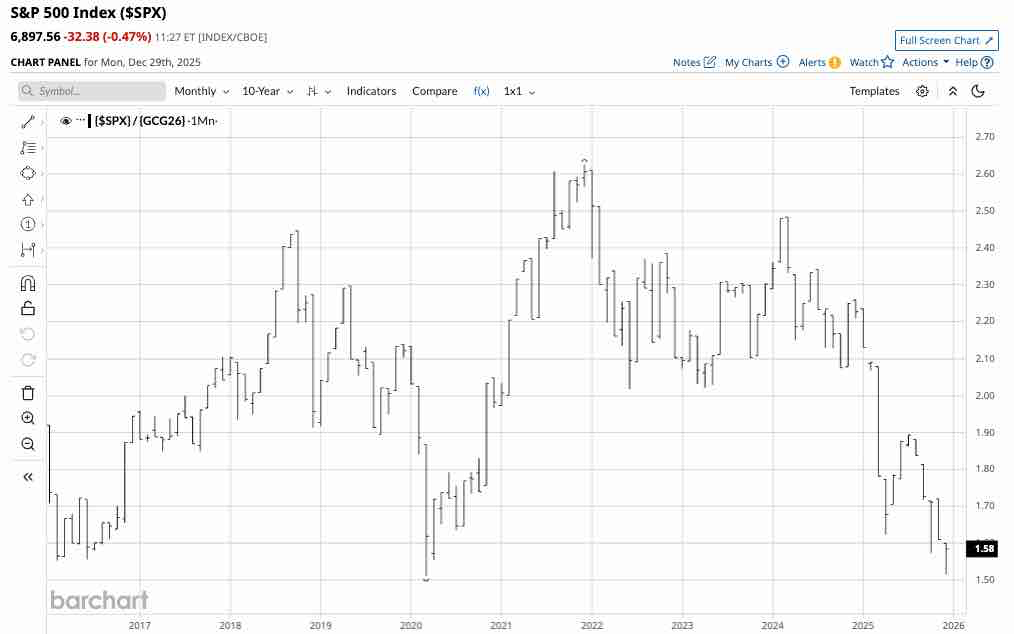
The chart of the S&P 500 divided by COMEX gold futures ({$SPX}/{GCG26}) shows that the stock market index in gold terms has moved over 29% lower in 2025. Meanwhile, the ten-year chart highlights that the average price relationship between the S&P 500 and gold has traded around the 2:1 level, with the index twice the level of gold.
Analysts and surveys say gold could be heading to $5,000 per ounce in 2026
In a November 28, 2025, CNBC quoted a Goldman Sachs survey of 900 institutional investor clients, in which 36% of respondents, a plurality, “expect gold to maintain its momentum and exceed $5,000 per troy ounce by the end of next year.”
JPMorgan analysts remain bullish on gold, forecasting that the price could reach an average of $5,055 per ounce by the final quarter of 2026.
In this case, a return to the average relationship between the precious metal and the leading U.S. benchmark equity index at 2:1 would put the S&P 500 at 10,000.
A 10,000 target for the S&P 500 is not unreasonable
Gold is telling us that the benchmark pricing mechanism for the U.S. stock market and the S&P 500 could be flawed, making U.S. stocks inexpensive at current levels. Thus, my call is that the S&P 500 may ignore P/E ratios and other traditional metrics and rise to my 10,000 target sometime in 2026. The SPX at 10,000 would have a significant bullish impact on all U.S. and other stock market indices.
On the date of publication, Andrew Hecht did not have (either directly or indirectly) positions in any of the securities mentioned in this article. All information and data in this article is solely for informational purposes. For more information please view the Barchart Disclosure Policy here.