The artificial intelligence (AI) trade has hit a rough patch. Fears are spreading that AI startups will disrupt, rather than benefit, established tech companies. Investors are spooked. And the "AI ghost trade" is weighing heavily on the sector.
But one event could change everything. Nvidia (NVDA) is set to report its fiscal fourth-quarter earnings on Feb. 25. And Wedbush Securities analyst Dan Ives says a strong showing from Nvidia and its CEO Jensen Huang could be exactly what the market needs to turn the tide.
Why the AI Trade Has Stalled
To understand why Nvidia's earnings matter so much right now, it helps to understand what's gone wrong.
Ives and his team at Wedbush recently outlined their top 10 catalysts for restarting the AI tech trade. At the top of the list? Nvidia should exceed Wall Street's “whisper numbers,” which are the unofficial, often higher expectations traders set beyond official analyst forecasts.
"The AI trade has been the 'fear of the unknown' for the tech and software sector," Ives wrote, adding that the current sentiment feels like "fighting a ghost," even as capital expenditure dollars approach roughly $700 billion this year alone.
The concern is real. Investors worry that AI startups could become what Ives colorfully calls “the Nightmare on Elm Street horror show for the tech industry,” undercutting big software players before those companies can fully monetize their own AI investments.
In short, the money is flowing in, but the returns haven't fully shown up yet. That uncertainty is driving the selloff.
Nvidia's AI Momentum
The analyst community is expecting a lot from Nvidia's upcoming report, and for good reason.
According to consensus estimates from 43 analysts, Nvidia's revenue for fiscal Q4 (ended in January) is projected at $65.74 billion. That compares to $39.33 billion in the same quarter a year ago, representing year-over-year growth of roughly 67%.
Look further out, and the picture gets even more compelling. Revenue for the full fiscal year 2026 is estimated at $213.65 billion, growing to $327.34 billion in 2027, according to analyst projections, a 53% increase.
On the earnings side, the average estimate for fiscal 2027 earnings per share (EPS) is $7.76, nearly double the $4.69 expected in fiscal 2026. These estimates reflect confidence in Nvidia's ability to keep printing money as AI infrastructure spending accelerates.
At Nvidia's CES 2026 keynote, Huang made his case for Nvidia clearly. He pointed to massive surges in model complexity, inferencing demand, and the coming wave of physical AI, robots, autonomous vehicles, and AI-powered factories. Each of those trends requires more chips. More specifically, they require Nvidia chips.
"A gigawatt data center is $50 billion," Huang told the CES crowd in January, noting that improvements in throughput per watt translate directly into data center revenues for customers. The message was clear — the demand isn't slowing down.
Nvidia at the Center of Every AI Bet
What makes Nvidia's earnings meaningful right now is that the company touches almost every corner of the AI ecosystem.
At the J.P. Morgan Healthcare Conference in January, Nvidia VP Kimberly Powell noted that AI inferencing costs have fallen more than 100x in four years — from Hopper to Blackwell to the forthcoming Rubin architecture. Lower costs mean faster adoption, which means more customers, which means more chip demand.
Nvidia is also expanding into healthcare, robotics, drug discovery, and sovereign AI infrastructure. Each of these markets represents billions in potential new revenue.
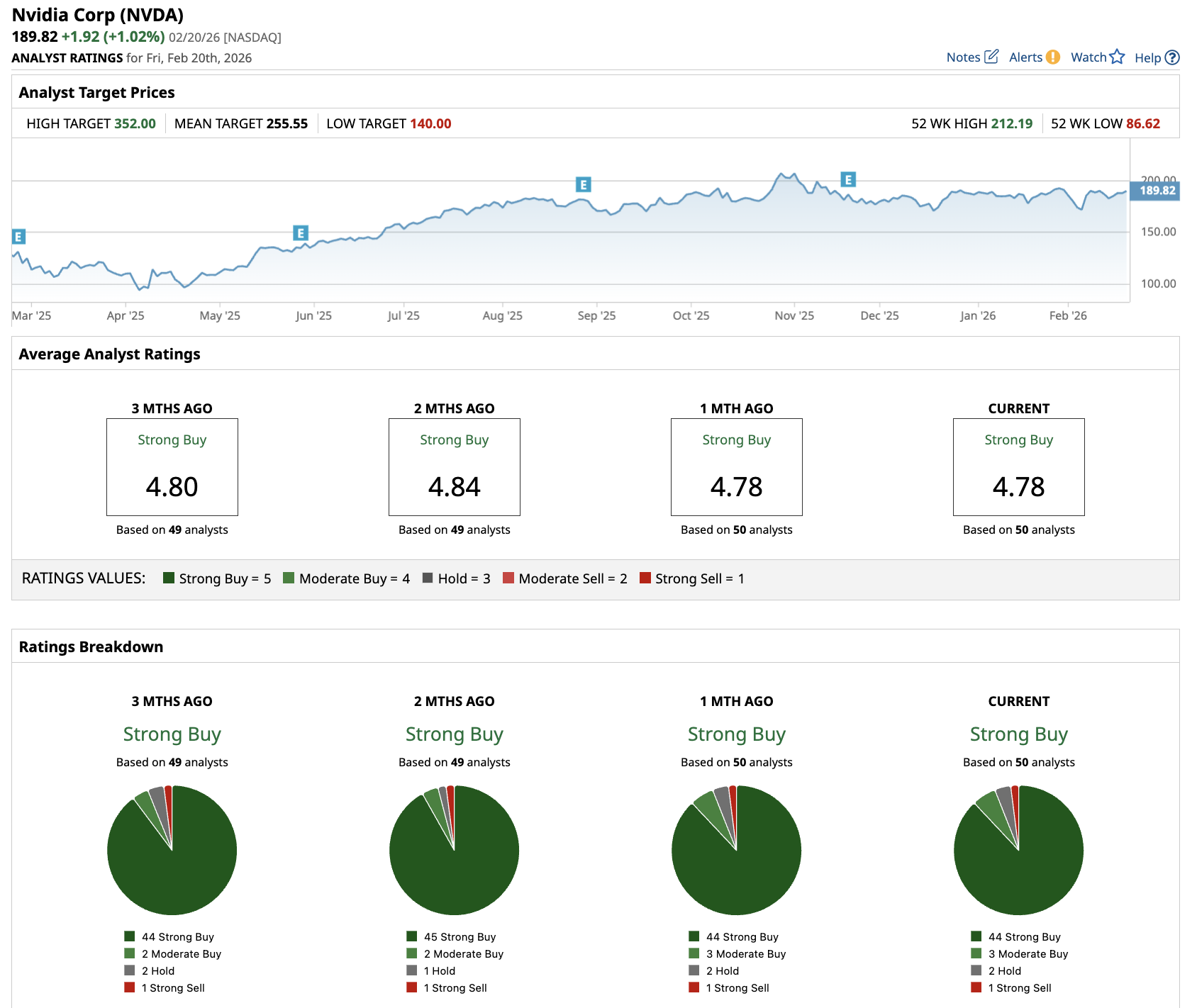
Out of the 50 analysts covering NVDA stock, 44 gave it a “Strong Buy” rating, three suggest it is a “Moderate Buy,” two recommend to “Hold”, and one recommends “Strong Sell.” The average Nvidia stock price target is $256, above the current price of $190.
Meanwhile, Ives' list of 10 catalysts to restart the AI trade includes multiple companies, from Oracle (ORCL) to Salesforce (CRM) to Microsoft (MSFT), that depend on Nvidia's hardware to deliver on their own AI promises.
If Huang delivers on Feb. 25, it won't just be a win for NVDA shareholders. It could restore confidence across the entire sector. For investors sitting on the sidelines, that's a moment worth watching.
On the date of publication, Aditya Raghunath did not have (either directly or indirectly) positions in any of the securities mentioned in this article. All information and data in this article is solely for informational purposes. For more information please view the Barchart Disclosure Policy here.
More news from Barchart
- Play the ‘SaaS Apocalypse’ Selloff in Palantir Stock With This 1 Winning, Protective Options Trade
- Should You Buy JPMorgan Stock as It Plans to Support Trump’s ‘Board of Peace’?
- Cathie Wood Bought the Dip in Robinhood Stock. Should You Buy HOOD in February 2026 Too?
- Strong Earnings from Nvidia Could Help End the 'AI Ghost Trade.' Should You Bet on NVDA Stock Now?