As of March 13, 2026, the enterprise software landscape is undergoing a foundational shift. The era of simple "if-this-then-that" automation has officially been superseded by the "Agentic Era." At the epicenter of this transformation is UiPath Inc. (NYSE: PATH). Once the undisputed king of Robotic Process Automation (RPA), UiPath has spent the last 24 months radically reinventing itself.
Today, the company stands at a critical juncture. Having just reported its first full-year GAAP profit for fiscal year 2026, UiPath is no longer a high-growth, high-burn "story stock." It is a maturing platform that has successfully navigated the "AI Valley of Death"—the period where traditional software firms were threatened with obsolescence by generative AI. With the introduction of "Agentic Automation" standards and a return to founder-led leadership, UiPath is attempting to prove that its "execution layer" is the indispensable glue for the modern AI-driven enterprise.
Historical Background
Founded in 2005 in Bucharest, Romania, by Daniel Dines and Marius Tîrcă, UiPath began as a software outsourcing firm before pivoting to RPA. For a decade, it operated in relative obscurity until the mid-2010s, when the demand for digital transformation exploded. UiPath’s bots—software that mimicked human keystrokes to automate repetitive tasks—became the gold standard for legacy industries like banking and healthcare.
The company’s trajectory was meteoric. Following a series of massive funding rounds, UiPath moved its headquarters to New York and went public in April 2021 in one of the largest US software IPOs in history. However, the post-IPO years were marked by volatility. The stock reached heights of over $80 before crashing as the market pivoted away from unprofitable tech in 2022.
The most pivotal historical moment occurred in mid-2024. After a period of slowing growth and leadership under former SAP executive Rob Enslin, founder Daniel Dines returned as CEO on June 1, 2024. Dines’ return signaled a "back-to-basics" approach, prioritizing product innovation over bureaucratic expansion. This "Dines 2.0" era focused exclusively on integrating Generative AI into the core platform, leading directly to the agentic breakthroughs of 2025 and 2026.
Business Model
UiPath’s business model has evolved from a simple per-bot subscription to a sophisticated, platform-wide consumption and outcome-based model. Its revenue streams are primarily derived from:
- Subscription Licenses: The core of the business, involving access to the UiPath Orchestrator, Studio, and the bot ecosystem.
- Maintenance and Support: Providing 24/7 reliability for enterprise-grade automation.
- Professional Services: Assisting large-scale clients in "Process Mining" and implementation.
As of early 2026, the company has transitioned many clients to the UiPath Agentic Platform. This model often includes "AI Units"—a flexible currency that customers use to power specialized agents, document understanding, and computer vision tasks. This shift helps mitigate the "seat-count risk" posed by AI, as revenue is tied to the volume of work performed by agents rather than the number of human users.
Stock Performance Overview
The five-year journey of PATH stock has been a cautionary tale of IPO hype followed by a grueling search for a floor.
- 5-Year View: Down significantly from its 2021 highs, reflecting the broader "SaaS correction" and initial fears that Large Language Models (LLMs) would make RPA redundant.
- 1-Year View: The stock saw a 29% recovery through 2025 as the market gained confidence in the company’s AI roadmap.
- Recent Performance (Q1 2026): Despite achieving GAAP profitability, the stock has recently faced a "Software Shakeout." In the first quarter of 2026, PATH declined roughly 30% from its 52-week highs.
As of today, March 13, 2026, the stock trades in the $11.00–$12.50 range. While the financial fundamentals are the strongest they have ever been, the valuation remains compressed as investors debate whether "Agentic AI" will expand the total addressable market (TAM) or cannibalize existing revenues.
Financial Performance
The fiscal year 2026 (ending January 31, 2026) was a landmark year for UiPath’s balance sheet. For the first time, the company achieved full-year GAAP profitability.
- Revenue: $1.611 billion, a 13% increase year-over-year.
- GAAP Net Income: $282.3 million, aided by disciplined cost management and a reduction in stock-based compensation (SBC).
- Annual Recurring Revenue (ARR): $1.853 billion, growing 11%.
- Margins: Non-GAAP operating margins reached a record 23%.
- Cash Flow: The company continues to be a cash-generating machine, with over $1 billion in cash and equivalents and no long-term debt, providing a massive war chest for the "Agentic" M&A strategy.
Leadership and Management
Daniel Dines, the founder and CEO, is the central figure in the UiPath narrative. His return in 2024 was seen as an admission that the company had lost its "innovator’s edge." Dines has spent the last 18 months flattening the organization and personally overseeing the development of UiPath Maestro.
The leadership team has been bolstered by "AI-native" talent, moving away from traditional enterprise sales veterans to product engineers. Governance has also improved, with the board of directors becoming more active in oversight, focusing on the ethical implications of autonomous agents. Dines’ strategy of "The Switzerland of AI" allows UiPath to remain model-agnostic, partnering with OpenAI (Microsoft Corp – NASDAQ: MSFT), Google (Alphabet Inc – NASDAQ: GOOGL), and Anthropic.
Products, Services, and Innovations
The 2026 product suite is built around three pillars that distinguish UiPath from legacy RPA:
- Autopilot: A cross-platform AI assistant that helps users discover, build, and run automations using natural language.
- UiPath Maestro: The "brain" of the operation. Maestro orchestrates "swarms" of agents. For example, in a loan approval process, one agent might extract data, another checks for fraud, and a third communicates with the customer—all overseen by Maestro.
- ScreenPlay: A breakthrough in Computer Vision. Instead of relying on brittle backend code, ScreenPlay allows AI agents to "see" and interact with any interface just as a human would, drastically reducing the cost of maintaining automations.
Competitive Landscape
UiPath faces a multi-front war:
- The Giants: Microsoft Power Automate is a formidable competitor due to its deep integration with the Office 365 ecosystem. Salesforce Inc. (NYSE: CRM) recently launched "Agentforce," directly challenging UiPath in the CRM-adjacent automation space.
- The Challengers: ServiceNow (NYSE: NOW) has integrated agentic workflows into its IT Service Management (ITSM) platform.
- The Advantage: UiPath’s edge lies in its "Cross-Platform Mastery." While Microsoft is best at Microsoft-centric tasks, UiPath excels in complex, multi-application environments involving legacy systems, web apps, and mainframes where "Agentic Vision" is required.
Industry and Market Trends
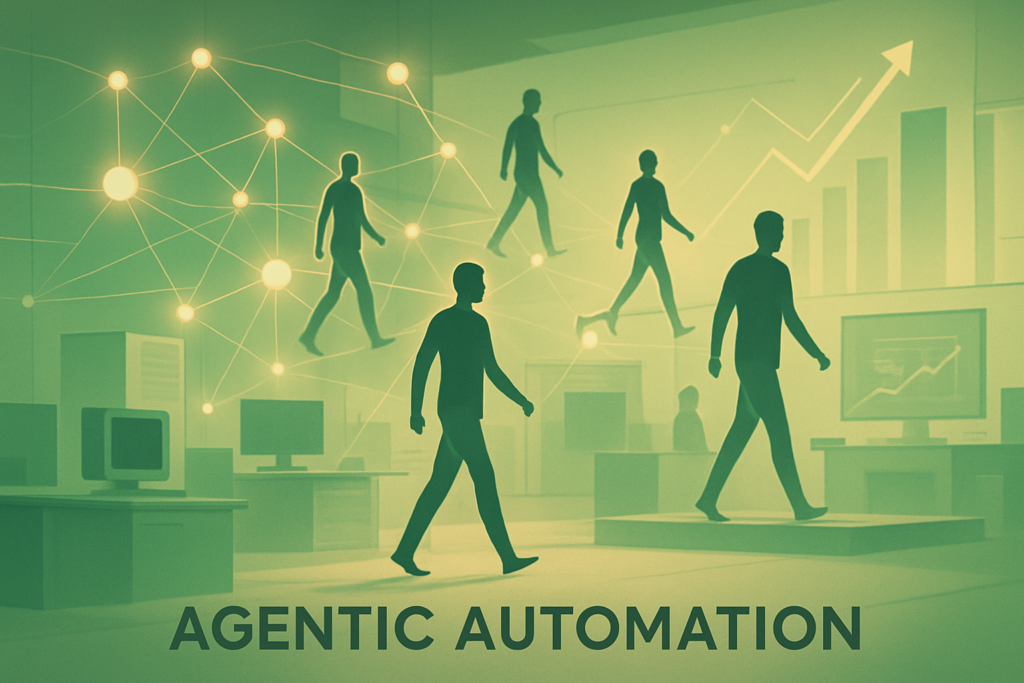
The "Agentic Economy" is the dominant trend of 2026. Organizations are moving away from "copilots" (which require constant human prompting) to "agents" (which can complete multi-step goals autonomously).
- Sector Shift: Finance and Healthcare are leading adoption, driven by the need for high-accuracy, high-governance automation.
- Labor Trends: As the global workforce faces demographic shrinkage, "digital workers" (agents) are being viewed as essential infrastructure rather than just productivity tools.
Risks and Challenges
- The "AI Sting": If agents become too efficient, customers may need fewer "seats" or "licenses," potentially leading to a revenue contraction despite increased utility.
- Execution Risk: UiPath’s recent acquisitions, including WorkFusion and Peak AI in early 2026, must be integrated flawlessly to justify their premiums.
- Technological Obsolescence: If LLMs develop native, reliable "action" capabilities (where the model itself acts as the OS), the need for a separate orchestration layer like UiPath could diminish.
Opportunities and Catalysts
- Vertical AI Agents: The March 2026 acquisition of Peak AI and WorkFusion allows UiPath to sell "out-of-the-box" agents for specific industries like Anti-Money Laundering (AML) and Retail Inventory Management.
- The $2 Billion ARR Milestone: Crossing this threshold in late 2026 or early 2027 could trigger a re-rating of the stock as it enters the "large-cap software" echelon.
- M&A Target: With its solid cash position and GAAP profitability, UiPath itself could become an attractive acquisition target for a cloud giant (like Google or Oracle) looking to buy a ready-made "Execution Layer" for their AI models.
Investor Sentiment and Analyst Coverage
Wall Street remains deeply divided on PATH.
- The Bulls (e.g., ARK Invest): Led by Cathie Wood, bulls argue that UiPath is the only company with the "connective tissue" to make AI agents useful in a messy, real-world corporate environment. They see the recent price dip as a generational buying opportunity.
- The Bears (e.g., BofA Securities): Skeptics point to decelerating revenue growth (13%) compared to the 30-40% of the past. They worry that the transition to an agentic model is a "defensive" move rather than an "offensive" one.
- Institutional Shift: We are seeing a rotation from "growth at any cost" investors to "value-oriented tech" investors who appreciate the GAAP profitability and robust buyback programs.
Regulatory, Policy, and Geopolitical Factors
The regulatory environment is becoming a tailwind for UiPath. The EU AI Act, fully in force by 2026, requires strict transparency and "human-in-the-loop" safeguards for autonomous systems. UiPath’s platform is built with these "guardrails" by design, offering enterprises a "compliant-by-default" way to deploy AI.
Geopolitically, UiPath’s dual roots in the US and Europe (Romania) have allowed it to navigate the increasing digital sovereignty requirements of the EU more effectively than many of its Silicon Valley-only peers.
Conclusion
UiPath’s achievement of GAAP profitability in early 2026 is a testament to the resilience of Daniel Dines’ vision and the company’s operational discipline. By pivoting from simple RPA to the sophisticated orchestration of autonomous agents, UiPath has successfully redefined its purpose for the AI age.
However, the "Software Shakeout" of 2026 serves as a reminder that the market is no longer satisfied with "AI potential"—it demands "AI performance." For investors, the key metric to watch over the next 12 months will be the growth of Agentic ARR. If UiPath can prove that its Maestro and ScreenPlay technologies are essential for the next generation of digital labor, the current valuation may look like a bargain. If, however, the "Big Three" cloud providers succeed in building their own native agentic layers, UiPath will face its toughest battle yet.
For now, UiPath remains the definitive "Switzerland of AI"—a profitable, independent platform in a world increasingly run by autonomous agents.
This content is intended for informational purposes only and is not financial advice.