
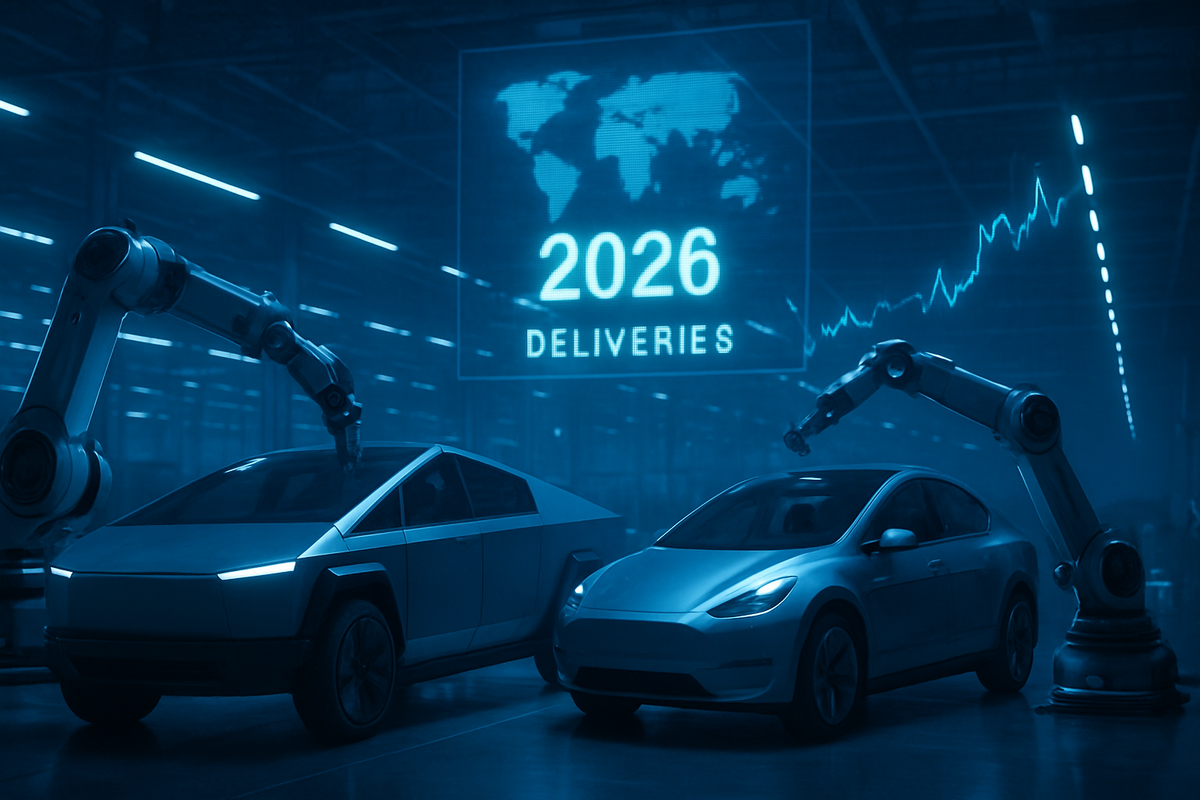
As the sun sets on 2025, the global financial community is fixated on Austin, Texas, where Tesla is preparing to unveil its year-end delivery figures. For the world’s most valuable automaker, these numbers represent more than just a quarterly sales tally; they are a definitive progress report on a year defined by extreme volatility, a pivot toward artificial intelligence, and a brutal price war in the electric vehicle (EV) sector. With the current date of December 25, 2025, investors are bracing for the official release in early January, an event that will likely dictate the momentum of the broader market as it enters 2026.
The stakes could not be higher. After a year that saw Tesla’s stock price touch new all-time highs near $498 before retreating, the company is navigating a "transitional" phase. The core automotive business, once the undisputed engine of growth, has faced a cooling global demand environment and the expiration of key consumer incentives. As Wall Street analysts sharpen their pencils, the upcoming report will reveal whether Tesla managed to hit the psychologically critical 2-million-unit mark for the year or if it fell short in the face of stiffening competition and macroeconomic headwinds.
The Final Sprint: Expectations and Obstacles
The consensus among Wall Street analysts for Tesla's (NASDAQ: TSLA) fourth-quarter deliveries sits at approximately 440,000 units, though estimates range widely from 415,000 to 455,000. This variability reflects a deeply divided sentiment regarding the impact of the "post-subsidy air pocket" in the United States. Following the expiration of the $7,500 federal EV tax credit on September 30, 2025, many observers fear a significant "demand pull-forward" occurred in the third quarter, leaving the final months of the year struggling to find organic buyers.
The timeline leading to this moment has been a rollercoaster of production milestones and strategic shifts. Throughout 2025, Tesla successfully ramped up the Cybertruck to a steady annual run rate of 250,000 units, finally turning the futuristic pickup into a contributor to the company’s bottom line rather than a drag on margins. However, this success has been offset by the aging lineup of the Model 3 and Model Y, which have faced relentless pressure in the Chinese market. Earlier this year, the refreshed Model Y provided a temporary boost, but by late Q4, the "Great Recalibration" of the EV market began to take hold, as consumers in both Europe and North America showed signs of "EV fatigue" amid high interest rates.
Key stakeholders, including CEO Elon Musk and major institutional investors like Vanguard and BlackRock, are watching these figures to validate Tesla's premium valuation. With a price-to-earnings (P/E) ratio hovering between 300 and 330, the market is no longer pricing Tesla as a mere car company. Instead, the delivery report is being viewed as the "floor" upon which Tesla’s ambitious AI and robotics future must be built. Any significant miss in vehicle volume could undermine the capital required to fund the massive compute clusters and humanoid robot production lines planned for the coming years.
Winners, Losers, and the Battle for Dominance
The impending delivery report will send ripples far beyond Tesla’s own balance sheet. Perhaps the biggest "winner" of 2025 has been BYD (OTC:BYDDY), which officially overtook Tesla as the world’s leading manufacturer of pure battery electric vehicles (BEVs) on an annual basis this year. With a 27% market share in China and a rapidly expanding footprint in Europe and Southeast Asia, BYD has successfully capitalized on the sub-$30,000 segment—a territory Tesla has yet to fully enter. A weak Tesla report would further cement BYD’s status as the new global volume leader, potentially attracting more "value-oriented" institutional capital away from U.S. equities.
In the domestic U.S. market, legacy giants Ford Motor Company (NYSE: F) and General Motors (NYSE: GM) find themselves in a complex position. Both companies spent 2025 retrenching from their ambitious EV targets. Ford, in particular, took a massive $19.5 billion charge late this year to rationalize its EV roadmap and indefinitely halted production of the F-150 Lightning in favor of hybrids. If Tesla’s numbers show a sharp decline, it may paradoxically "win" Ford and GM some breathing room with their own shareholders, validating their cautious pivot back to internal combustion and hybrid models as the EV transition slows.
Conversely, pure-play EV startups like Rivian Automotive (NASDAQ: RIVN) and Lucid Group (NASDAQ: LCID) are at a crossroads. Rivian emerged as a "survivor" in late 2025, reporting a modest gross profit and securing its future through a multi-billion dollar partnership with Volkswagen. For Rivian, a strong Tesla report suggests there is still a robust appetite for premium EVs, providing a favorable tailwind for the upcoming launch of their R2 SUV in early 2026. For Lucid, which remains reliant on infusions from Saudi Arabia’s Public Investment Fund, the health of the overall EV market is a matter of existential importance as they attempt to scale the Gravity SUV.
A Wider Significance: The AI Pivot and Global Rivalries
The 2025 year-end numbers carry a weight that transcends simple sales charts; they represent a fundamental shift in the industrial zeitgeist. We are witnessing the end of the "Early Adopter" era for electric vehicles and the beginning of a "Pragmatic" era. Tesla’s struggle to maintain high growth rates in its automotive division has forced the company to lean heavily into its Full Self-Driving (FSD) software and its Optimus humanoid robot project. This transition is a historical precedent in the making—a hardware-heavy manufacturing giant attempting to rebrand as a high-margin software and robotics powerhouse in real-time.
Industry trends suggest that the competitive moat is shifting from "who can build the best battery" to "who can solve autonomy." Tesla’s FSD v13 and v14 releases in late 2025 have been central to this narrative, as the company attempts to decouple its stock price from vehicle deliveries. However, this strategy faces regulatory headwinds. As Tesla pushes for a "Cybercab" (Robotaxi) launch in 2026, the delivery numbers serve as a proxy for the size of the fleet that will eventually run this autonomous software. A smaller-than-expected fleet growth in 2025 could delay the network effects Tesla needs to dominate the ride-hailing market.
Furthermore, the geopolitical implications are stark. The rivalry between Tesla and Chinese OEMs has become a proxy for the broader technological competition between the U.S. and China. With BYD leading the charge, the global EV market is bifurcating. Tesla’s ability to defend its market share in 2025, or lack thereof, will likely influence future trade policies, tariffs, and subsidy structures in both Washington and Brussels as they seek to protect domestic industries from an influx of low-cost Chinese technology.
What Lies Ahead: The Roadmap to 2026
Looking toward early 2026, the short-term outlook for the EV sector appears challenging. Analysts are already warning of a "dreadful" first half of 2026 for U.S. sales as the market continues to adjust to the loss of federal tax credits. Tesla will likely need to engage in further strategic pivots, potentially accelerating the timeline for its rumored "Model 2"—a $25,000 affordable EV—to reclaim the volume crown from BYD. Production of this next-generation platform is expected to begin in early 2026, and its success is now viewed as mandatory rather than optional.
The true "wild card" for 2026 remains the Cybercab. Scheduled for volume production in April 2026 at Giga Texas, this dedicated Robotaxi represents Elon Musk’s ultimate bet on the future of transportation. If the year-end 2025 delivery numbers are soft, the pressure on the Cybercab to deliver a "flawless" launch will be immense. Additionally, the commercial deployment of Optimus robots in Tesla’s own factories by late 2026 could provide the first tangible evidence of the company’s robotics-driven margin expansion, potentially justifying the sky-high P/E ratio that currently baffles traditional value investors.
Final Assessment: A Market in Transition
As we wrap up 2025, the key takeaway is that Tesla is no longer just a car company, but it is not yet a fully realized AI utility. The year-end delivery report will be the final piece of data in a year that saw the EV industry undergo a "Great Recalibration." While the 2-million-unit target remains the benchmark for success, the qualitative data—margins, FSD take-rates, and Cybertruck profitability—will be just as important for determining Tesla’s trajectory in the coming months.
Investors should watch for three things in early 2026: the official Q4 delivery tally in the first week of January, the subsequent earnings call where 2026 guidance will be issued, and any updates regarding the "Model 2" production start. The market is moving into a phase where "promises made" must become "promises kept." Tesla has spent years building the infrastructure for an autonomous future; 2026 will be the year the world finds out if that future is ready for prime time.
This content is intended for informational purposes only and is not financial advice.