
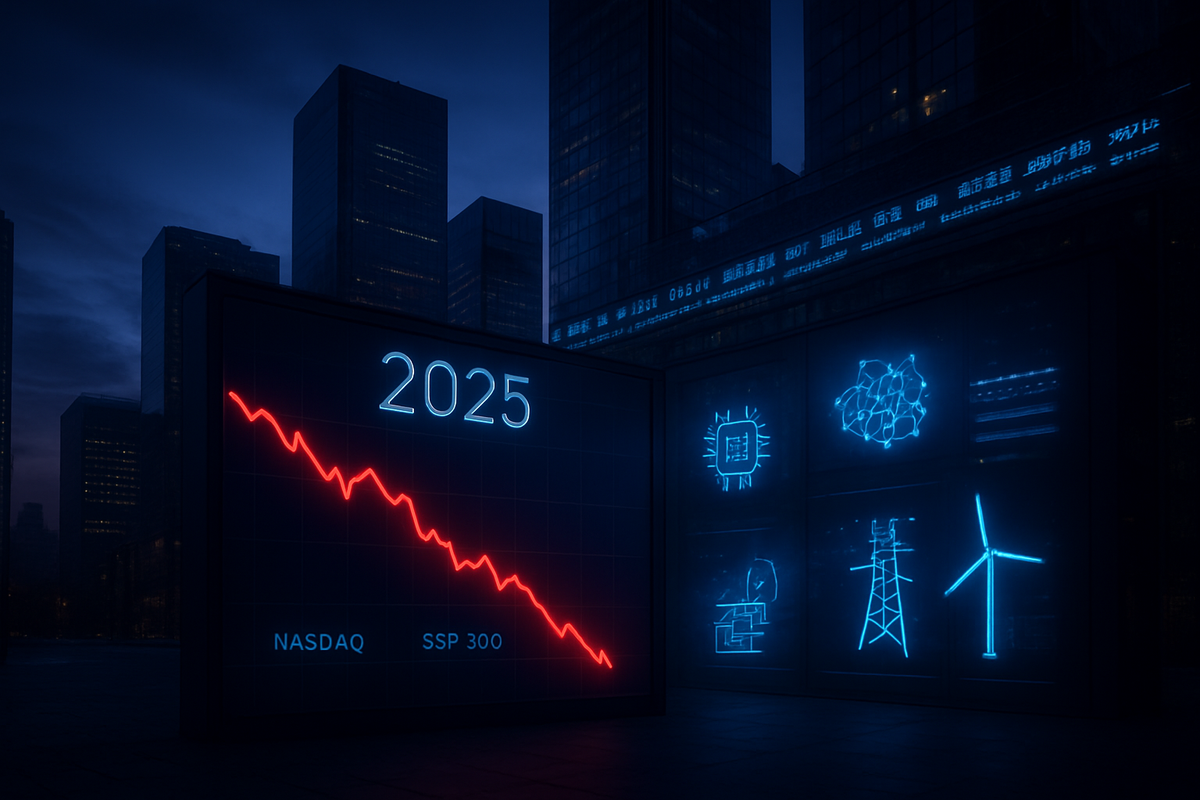
As the final trading days of 2025 come to a close, the high-octane rally that defined the year has hit a significant speed bump. The S&P 500 (NYSE: SPY) and the Nasdaq Composite (NASDAQ: QQQ) have recorded back-to-back losses this week, marking a somber end to an otherwise historic year for equity markets. This late-December cooling period, which analysts are calling the "Great Rebalancing," has seen institutional investors aggressively trimming their positions in large-cap technology stocks to lock in gains and realign their portfolios for the upcoming 2026 fiscal year.
The immediate implications are clear: the "mechanical de-risking" of nearly $1 trillion in capital is putting downward pressure on the market's most influential names. While the broader indices remain up significantly for the year—with the S&P 500 holding onto a nearly 18% gain—the sudden shift in sentiment suggests that the "easy money" phase of the artificial intelligence (AI) bull market may be transitioning into a more discerning, value-driven environment.
The Mechanical Flush: A Timeline of the December Dip
The sell-off began in earnest during the week of December 22, just as the S&P 500 was flirting with the psychological 7,000 level. After hitting a record high of 6,980 earlier in the month, the index has retreated to approximately 6,905 as of December 30, 2025. This pullback was not triggered by a single catastrophic event but rather by a confluence of structural factors. Institutional giants like BlackRock (NYSE: BLK) and Vanguard have been forced to sell off their winning tech positions to maintain target asset allocations. Because technology stocks outperformed other sectors so drastically in 2025, many diversified funds found themselves "overweight" in equities, necessitating a multi-billion dollar rebalancing act to start 2026 with a neutral stance.
Key players in this drama include the algorithmic trading desks of major investment banks, which have been executing "wash-sale" trades to offset capital gains. Throughout 2025, the market was propelled by a relentless "AI Infrastructure" trade, but by mid-December, the momentum began to stall. The timeline shows a distinct peak on December 15, followed by a steady erosion of value in the "Magnificent Seven" stocks. This was exacerbated by tax-loss harvesting in lagging sectors like Healthcare and Consumer Staples, as investors sought to minimize their tax liabilities following a year of record-breaking profits.
Initial market reactions have been characterized as a "controlled flush." Unlike the panicked selling seen in previous market corrections, the current volume is high but orderly. Traders are not fleeing the market entirely; instead, they are rotating capital. On December 29 alone, the Nasdaq saw a 0.7% slide, while the Energy sector (NYSE: XLE) surged, continuing a 13% monthly gain that has made it the primary beneficiary of the year-end rotation.
Winners and Losers of the Year-End Shuffle
The primary "losers" in this year-end recalibration are the very companies that led the 2025 charge. Nvidia (NASDAQ: NVDA), which briefly became the world's first $5 trillion company in October, has seen its market cap pull back to the $4.2 trillion range. Despite a 42% gain for the year, the stock fell nearly 3.8% in the final week as investors questioned whether the $500 billion spent on AI capital expenditure by big tech in 2025 would yield immediate dividends in 2026. Microsoft (NASDAQ: MSFT) also faced headwinds, dropping 2.2% in late December as it struggled against a "double top" chart pattern, with investors re-rating its AI-integrated Azure and Office revenues.
Apple (NASDAQ: AAPL) has experienced a different kind of struggle. While it avoided the sharp volatility of its semiconductor peers, it has shown "technical fatigue." Apple’s 2025 gains were a more modest 10%, as the market adopted a "sell on the news" approach following its latest product launches. The company is now being viewed by some analysts as a "funding source"—a stable asset that investors sell to raise cash for more aggressive bets or to move into defensive sectors.
On the winning side, defensive value sectors and "real-world" earnings plays are seeing a renaissance. Utilities and Energy companies have become the darlings of the December rebalancing. As investors look toward 2026, there is a growing appetite for companies with high dividend yields and low price-to-earnings ratios. This rotation suggests that the market is preparing for a period of slower growth and higher-for-longer interest rates, favoring companies with strong balance sheets over high-growth, high-valuation tech names.
AI Skepticism and the Valuation Wall
The wider significance of this sell-off lies in the evolving narrative around artificial intelligence. For much of 2024 and 2025, the market rewarded any company with an AI story. However, as we head into 2026, the "show-me-the-money" phase has arrived. The emergence of high-efficiency, low-cost AI models from international competitors has planted seeds of doubt regarding the long-term moat of U.S. tech giants. This shift fits into a broader industry trend where the focus is moving from building AI infrastructure to achieving actual ROI.
Furthermore, the S&P 500 is currently hitting a "valuation wall." With price-to-earnings ratios at historic highs, there is virtually no margin for error in 2026 earnings reports. This event mirrors the historical precedents of the late 1990s, where a period of massive technological investment was followed by a sharp valuation reset once the market realized that earnings would take longer to materialize than originally anticipated. Additionally, the lingering effects of the "Liberation Day" trade tariffs implemented in April 2025 have begun to squeeze margins for hardware manufacturers, adding another layer of complexity to the 2026 outlook.
The ripple effects are also being felt by competitors and partners. While the giants are being sold off, smaller "AI application" companies are being scrutinized even more heavily. If the providers of the "shovels" (like Nvidia) are seeing a pullback, the market is naturally becoming more skeptical of the "miners" who are using those tools to build software services that have yet to achieve mass profitability.
The Road to 2026: Strategic Pivots and Scenarios
Looking ahead, the market faces two primary scenarios for the first quarter of 2026. The optimistic view, held by several Wall Street firms, is that this year-end sell-off is a healthy consolidation that will set the stage for the S&P 500 to reach targets between 7,200 and 7,700 by the end of next year. In this scenario, the "Great Rebalancing" provides a more sustainable foundation for growth, as capital is spread more evenly across different sectors of the economy rather than being concentrated in a handful of tech stocks.
The more cautious scenario involves a "valuation reset" or a formal correction of 10% or more in early 2026. If the Federal Reserve remains hawkish due to persistent 3% inflation, the high multiples currently assigned to tech stocks may become indefensible. Companies will likely need to execute strategic pivots, moving away from "growth at all costs" and toward "efficiency and monetization." We may see a wave of consolidation in the AI space as larger players acquire smaller startups that can no longer find funding in a more disciplined market environment.
Investors should prepare for increased volatility in January. The "January Effect," where stocks typically rise as new capital enters the market, may be muted in 2026 if the current de-risking trend continues. Strategic adaptations will be required, with a focus on companies that can demonstrate tangible productivity gains from their AI investments rather than just promising future capabilities.
Final Thoughts: A Controlled Transition
The year-end sell-off of 2025 is a reminder that even the most powerful bull markets require periods of digestion. The back-to-back losses in the S&P 500 and Nasdaq are less a sign of a looming crash and more an indication of a market that is maturing. The "Magnificent Seven" have carried the weight of the indices for years, and a broadening of the market's leadership is a necessary step for long-term health.
As we move into 2026, the key takeaway for investors is the importance of diversification. The era of blindly buying tech indices may be giving way to a "stock-picker's market," where individual company fundamentals and actual earnings growth matter more than sector momentum. Moving forward, the market will be watching the Federal Reserve’s first meeting of the new year and the initial 2026 guidance from the tech titans very closely.
The lasting impact of this December dip will likely be a shift in investor psychology—from the euphoria of the AI boom to a more grounded, analytical approach to the digital economy. While the 2025 bull run was one for the history books, the transition to 2026 suggests that the market is finally ready to demand proof of the "AI revolution's" bottom-line impact.
This content is intended for informational purposes only and is not financial advice.