
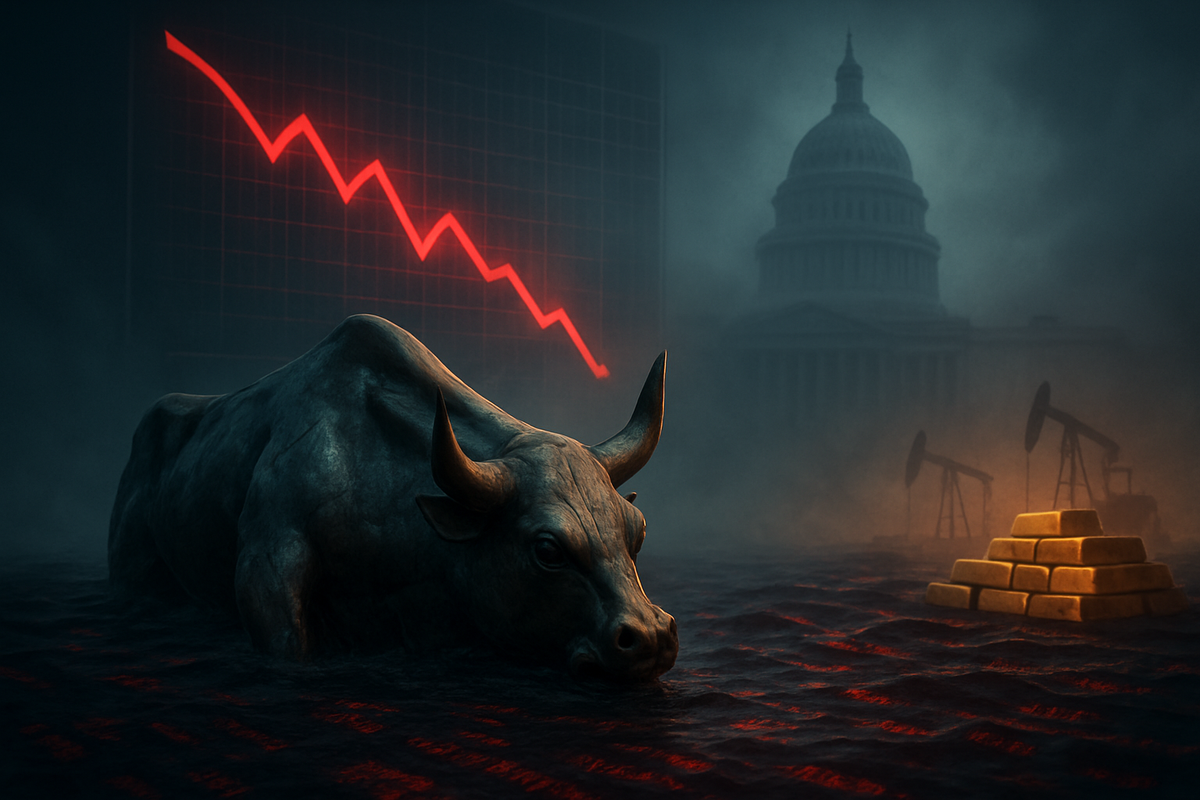
The first trading session of 2026 has been marked by a seismic shift in global capital flows, as a "Sell America" sentiment takes hold of international markets. Following a weekend of unprecedented legal escalation between the Department of Justice (DOJ) and the Federal Reserve, the U.S. dollar has plunged to multi-decade lows, while gold and global commodities have surged to record-breaking heights. Investors are increasingly viewing the United States not as a global safe haven, but as a market plagued by the kind of institutional and political risk typically reserved for emerging economies.
This morning, January 12, 2026, the market opened to the news of a full-blown constitutional crisis. With the DOJ issuing grand jury subpoenas to Federal Reserve Chair Jerome Powell and the central bank’s independence under direct assault, the "triple sell-off" of the dollar, Treasuries, and equities has intensified. The exodus from U.S.-based assets is no longer a slow drip; it has become a flood, as capital rotates toward resource-heavy economies like Canada and undervalued financial sectors in Europe.
A Weekend of Turmoil: The DOJ vs. The Fed
The current market panic was triggered on Friday, January 9, 2026, when the DOJ served the Federal Reserve with grand jury subpoenas. The investigation, spearheaded by Attorney General Pam Bondi and U.S. Attorney Jeanine Pirro, centers on allegations of perjury and financial mismanagement regarding a $2.5 billion renovation of the Fed’s Washington D.C. headquarters. While the DOJ frames the probe as a necessary oversight of taxpayer dollars, the timing—occurring after months of public friction between the executive branch and the Fed over interest rate policy—has led to widespread accusations of political retribution.
The situation reached a fever pitch on Sunday, January 11, when Chair Jerome Powell released a defiant video statement. Powell characterized the investigation as a "pretext" intended to intimidate the central bank into abandoning its mandate of price stability in favor of politically motivated rate cuts. The refusal of the Fed to yield has created a standoff that many analysts believe threatens the very foundation of the global financial system. Initial market reactions in overnight trading saw the U.S. Dollar Index (DXY) collapse, while spot gold shattered all previous records, surging past the $4,600 per ounce mark as the sun rose on January 12.
Winners and Losers: The Corporate Fallout
The "Sell America" rotation has created a stark divide between domestic U.S. giants and global resource-based alternatives. Major U.S. financial institutions, such as JPMorgan Chase (NYSE: JPM), have borne the brunt of the uncertainty. Shares of JPMorgan fell over 2.4% in early trading on January 12 to $321.07, as investors fear that a politically compromised Fed will lead to an erratic and unpredictable interest rate environment. Similarly, tech bellwether Nvidia (NASDAQ: NVDA) has continued its slide from 2025 highs, trading at $184.86—a nearly 13% drop from its October peak—as tightening export restrictions and the "April Tariff Storm" of 2025 weigh on its global supply chain.
Conversely, the flight to safety has been a boon for hard assets and non-U.S. financials. Gold mining giants like Newmont (NYSE: NEM) and Barrick Gold (NYSE: GOLD) have seen their valuations soar, with Newmont hitting an all-time high of $109.30 this morning. In Canada, the Royal Bank of Canada (NYSE: RY) has emerged as a relative safe harbor for North American capital, remaining resilient at $169.19 while its U.S. counterparts falter. Energy infrastructure firm Enbridge (NYSE: ENB) has also seen steady demand as investors prioritize "real" assets and infrastructure over U.S. growth equities that are sensitive to domestic policy volatility.
The Broader Significance: Institutional Erosion and Global Shifts
The "Sell America" sentiment is not merely a reaction to a single legal probe; it is the culmination of a broader trend of de-dollarization and institutional erosion. Analysts point to the "April Tariff Storm" of 2025 as the precursor, which began the process of decoupling global trade from the U.S. dollar. The DOJ’s current actions against the Fed are seen as the final blow to the "American Exceptionalism" premium that has supported U.S. asset prices for decades. By treating the central bank as a political arm of the executive, the U.S. is now being priced with an "institutional risk premium" similar to that of volatile emerging markets.
Historically, the independence of the Federal Reserve has been the bedrock of global trust in the U.S. dollar. Comparisons are already being drawn to the stagflationary era of the 1970s, but with a modern twist: the current crisis involves a direct legal challenge to the Fed's leadership. This has prompted a massive rotation into the EURO STOXX Banks Index and emerging markets like Brazil and Poland, where valuations are significantly more attractive—trading at roughly 16x earnings compared to the nearly 38x earnings seen in the S&P 500 during its late-2025 peak.
What Lies Ahead: The January 27 Crossroads
The immediate future of the markets hinges on two critical events scheduled for later this month. First, the Supreme Court is set to hear arguments regarding the legality of the executive branch firing Fed Governor Lisa Cook "for cause," a case that will define the legal limits of presidential power over the central bank. Second, the Federal Open Market Committee (FOMC) is scheduled to meet on January 27, 2026. This meeting will be the ultimate test of Chair Powell’s resolve; any sign of the Fed buckling under DOJ pressure could lead to a catastrophic loss of inflation anchoring and a further collapse of the dollar.
In the long term, U.S. corporations may be forced to undergo strategic pivots, potentially moving headquarters or primary listings to more stable jurisdictions if the domestic political climate does not stabilize. Market opportunities are likely to remain concentrated in commodities, "hard" assets, and jurisdictions with clear rule-of-law protections. Investors should prepare for a period of heightened volatility, where traditional U.S. Treasury bonds no longer serve as the "risk-free" asset they once were.
Final Assessment: A Paradigm Shift in Progress
The events of January 12, 2026, mark a definitive turning point in global finance. The "Sell America" movement represents a fundamental loss of confidence in the U.S. as a neutral and stable arbiter of global capital. While the U.S. economy remains a powerhouse in terms of raw output, the degradation of its institutions is proving to be a cost that global investors are no longer willing to ignore. The shift toward Canadian resources, European value, and hard commodities like gold at $4,600/oz suggests that the world is actively seeking a post-dollar equilibrium.
Moving forward, the market will be hyper-focused on the legal battles surrounding the Federal Reserve. Any further escalation by the DOJ or a potential resignation by Chair Powell could trigger a second wave of capital flight. For the coming months, the mantra for global investors appears to be "diversification away from the dollar." The era of "TINA" (There Is No Alternative) for U.S. stocks has officially ended, replaced by a global search for stability in an increasingly fragmented financial world.
This content is intended for informational purposes only and is not financial advice