
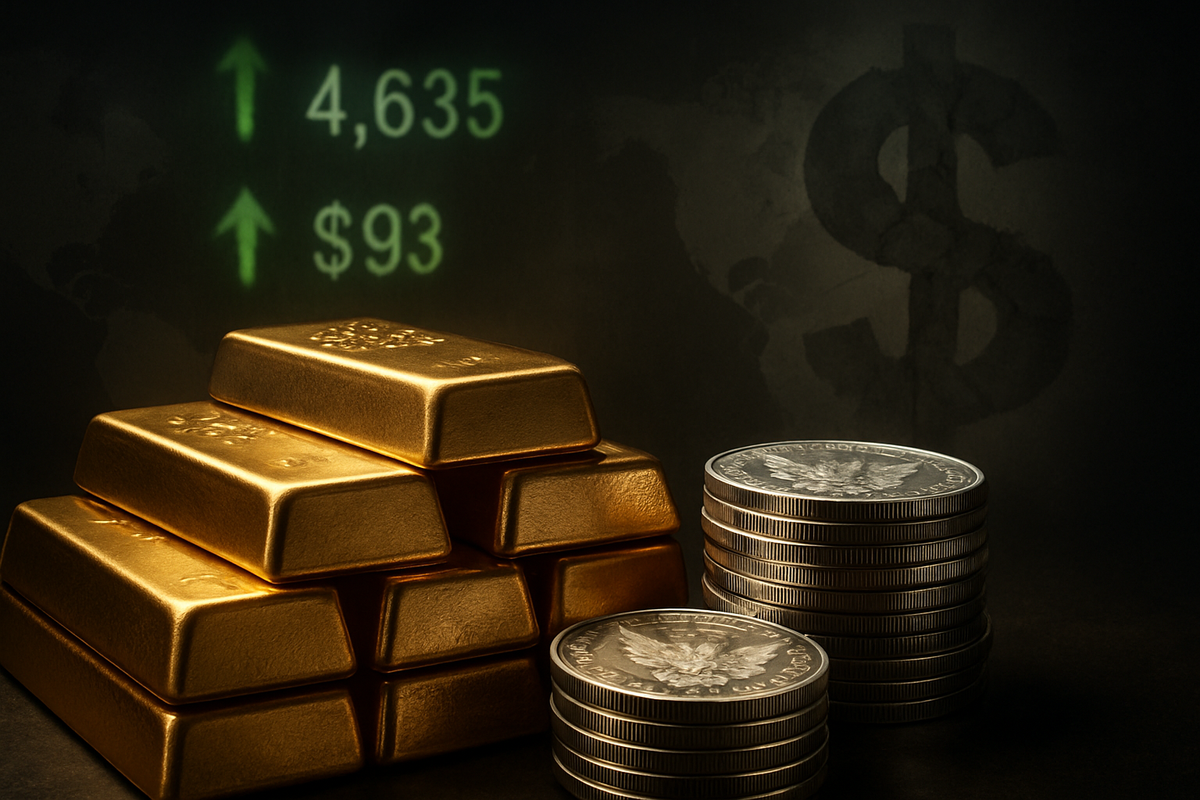
NEW YORK — In a historic trading session that has sent shockwaves through global capital markets, precious metals reached unprecedented heights today, January 19, 2026. Spot gold surged to a staggering $4,635 per ounce, while silver outpaced its yellow counterpart with a 7.4% daily jump, firmly establishing itself at $93 per ounce. The rally represents a fundamental shift in the global financial order, as investors flee traditional fiat currencies and equities in favor of "hard money" assets.
The explosive price action comes as a "perfect storm" of geopolitical and domestic factors converge. From military interventions in South America to a structural crisis of confidence within the Federal Reserve, the traditional pillars of market stability have been shaken. Analysts are now describing the current environment as the most significant "flight to quality" since the 1970s, as the twin pressures of war and fiscal expansionism force a radical repricing of risk.
The Geopolitical Powder Keg: From Caracas to Tehran
The immediate catalyst for the January surge can be traced back to the first week of the year. On January 3, 2026, the U.S. launched a targeted military operation in Venezuela to remove President Nicolás Maduro. While the administration framed the move as a restoration of democracy, the subsequent installation of an interim government and the announcement of U.S. oversight of Venezuelan oil revenues triggered immediate regional volatility. The "chaos premium" on commodities spiked as neighboring nations and global powers reacted to the shift in the South American power balance.
Simultaneously, the Middle East has entered its most precarious state in decades. Mass domestic unrest in Iran, beginning in late 2025, met a violent crackdown by Tehran earlier this month. The situation escalated when the U.S. administration publicly promised that "help is on the way" to Iranian protesters and threatened a 25% tariff on any nation continuing to trade with the Islamic Republic. Tehran’s counter-threat of strikes on regional U.S. bases has effectively frozen the risk appetite of institutional investors, driving billions into gold. Adding to the geopolitical malaise, a diplomatic rift with NATO over the proposed annexation of Greenland led to the implementation of 10% tariffs on several European allies, further fracturing the Western alliance and devaluing the Euro against gold.
Winners and Losers in the New Bullion Era
The surge to $4,635 gold has created a windfall for major mining corporations, which are now operating with profit margins once thought impossible. Newmont (NYSE: NEM) has emerged as a primary beneficiary; with its all-in sustaining costs (AISC) hovering around $1,500, the company is generating nearly $3,000 in free cash flow for every ounce mined. Similarly, Barrick Gold (NYSE: GOLD), which recently underwent a strategic rebranding to reflect its broader metals portfolio, has seen its Nevada-based assets become "cash-flow engines" that have pushed its stock to multi-year highs.
However, the "Silver Squeeze" to $93 has created a different set of challenges for industrial giants. Tesla (NASDAQ: TSLA) is facing a significant margin squeeze as the cost of silver—a critical component in battery management systems and electrical contacts—adds an estimated $150 to $200 in direct costs per vehicle. CEO Elon Musk has expressed concern over "silver liquidity," as supply remains tight following China’s decision on January 1, 2026, to implement strict export licenses on refined silver. Renewable energy leaders like First Solar (NASDAQ: FSLR) are also feeling the heat; a shortage of silver paste required for photovoltaic cells has threatened to slow production targets for the 2026 fiscal year, highlighting the vulnerability of the green energy transition to commodity price shocks. Even Pan American Silver (NASDAQ: PAAS), while benefiting from the price rise, has had to navigate increased operational risks in South America due to the regional instability following the Venezuela intervention.
A Crisis of Confidence: The Domestic Policy Pivot
Beyond geopolitics, the rally is being fueled by a historic collapse in confidence regarding U.S. fiscal and monetary policy. The "One Big Beautiful Bill" Act (OBBBA), signed in mid-2025, introduced $4 trillion in stimulus and permanent tax cuts that have pushed the U.S. debt-to-GDP ratio into uncharted territory. As the Treasury Department struggles to auction off record amounts of new debt, the Federal Reserve has been forced to pivot. In December 2025, the central bank effectively restarted Quantitative Easing (QE) to provide liquidity to a parched money market, a move that many investors interpreted as the final surrender of the "inflation fight."
Compounding this fiscal anxiety is an institutional crisis at the Federal Reserve itself. On January 11, 2026, reports of a DOJ probe into Fed leadership regarding regulatory failures and political independence sent regional banking stocks into a tailspin. This "credibility gap" has led both domestic and foreign investors to treat gold as "reserve insurance." Unlike the 2008 or 2020 crises, the current rally is not just about a temporary downturn; it is a structural hedge against the perceived debasement of the U.S. Dollar as a global reserve asset.
The Road to $5,000: What Comes Next?
As gold approaches the psychological $5,000 barrier, the market is bracing for a period of extreme volatility. In the short term, the COMEX and LBMA exchanges are facing potential liquidity "vacuums" as physical silver supply dries up. We may see industrial users begin to engage in panic-buying or "pre-stocking" to secure supply for the remainder of 2026, which could push silver toward the $100 mark. Strategic pivots are already underway in the tech sector, with R&D teams racing to find copper-based or synthetic alternatives for silver in high-end electronics.
Longer-term, the focus will remain on the Federal Reserve’s ability to stabilize the banking sector. If the DOJ probe leads to a leadership vacuum at the central bank, the flight from the dollar could accelerate. Market participants will be watching for any signs of a "gold-backed" digital currency initiative from BRICS nations or a further escalation in the U.S.-China trade war, which would only add fuel to the precious metals fire.
Summary and Investor Outlook
The events of early 2026 have fundamentally redefined the role of gold and silver in a modern portfolio. What were once seen as "relics" of a bygone era are now the only assets providing true protection against a backdrop of military conflict, fiscal instability, and institutional decay. The jump to $4,635 gold and $93 silver is a clear signal that the market no longer views current economic policies as sustainable.
Moving forward, investors should keep a close eye on regional developments in Venezuela and the potential for a de-escalation in the Middle East, though the primary driver remains U.S. fiscal health. The "Golden Age" for miners is likely to continue as long as spot prices remain comfortably above production costs, but for the wider market, the surge in bullion is a sobering reminder of the costs of global instability. Watch for the next Federal Reserve meeting in February; any hint of further QE or a pause in rate hikes could be the final push gold needs to break $5,000.
This content is intended for informational purposes only and is not financial advice.