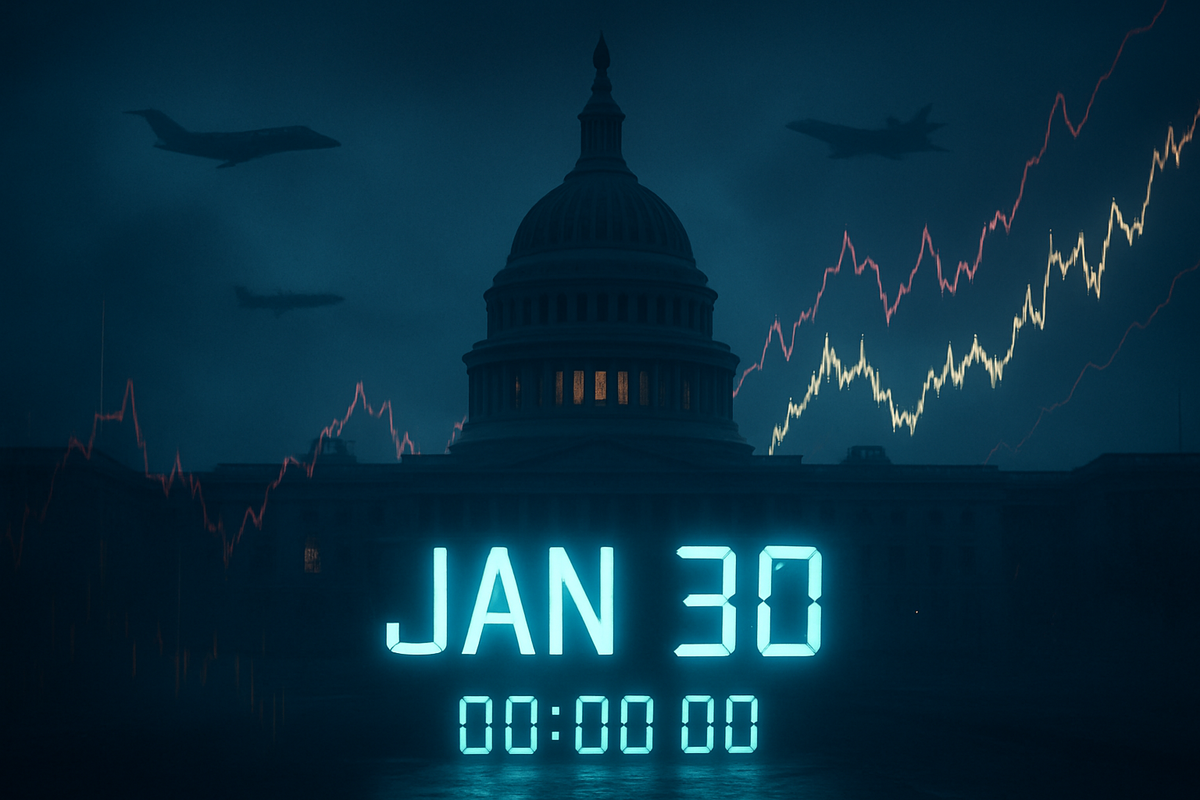
As the clock ticks toward the 12:01 a.m. deadline on January 30, 2026, a familiar sense of dread has settled over Washington and Wall Street. Following a temporary funding measure that ended a historic 43-day partial government shutdown in late 2025, the United States is once again on the precipice of a fiscal cliff. The current impasse, driven by a deep partisan divide in the Senate over Homeland Security funding and immigration policy, threatens to shutter key federal agencies and disrupt a fragile economic recovery that is already grappling with record-high precious metal prices and rising market volatility.
The immediate implications are stark: if a resolution is not reached by Friday, funding for nine major federal departments—including Defense, Homeland Security, and Transportation—will expire. This looming "Shutdown Redux" has triggered a flight to safety, with gold prices surging past $5,100 per ounce and the Cboe Volatility Index (VIX) signaling an expectant spike in market fear. While the House of Representatives has made unprecedented progress by passing all twelve annual appropriations bills, the legislative machinery has ground to a halt in the Senate, leaving investors and federal contractors in a state of high-stakes suspense.
The Legislative Logjam: From "Regular Order" to Senate Stagnation
The path to the current crisis began in November 2025, when a record-breaking 43-day shutdown was finally paused by a Continuing Resolution. In the months since, House Appropriations Chairman Rep. Tom Cole and Senate Appropriations Chair Sen. Susan Collins have attempted to steer the budget process back toward "regular order." On January 22, 2026, the House reached a significant milestone, passing its final sets of appropriations bills, including the massive H.R. 7148, which covers Defense and Labor-HHS-Education. This was hailed by House leadership as a return to transparency, avoiding the traditional "omnibus" spending packages that have historically drawn criticism.
However, this momentum has vanished in the Senate. The primary hurdle is H.R. 7147, the Homeland Security funding bill. Senate Democrats, led by Chuck Schumer, have signaled a firm blockade against the measure, citing deep-seated disagreements over border enforcement strategies and ICE accountability. These tensions were further inflamed by a recent high-profile shooting in Minneapolis involving federal officers, which has turned the budget debate into a referendum on immigration reform. With the House in recess until February and the Senate having just returned from its own break, the window for a legislative compromise is narrowing to a few frantic days.
The stalemate is not merely over dollar amounts; it is a clash of fundamental policy priorities. While a tentative topline budget agreement of $1.65 trillion was reached earlier this month, the Trump administration’s insistence on deep cuts to non-defense programs—embodied in the proposed 23% reduction in some agencies—continues to be a flashpoint. As of January 26, prediction markets like Polymarket and Kalshi have seen the odds of a partial shutdown starting January 31 surge to a staggering 80%, reflecting a growing belief that a "short-term patch" may be the only, albeit unlikely, escape hatch.
Winners, Losers, and the Corporate Fallout
The threat of a shutdown has sent ripples through the equities market, creating a divergent landscape for public companies. In the defense sector, "pure-play" manufacturers like Lockheed Martin Corp. (NYSE: LMT) and Northrop Grumman Corp. (NYSE: NOC) are currently underperforming the broader market. Investors are wary of administrative delays in multi-year contract funding and the potential for "at-risk" work during a lapse. Despite this, some analysts view the dip as a buying opportunity; Morgan Stanley recently maintained bullish price targets for NOC ($720) and LMT ($630), betting on a post-resolution rebound.
In contrast, service-oriented contractors like Leidos Holdings, Inc. (NYSE: LDOS) have shown remarkable resilience. Leidos benefit from its heavy involvement in "excepted activities," such as air traffic control modernization and international cyber contracts that remain high priorities regardless of a domestic funding lapse. Similarly, Booz Allen Hamilton Holding Corp. (NYSE: BAH) is being watched as a potential "catch-up" beneficiary. While its shares are currently flat, historical trends suggest that its cybersecurity and AI-driven analytics projects will see a surge in funding once the government reopens and seeks to fast-track delayed initiatives.
The healthcare sector, however, is facing a more existential threat. Companies like Centene Corp. (NYSE: CNC) and Humana Inc. (NYSE: HUM) are under severe pressure not only from the shutdown threat but also from the broader implications of the "One Big Beautiful Bill Act" (OBBBA). The potential expiration of Affordable Care Act (ACA) subsidies and proposed Medicaid cuts have made these stocks highly volatile. Centene shares dropped nearly 10% late last year, and analysts estimate a potential $0.20 to $0.40 hit to 2026 earnings per share (EPS) if the budget impasse prevents a retroactive extension of these subsidies.
Airlines are also braced for impact, having already suffered significant losses during the 2025 shutdown. Delta Air Lines, Inc. (NYSE: DAL) reported a $200 million pre-tax profit hit from the previous 43-day lapse and has issued conservative 2026 guidance as a result. United Airlines Holdings, Inc. (NASDAQ: UAL) saw an even steeper $250 million earnings hit previously. The current shutdown threat, combined with a massive winter storm currently battering the East Coast, has led to a drop in shares for both carriers as investors fear a repeat of air traffic control staffing shortages that could ground thousands of flights.
Broader Significance and Historical Echoes
The current standoff is more than a budgetary dispute; it represents a fundamental shift in how the U.S. government functions—or fails to. The push for "regular order" in the House was intended to prevent the very crisis currently unfolding, but it has instead highlighted the difficulty of passing individual bills in a hyper-polarized environment. This event fits into a broader industry trend where federal policy is becoming the primary driver of market volatility, overshadowing traditional economic indicators like inflation or employment data.
Historically, the 2025 shutdown and the current 2026 threat draw inevitable comparisons to the record-breaking 35-day shutdown of 2018-2019. However, the stakes in 2026 are arguably higher. The integration of artificial intelligence and advanced cybersecurity into federal operations means that even a short-term lapse in funding can have long-term repercussions for national security and technological competitiveness. The surge in gold prices to $5,100/oz is a historical anomaly that underscores the depth of current institutional distrust and the perceived instability of the dollar-denominated financial system during these recurring fiscal crises.
Furthermore, the OBBBA policy shifts represent a regulatory pivot toward individual-centric healthcare funding, moving away from traditional insurer-led models. This "policy shock" is being compounded by the shutdown, as the lack of a clear budget prevents companies from planning for these systemic changes. The ripple effects are being felt by partners and competitors alike, as the entire federal contracting ecosystem waits to see if the "Shutdown Redux" will become a permanent feature of the mid-2020s political landscape.
The Road Ahead: Potential Scenarios and Strategic Pivots
As we move toward the January 30 deadline, several scenarios are on the table. The most optimistic involves a "laddered" Continuing Resolution or a very short-term extension for the Department of Homeland Security, allowing more time for a deal on immigration. Such a move would likely trigger a relief rally in defense and transportation stocks. Conversely, a full partial shutdown would force companies into strategic pivots. We could see defense contractors shift resources toward international projects or "excepted" federal work to maintain cash flow, while airlines may need to drastically reduce capacity in anticipation of FAA staffing shortages.
In the long term, this cycle of fiscal brinkmanship may lead to a permanent "risk premium" being attached to any company with significant government exposure. Strategic adaptations, such as diversifying revenue streams away from federal contracts or increasing lobbying efforts for "essential service" designations, will become mandatory for survival. Market opportunities may emerge for firms specialized in "shutdown insurance" or alternative financing for federal projects, but these remain speculative in the current high-volatility environment.
Summary and Investor Outlook
The January 30 deadline is a crucible for the 2026 fiscal year. The key takeaways for investors are the stark divergence between the House's legislative progress and the Senate's political deadlock, and the resulting "shutdown fatigue" that is driving capital into safe havens like gold. While the defense sector offers potential value on the dip, the healthcare sector remains fraught with regulatory and funding risks that could have lasting impacts on earnings.
Moving forward, the market will be hyper-sensitive to any signals of a Senate compromise. Investors should keep a close eye on the VIX and the 12:01 a.m. Saturday expiration. Even if a shutdown is avoided at the eleventh hour, the underlying tensions over the OBBBA and immigration are unlikely to dissipate, suggesting that fiscal volatility will remain a dominant theme for the remainder of 2026. The coming months will require a disciplined approach, focusing on companies with diverse revenue bases and the operational flexibility to weather the recurring storms of Washington's budget battles.
This content is intended for informational purposes only and is not financial advice