
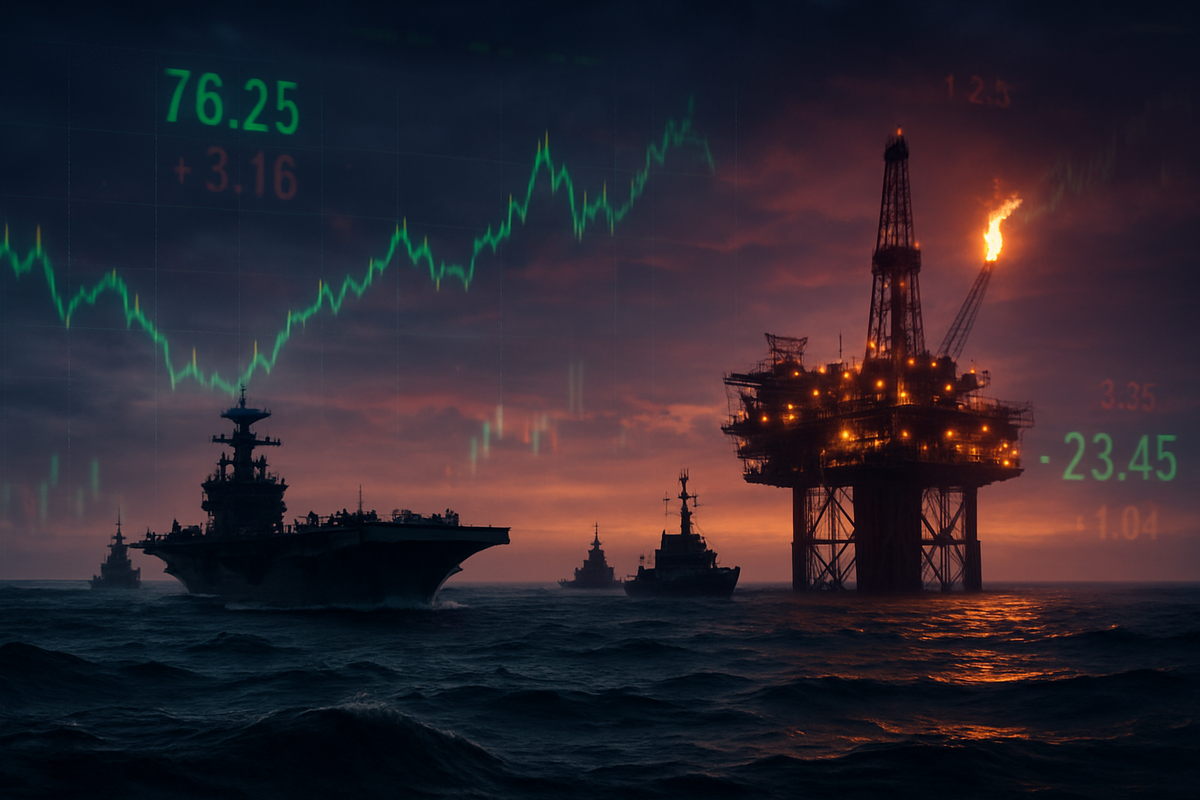
As of January 26, 2026, the global energy landscape is being reshaped by a sudden and dramatic resurgence of geopolitical volatility. For much of the previous year, oil prices remained suppressed by a "wall of supply" from non-OPEC producers, but a series of military escalations in both the Western Hemisphere and the Middle East has forced traders to price in a "war premium" that many had thought was a relic of the past decade.
The dual shocks of a U.S.-led military intervention in Venezuela and a massive naval standoff in the Persian Gulf have created a floor for crude prices, complicating the disinflationary narrative that central banks have been championing. While Brent and WTI remain well below their historical triple-digit peaks due to record-breaking production in the United States and Guyana, the "geopolitical risk premium"—currently estimated at roughly $4.00 per barrel—is acting as a stubborn tailwind for energy costs at a sensitive time for the global economy.
The January Flashpoints: Caracas and the Gulf
The current market anxiety traces back to January 3, 2026, when the United States launched Operation Absolute Resolve. The targeted military strike in Caracas resulted in the capture of President Nicolás Maduro, who was promptly transported to New York to face federal narco-terrorism charges. This operation followed months of escalating rhetoric and naval harassment by Venezuelan forces against offshore drilling rigs in the Esequibo region, a territory claimed by both Venezuela and Guyana. The intervention has effectively decapitated the Venezuelan leadership, leaving the country’s massive oil reserves—the largest in the world—in a state of geopolitical limbo as a transitional government led by Delcy Rodríguez attempts to negotiate a return to the global market.
Simultaneously, the Middle East has entered its most precarious phase in years. Following Tehran’s formal rejection of a final enrichment-limit proposal on January 20, the White House announced that a formidable U.S. "Armada" of carrier strike groups was being diverted to the Persian Gulf. On January 23, 2026, Brent crude futures surged by nearly 3% in a single trading session as satellite imagery showed Iranian fast-attack craft mobilizing near the Strait of Hormuz. This narrow waterway handles approximately 20% of the world’s daily oil consumption, and any disruption there could instantly bypass the current supply surplus and send prices skyrocketing.
Corporate Winners and the High Stakes of Extraction
In this environment of high-stakes diplomacy and military maneuvers, several public companies are seeing their strategic bets pay off—or face significant impairment. ExxonMobil (NYSE: XOM) has emerged as perhaps the biggest beneficiary of the U.S. intervention in Venezuela. By de-risking the maritime border between Venezuela and Guyana, the military action has secured Exxon’s multi-billion dollar investments in the Stabroek block. With the threat of Venezuelan naval seizure removed, Exxon is expected to accelerate its production targets in Guyana, which are already nearing 1.5 million barrels per day.
Conversely, Chevron (NYSE: CVX) finds itself in a more complex position. Having maintained a presence in Venezuela through joint ventures with the state-owned PDVSA during the sanctions era, Chevron’s local operations are currently frozen. While the company is actively lobbying for new licenses under the transitional government, the short-term uncertainty has forced a shift in focus toward its assets in Kazakhstan and the Permian Basin. Meanwhile, European majors like Shell (NYSE: SHEL) and BP (NYSE: BP) are undergoing what analysts call "The Great Reset." Both companies have recently rolled back their carbon-reduction targets to focus on core oil and gas profitability, sensing a "generational opportunity" to participate in the eventual reconstruction of Venezuela’s crumbling energy infrastructure.
On the sovereign side, Saudi Aramco (TADAWUL:2222) has taken a surprisingly aggressive stance. Rather than cutting production to prop up prices during this volatility, Aramco slashed its Official Selling Prices (OSPs) to multi-year lows in mid-January. This suggests a strategic shift from "price defense" to "market share defense," as the Saudi giant seeks to squeeze high-cost producers in the U.S. and Brazil while the geopolitical premium provides a temporary cushion for their own margins.
Inflation Stagnation and the Central Bank Dilemma
The return of the risk premium is creating a headache for the Federal Reserve and the European Central Bank (ECB). In the United States, the Fed is currently holding the federal funds rate at 3.5%–3.75%. While core PCE inflation has cooled to 2.8%, it remains stubbornly above the 2% target. The recent $4.00 per barrel premium in oil prices is threatening to stall further progress. Fed officials have indicated that while they are primarily focused on the inflationary impact of new global trade tariffs, they cannot ignore the "second-round effects" of higher transportation and manufacturing costs driven by energy volatility.
The situation in Europe is slightly different but no less precarious. The ECB successfully guided Eurozone inflation down to 1.9% in December 2025, largely thanks to falling natural gas prices. However, the bank’s leadership warned this week that a prolonged naval standoff in the Middle East remains the "top upside risk" for 2026. A closure of the Strait of Hormuz would disproportionately affect European energy imports, potentially forcing the ECB to halt its planned rate cuts to combat a fresh wave of cost-push inflation.
The Road Ahead: Scenarios for 2026
The short-term outlook for the oil market depends entirely on the "Armada" in the Persian Gulf. If the U.S. naval presence successfully deters Iranian interference without a direct kinetic exchange, the geopolitical premium is expected to evaporate by the second quarter of 2026, as the underlying supply surplus reasserts itself. However, any tactical miscalculation in the Strait of Hormuz could see Brent crude test the $90 or even $100 level, regardless of how much oil the U.S. is pumping.
In South America, the "post-Maduro" transition represents a massive long-term opportunity. If the transitional government can stabilize and secure U.S. backing, we could see the fastest re-integration of a major producer in history. The strategic pivot required for companies like Chevron (NYSE: CVX) and TotalEnergies (NYSE: TTE) will involve massive capital expenditure to rehabilitate refineries that have seen little maintenance for a decade. This could lead to a "Venezuela Renaissance" by 2028, further adding to the global supply glut and potentially crashing prices in the late 2020s.
Summary and Investor Takeaways
The events of January 2026 serve as a stark reminder that even in an era of "peak demand" narratives and record U.S. production, the "geopolitical risk premium" remains a potent force. The capture of the Venezuelan leadership and the naval standoff with Iran have created a floor for prices that fundamentals alone cannot explain.
For investors, the coming months will require a focus on "geopolitical resilience." Companies with diversified assets in stable regions—like the Permian Basin and Guyana—remain the safest bets. However, the potential for a "peace dividend" if tensions ease could quickly punish those who are over-leveraged in expectation of $80 oil. Moving forward, the key indicators to watch will be the status of the Iranian enrichment negotiations and the transparency of the oil revenue management systems being established in Caracas. While the world isn't running out of oil, the price of "safe" oil has just gone up.
This content is intended for informational purposes only and is not financial advice