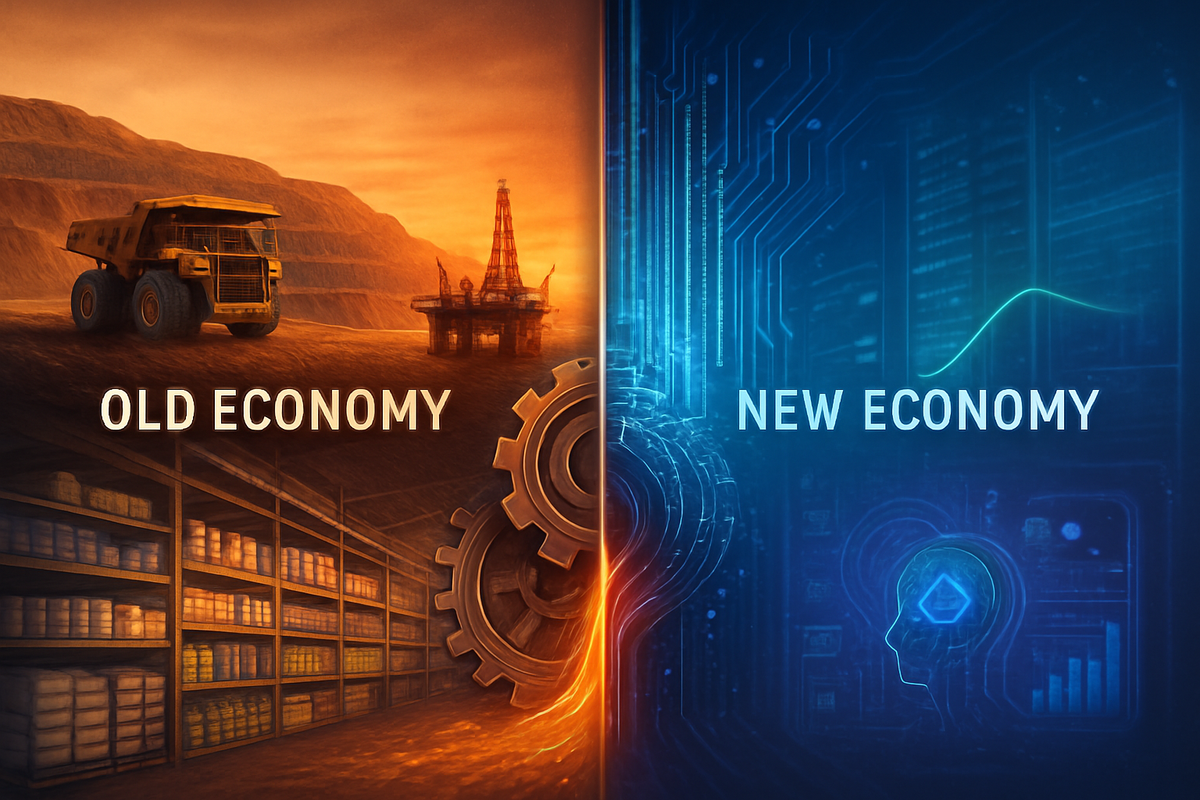
As the first month of 2026 draws to a close, the financial landscape is witnessing a profound structural shift that many analysts are calling the 'Great Rotation.' After years of dominance by Silicon Valley and the banking elite, the pendulum of investor sentiment has swung back toward the tangible pillars of the 'Old Economy.' In a reversal that has caught many momentum traders off guard, the Energy, Materials, and Consumer Staples sectors have emerged as the clear frontrunners of the new year, while the once-invincible Technology and Financial sectors have begun to lag behind the broader market.
This transition marks a critical juncture for the S&P 500. For the first time in nearly two years, the rally is no longer being carried by a handful of mega-cap growth stocks. Instead, capital is flowing into industrial gas producers, copper miners, and retail giants, signaling a market that is prioritizing realized earnings and defensive stability over speculative future growth. While the headline indices appear more stable, the underlying churn suggests that the 'AI at any cost' era may be evolving into a more disciplined phase of the market cycle.
The Return of the 'Old Economy': A Sea Change in Wall Street Sentiment
The timeline of this rotation trace back to the final quarter of 2025, when the initial euphoria surrounding Generative AI began to collide with the cold reality of corporate balance sheets. Throughout 2024 and mid-2025, companies poured billions into AI infrastructure, but by late 2025, investors started demanding a clearer return on investment (ROI). This 'AI plateau' coincided with a stabilized interest rate environment, as the Federal Reserve paused its cutting cycle in December 2025, leaving the benchmark rate at a steady 3.50%–3.75%. With inflation proving 'sticky' near the 3% mark, the allure of high-duration growth stocks faded in favor of companies with immediate pricing power.
By the second week of January 2026, the divergence became undeniable. The Materials sector, buoyed by a global supply crunch in industrial metals, surged 9.05% year-to-date. Consumer Staples, often ignored during bull runs, followed closely with a 5.9% gain as households adjusted to persistent inflationary pressures. In contrast, the Information Technology sector has seen a modest decline of 0.40%, a stark departure from the double-digit gains seen in previous years. This shift was punctuated by a series of earnings reports where even slight misses in AI-related revenue led to sharp sell-offs, prompting a mass migration toward 'safe haven' value plays.
The stakeholder reaction has been mixed but largely constructive. Institutional asset managers, such as State Street and BlackRock, have been observed rebalancing portfolios to increase exposure to commodities and essentials. Retail investors, who were heavily concentrated in tech, are now facing the challenge of diversifying into sectors they previously considered 'boring.' However, the broader market sentiment remains cautiously optimistic, as the lack of a systemic crash suggests that capital is being redistributed rather than withdrawn entirely.
The New Leadership and the Tech Retreat
The primary beneficiary of this rotation has been the Materials sector, specifically companies tied to the 'Copper Supercycle.' Freeport-McMoRan (NYSE: FCX) has seen its valuation swell as copper prices hit record highs of $6.00 per pound, driven by the continued electrification of the global grid. Similarly, Linde plc (NYSE: LIN) has outperformed the market, leveraging its dominant position in industrial gases required for both high-end manufacturing and the cooling of the very data centers that the tech sector is struggling to monetize.
In the Consumer Staples space, Walmart Inc. (NYSE: WMT) has solidified its position as a market leader by capturing a 'barbell' of consumers—retaining budget-conscious shoppers while attracting higher-income households looking to hedge against inflation. Procter & Gamble Co. (NYSE: PG) has also become a darling for income-seeking investors, with its projected $10 billion dividend payout in 2026 serving as a lighthouse in a volatile sea. The Energy sector, led by Exxon Mobil Corp. (NYSE: XOM) and Chevron Corp. (NYSE: CVX), has maintained strength through aggressive share buyback programs and high free cash flow, even as oil prices remain in a moderate range.
Conversely, the 'Magnificent Seven' era is facing its toughest test yet. Nvidia Corp. (Nasdaq: NVDA) and Apple Inc. (Nasdaq: AAPL) have seen their momentum stall as they grapple with 'large-number law' growth projections and high valuation hurdles. For Nvidia, the narrative has shifted from 'how many chips can they make' to 'how many customers can actually turn these chips into profit.' Meanwhile, the Financials sector has been weighed down by JPMorgan Chase & Co. (NYSE: JPM), which, despite its massive scale, warned of a $105 billion expense shock for 2026, dampening enthusiasm for the banking sector even as interest rates remain favorable for lending margins.
Broadening Horizons: Why Market Breadth Matters
The most significant implication of this rotation is the dramatic improvement in market breadth. For much of 2024, the S&P 500’s gains were dangerously concentrated, with a small group of tech stocks accounting for the majority of the index's performance. As of late January 2026, however, more than 54% of the S&P 500 constituents are trading above their 200-day moving average. This broadening of participation is widely viewed by market technicians as a sign of a healthier, more resilient bull market. It reduces 'single-point failure' risk, where a single bad earnings report from a tech giant could formerly send the entire index into a tailspin.
This trend mirrors historical precedents, such as the post-dot-com bubble era of the early 2000s, where value stocks and commodities flourished after the tech-heavy Nasdaq collapsed. While the current tech slowdown is far less severe than the 2000 crash, the underlying mechanism—a mean reversion of valuations—is strikingly similar. With the S&P 500 tech sector trading at a P/E of 36x compared to the value-oriented sectors trading at a 15% discount to fair value, the mathematical pressure for a rotation was inevitable.
Regulatory and policy implications are also playing a role. Increased scrutiny of big tech acquisitions and the introduction of new capital requirements for major banks have made those sectors less attractive compared to the relatively deregulated and 'essential' nature of Staples and Materials. This regulatory environment is pushing capital into industries that are perceived as having less legal and political risk, further cementing the status of Energy and Staples as the new market anchors.
Navigating the Path to a Balanced Bull Market
Looking ahead, the short-term outlook for the S&P 500 depends on whether the 'Old Economy' sectors can provide enough growth to offset the cooling of the tech sector. If the Materials and Energy sectors continue their ascent, the index could see a slow but steady climb throughout 2026. However, a significant risk remains: if the tech sector experiences a more drastic valuation reset rather than a soft landing, the broader market could face a period of stagnation or a modest correction as the index reweights itself.
In the long term, companies in the Technology and Financial sectors will likely need to undergo strategic pivots. We are already seeing firms like Microsoft Corp. (Nasdaq: MSFT) shift their focus from pure AI capability to AI efficiency and cost-saving tools for enterprise clients. For investors, the challenge will be to adapt to an environment where 'buy the dip' in tech may no longer be a guaranteed winning strategy. The emergence of the 'commodity supercycle' suggests that a diversified portfolio including physical assets may be a requirement rather than an option for the remainder of the decade.
The potential for a 're-rotation' exists if inflation suddenly drops to the Fed's 2% target, which could reignite the growth trade. However, as of January 2026, the evidence suggests that the market has entered a more mature, cyclical phase. The opportunities of the next year likely lie in the companies that provide the raw materials and daily necessities that keep the global economy functioning, rather than the ones providing the software to simulate it.
A Fundamental Realignment for the Next Era
The Great Rotation of 2026 is more than just a temporary fluctuation; it is a fundamental realignment of what Wall Street values. The shift from high-growth speculation to tangible value reflects a world where capital is no longer free, and where 'real' things—energy, food, and minerals—have regained their status as the ultimate hedges against uncertainty. While the lagging performance of Technology and Financials may be jarring to those who grew accustomed to the 2020-2024 era, the broadening of the market is an essential step toward a more sustainable economic cycle.
The key takeaway for the coming months is that 'market health' is being redefined by breadth rather than momentum. Investors should closely monitor the earnings of the Staples and Materials sectors to see if they can maintain their newfound leadership. Meanwhile, the tech sector's ability to prove its AI ROI will be the deciding factor in whether it can rejoin the rally or continue its descent into a multi-year consolidation phase.
As we move deeper into 2026, the S&P 500 is proving that it is more than just a tech index. The resurgence of the 'Old Economy' has provided a necessary safety net, ensuring that the bull market can endure even as its former leaders take a well-earned rest. For the savvy investor, the message is clear: the frontier has moved from the cloud back to the ground.
This content is intended for informational purposes only and is not financial advice