As the dust settles on the final trading sessions of 2025 and we move through the first month of 2026, the financial community is dissecting a year-end performance that was as historic as it was unconventional. Historically, the months of November and December are the "golden window" for investors, buoyed by holiday spending, institutional window dressing, and the anticipation of the "Santa Claus Rally." While the S&P 500 (NYSEARCA: SPY) and the Nasdaq Composite (NASDAQ: QQQ) managed to lock in double-digit gains for the full year of 2025, the final two months provided a masterclass in how macroeconomic volatility can challenge even the most reliable seasonal trends.
The immediate implications of this period have been profound for January’s market sentiment. With the S&P 500 ending the year at roughly 6,845—up 16.39% for 2025—and the Dow Jones Industrial Average (INDEXDJX: .DJI) breaching the monumental 48,000 mark in mid-November, the "historic finish" bulls were looking for materialized in price levels, if not in the momentum of the final weeks. However, the failure of a sustained Santa Claus Rally in the final days of December has left traders on high alert as we approach the end of January 2026, searching for signs of whether the seasonal "January Effect" will carry the market to new heights or if a correction is overdue.
A Turbulent Path to the 48,000 Milestone
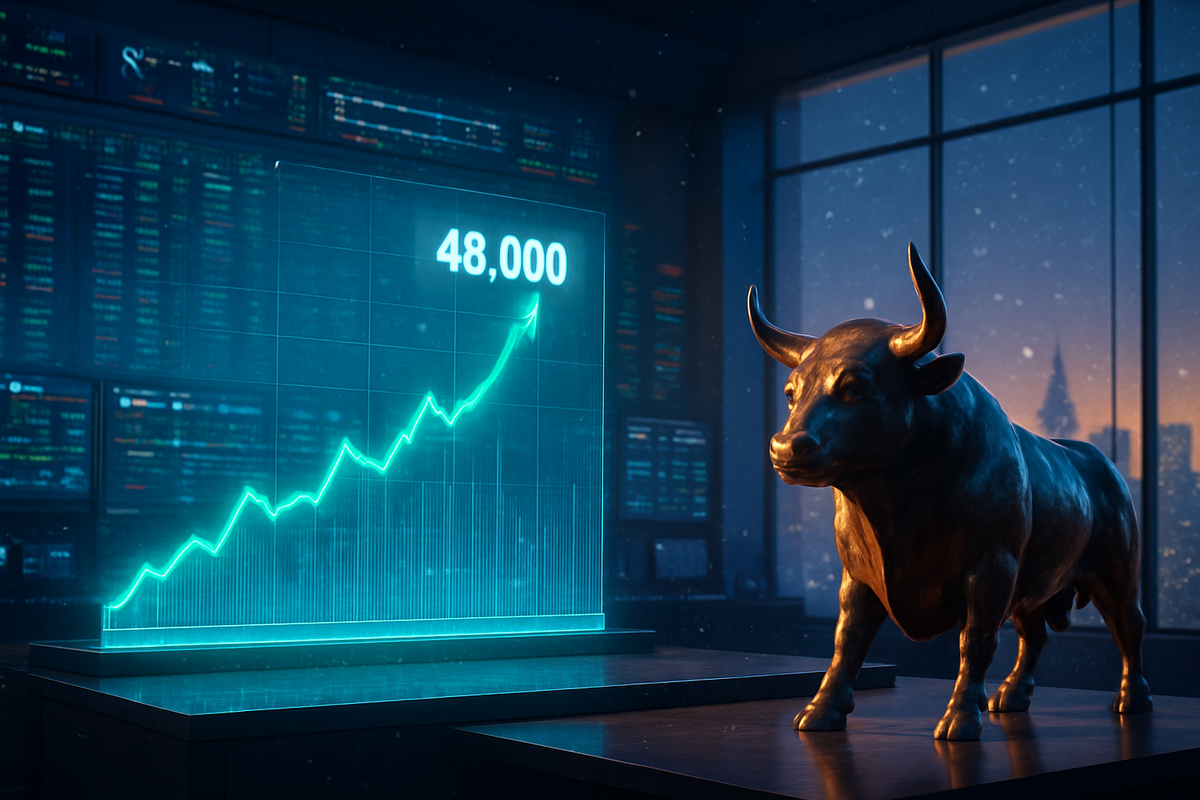
The path to the year-end finish line in 2025 was anything but linear. The market entered November with significant headwinds as a 43-day government shutdown paralyzed Washington, creating a fog of uncertainty over federal spending and economic data releases. It wasn't until the shutdown ended in mid-November that the "bulls" truly found their footing. On November 12, 2025, the Dow Jones Industrial Average (INDEXDJX: .DJI) made history by closing above 48,000 for the first time, driven by a relief rally that suggested the seasonal optimism was finally kicking in.
However, the momentum shifted in December. On December 10, the Federal Reserve attempted to grease the wheels of the economy by cutting interest rates by 25 basis points, bringing the federal funds rate to a range of 3.50%–3.75%. While the initial reaction was positive, the rally was short-lived. Concerns over an "AI Bubble" began to weigh heavily on the tech-heavy Nasdaq, which saw institutional investors begin to take profits after a massive run-up throughout the year. The traditional Santa Claus Rally—the last five trading days of December and the first two of January—was notably muted, ending with a four-session losing streak that capped the year on a cautious note.
Seasonal Winners and Losers: A Tale of Two Tapes
Despite the late-December stumble, certain sectors leveraged historical seasonality to deliver outsized returns. Consumer discretionary and retail stocks were among the primary beneficiaries of holiday spending. Dillard's (NYSE: DDS) and Expedia Group (NASDAQ: EXPE) showed remarkable strength, with the latter benefiting from a late-year surge in travel bookings. Health Care also emerged as a surprise leader in the fourth quarter, outperforming the broader market as investors rotated into defensive, high-quality names amid the mid-November government volatility.
On the other side of the ledger, the high-flying technology sector, which had carried the market for much of 2025, faced a "window dressing" conundrum. While stalwarts like Microsoft (NASDAQ: MSFT) and NVIDIA (NASDAQ: NVDA) remained foundationally strong, they became targets for tax-loss harvesting and profit-taking in December. Interestingly, companies focused on AI infrastructure, such as Micron Technology (NASDAQ: MU), Western Digital (NASDAQ: WDC), and Palantir Technologies (NYSE: PLTR), managed to buck the broader tech malaise, finishing the year with triple-digit annual gains as institutional managers scrambled to include these "winners" in their year-end portfolios.
Historical Precedents and the "Santa Claus" Indicator
The wider significance of the 2025 year-end performance lies in its deviation from historical averages. Typically, November and December see the S&P 500 return an average of +0.96% and +1.32%, respectively. While November 2025 met this criteria with a slight gain, December’s -0.05% return for the S&P was a rare departure from the norm. Historically, when the "Santa Claus Rally" fails to materialize, it has often served as a warning sign for the year ahead. The adage "If Santa fails to call, bears may come to Broad and Wall" is currently being debated across trading desks in New York.
This event fits into a broader industry trend of "sector rotation" that we have observed throughout the last year. The move away from pure-play AI growth into value-oriented financials and healthcare suggests a maturing bull market. Furthermore, the Federal Reserve's pivot to a more accommodative stance in December 2025 reflects a policy shift aimed at achieving a "soft landing" in 2026, though the market’s tepid reaction suggests that investors may already have priced in the benefits of lower rates.
What Lies Ahead for the First Quarter of 2026
As we look toward the remainder of Q1 2026, the short-term outlook is defined by a "wait-and-see" approach. The failure of the year-end rally to persist into January has forced many hedge funds to pivot their strategies toward volatility-hedging. If the market can reclaim the 6,900 level on the S&P 500 by the end of February, the "historic finish" of 2025 will be viewed as a healthy consolidation. However, if the current stagnation continues, the risk of a 5-10% correction increases as the market grapples with the high valuations established during the late-2025 surge.
Market opportunities are likely to emerge in mid-cap stocks and sectors that were overlooked during the AI frenzy. We expect a potential strategic pivot by major tech firms toward demonstrating actual revenue growth from AI integration, rather than just infrastructure spending. Investors should also watch for regulatory developments following the end of the government shutdown, as delayed policy decisions regarding tech antitrust and energy exports are expected to reach the floor in early 2026.
Summary and Investor Outlook
The 2025 "Year-End Seasonality" story was one of incredible milestones met with unexpected resistance. While the Dow reaching 48,000 and the S&P 500’s 16% annual gain are hallmarks of a historic bull run, the lackluster December performance serves as a reminder that seasonal trends are not guarantees. The primary takeaway for investors is that while the macro environment—boosted by Fed rate cuts—remains supportive, the "easy money" phase of the recovery may be transitioning into a more selective, earnings-driven market.
Moving forward, investors should keep a close eye on the "January Barometer"—the theory that as January goes, so goes the rest of the year. With only a few days left in the month, the market's ability to hold its current levels will be a critical indicator for 2026. Lasting impact will likely be found in the AI sector’s resilience and the ability of consumer spending to remain robust in the face of shifting interest rates. Watch for upcoming Q4 earnings reports to see if the corporate "historic finish" matches the stock market's ambitious pricing.
This content is intended for informational purposes only and is not financial advice.