As the sun sets on February 24, 2026, the financial world is holding its collective breath for a single data point: the fourth-quarter fiscal 2026 earnings report from Nvidia (Nasdaq: NVDA). Tomorrow's announcement is not merely a financial update; it has become the definitive pulse check for the most expensive industrial build-out in human history. With consensus revenue estimates hovering between $65 billion and $67 billion—a staggering 67% increase from the previous year—the stakes have shifted from "how fast can they build it?" to "when will it pay off?"
The immediate implications are profound. Nvidia’s market cap, which has oscillated around the $4 trillion mark, reflects a "pricing for perfection" environment where a standard "beat and raise" may no longer satisfy a market hungry for evidence of sustainable AI monetization. As hyperscalers continue to funnel hundreds of billions into data centers, the "AI do or die" narrative has reached a fever pitch, forcing a confrontation between silicon-fueled optimism and the cold reality of return on investment (ROI).
The Transition from Blackwell to Rubin Amidst Stargate Turbulence
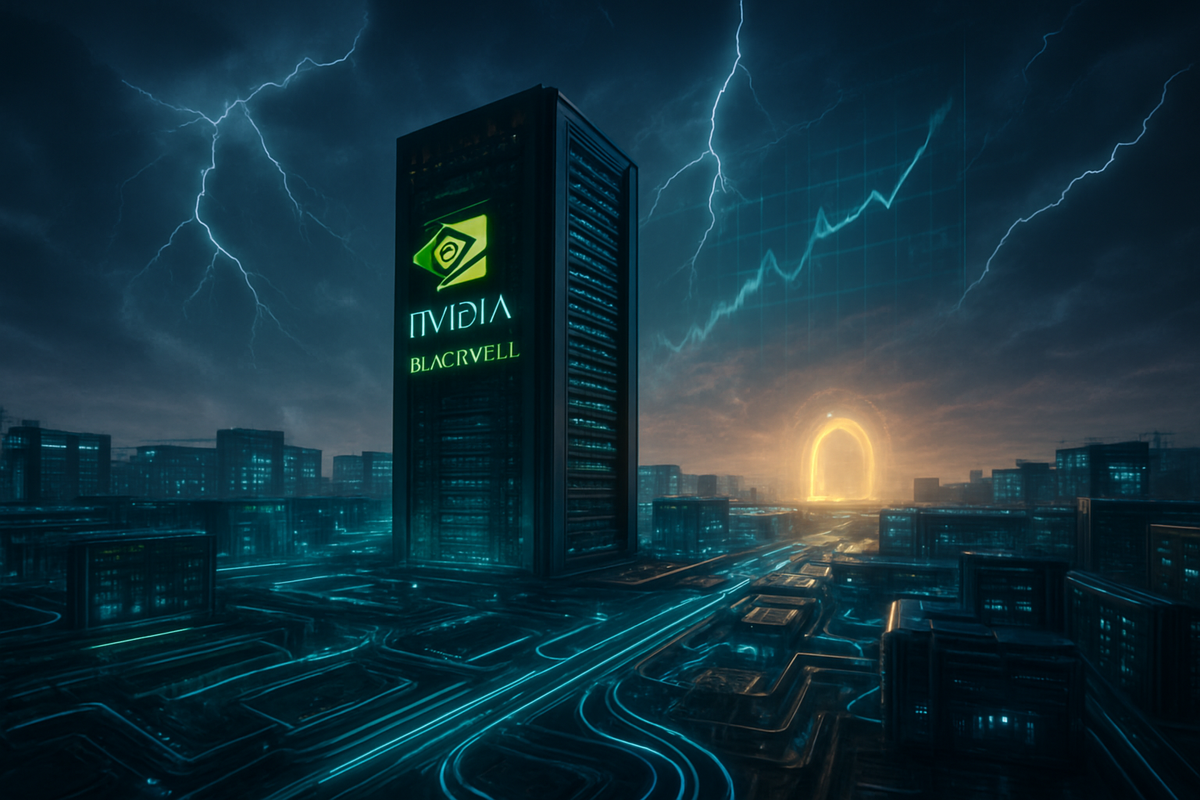
The narrative surrounding Nvidia’s fourth quarter is dominated by a complex product transition. The Blackwell architecture (B200/GB200) has been the primary engine of growth, with CEO Jensen Huang describing demand as "insane" throughout late 2025. However, as of today, February 24, reports indicate that while Blackwell systems are effectively sold out through mid-2026, the market is already looking toward the next horizon: the "Vera Rubin" (R200) architecture. Teased just weeks ago at CES 2026, the Rubin platform promises a 10x reduction in inference costs, creating a potential "air pocket" where customers might hesitate to commit to current hardware in anticipation of the H2 2026 Rubin rollout.
Adding to the tension is the reported deadlock in "Project Stargate," the ambitious $500 billion AI infrastructure venture between OpenAI, SoftBank (OTC: SFTBY), and Oracle (NYSE: ORCL). Whispers from Silicon Valley today suggest the project has stalled due to disagreements over funding structures and the sheer logistical nightmare of securing enough power for its proposed Texas-based "super-campus." This potential setback for the largest planned GPU cluster in history has sent tremors through the supply chain, as investors wonder if the physical limits of the electrical grid are finally slowing the AI juggernaut.
The timeline leading to this moment has been a relentless one-year product cycle—a pace Nvidia established in late 2024 to stay ahead of internal "homegrown" silicon efforts by its own largest customers. This "annual cadence" has effectively compressed the semiconductor development cycle, leaving little room for error for either Nvidia or its manufacturing partner, Taiwan Semiconductor Manufacturing Company (NYSE: TSM).
Winners and Losers in the Inference Wars
The primary beneficiaries of this cycle continue to be the "Fab Four" hyperscalers—Microsoft (Nasdaq: MSFT), Alphabet (Nasdaq: GOOGL), Amazon (Nasdaq: AMZN), and Meta Platforms (Nasdaq: META). These companies are projected to spend a combined $660 billion to $690 billion on capital expenditures in 2026. However, the "winner" status is conditional; they are now under immense pressure to show that "Agentic AI" and large-scale inference are driving actual bottom-line growth. Microsoft and Google have claimed they are monetizing capacity as fast as it is installed, but any hint of a slowdown in tomorrow’s guidance could turn these massive spenders into the market's biggest liabilities.
On the competitive front, Advanced Micro Devices (Nasdaq: AMD) is facing a critical "do or die" window. While its MI350 and MI400 series have gained some traction in the mid-tier inference market, Nvidia’s aggressive move to an annual release cycle is suffocating AMD's ability to maintain performance parity. Meanwhile, Intel (Nasdaq: INTC) remains in a precarious position, struggling to prove its Gaudi 3 and 4 accelerators can compete on a total cost of ownership (TCO) basis against the integrated Nvidia Blackwell racks. The "losers" in this environment are likely the second-tier cloud providers who lack the capital to keep up with the Blackwell-to-Rubin transition, potentially leading to a further consolidation of AI power among the top three hyperscalers.
The Physical Reality of Power and the Software Moat
The wider significance of tomorrow’s earnings lies in the transition from the "Training Phase" to the "Inference Phase." In 2024 and 2025, the focus was on building the massive models that define Generative AI. In 2026, the focus is on running them. This shift is significant because inference is where the "money is made," but it is also where Nvidia’s software moat—specifically CUDA and its new NIM (Nvidia Inference Microservices)—faces its toughest test. If hyperscalers can successfully port their inference workloads to their own custom silicon (like Google’s TPU v7 or Amazon’s Trainium 2), Nvidia’s high margins could finally be at risk.
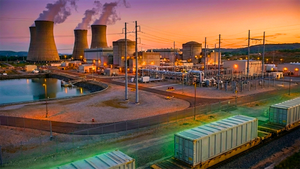
Furthermore, the industry has hit what analysts are calling the "Physical Reality Wall." The bottleneck is no longer just the number of HBM4 memory chips TSM can produce, but the amount of gigawatts the global power grid can provide. This has turned energy infrastructure companies into essential partners in the semiconductor ecosystem. Historical comparisons are being drawn to the build-out of the fiber-optic networks in the late 1990s; the question for 2026 is whether we are currently overbuilding the "digital tracks" for a train of AI applications that has yet to fully arrive.
The Road to H2 2026: What Lies Ahead
In the short term, the market will react violently to any change in Nvidia’s gross margins, which have been the envy of the S&P 500. A strategic pivot toward "Rack-scale-as-a-Service" is expected, as Nvidia seeks to move beyond selling individual chips to selling entire, liquid-cooled data center units. This move would further entrench their position but requires a massive coordination effort with global utilities and construction firms.
Potential scenarios for the remainder of 2026 include a "Soft Landing," where the Rubin architecture launch in the second half of the year reignites demand, or a "Consolidation Phase," where hyperscalers pause buying to optimize the trillions of dollars of hardware they have already purchased. The "AI do or die" moment specifically applies to the software layer; if the anticipated wave of "AI Agents" fails to revolutionize enterprise productivity by late 2026, the capital expenditure taps may finally begin to tighten.
Final Assessment: The Last Frontier of Growth
The key takeaway for investors heading into tomorrow is that Nvidia is no longer just a chip company; it is the central bank of the AI economy. The report will likely show record revenues, but the quality of that revenue—specifically how much is coming from recurring software services versus one-time hardware sales—will determine the stock’s trajectory for the rest of the year.
Moving forward, the market will be hyper-focused on the "utilization rates" of these massive GPU clusters. If the "Stargate" project remains deadlocked, it may signal that the era of "limitless" AI spending is evolving into a more disciplined, ROI-focused environment. Investors should watch for updates on Rubin’s production timeline and any commentary on power availability, as these will be the true governors of growth in the months to come. The "AI do or die" moment is here; tomorrow, we find out who survives.
This content is intended for informational purposes only and is not financial advice.