
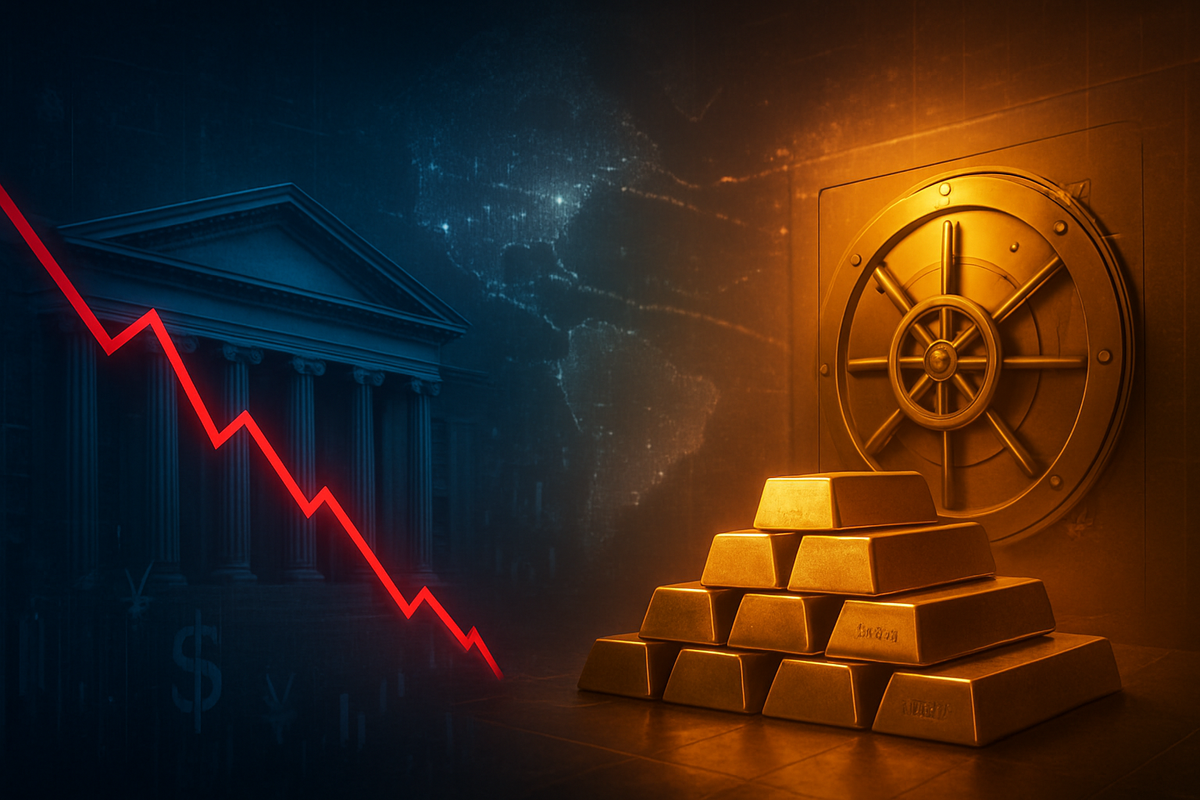
BEIJING / NEW YORK — In a move that has sent shockwaves through international debt markets, the People’s Bank of China (PBOC) and the National Financial Regulatory Administration (NFRA) have reportedly issued a directive to the nation’s largest state-owned banks, advising a strategic and accelerated reduction in their holdings of U.S. Treasury securities. The move, characterized as a "window guidance" measure to mitigate concentration risk, has sparked a "Sell America" sentiment across global trading floors, leading to a notable softening of the U.S. Dollar (USD) and a spike in Treasury yields as of late February 2026.
The immediate implications are multifaceted: while the directive aims to "sanction-proof" the Chinese economy and diversify its massive investment portfolios into physical assets like gold, it has simultaneously tightened global financial conditions. The 10-year U.S. Treasury yield, a benchmark for everything from mortgages to corporate loans, climbed to 4.25% following the news, reflecting concerns that the world’s second-largest economy is permanently cooling its decade-long romance with the greenback. For the U.S. Treasury Department, the challenge is now one of narrative control, as they attempt to reassure investors that private-sector demand can fill the multi-billion-dollar void left by Beijing.
A Calculated Retreat: Inside the February Directive
The pivot began in earnest on February 9, 2026, when reports surfaced of high-level meetings between Chinese regulators and executives at the country's "Big Four" state banks. According to market participants familiar with the discussions, the PBOC issued verbal instructions for these institutions to limit new purchases of U.S. sovereign debt and begin a "orderly liquidation" of existing positions that exceeded internal risk thresholds. This "window guidance"—a traditional Chinese regulatory tool that avoids formal written policy—allowed Beijing to distance the move from official state-to-state diplomacy while effectively steering billions of dollars out of the U.S. financial system.
This latest move is the culmination of a trend that accelerated throughout late 2025. By January 2026, China’s total holdings of U.S. Treasuries had already plummeted to a 17-year low of approximately $682.6 billion, a staggering 50% decline from its 2013 peak. The sell-off in 2025 alone accounted for over $115 billion in divested assets. Analysts suggest that the timing of the February 2026 directive was intended to capitalize on a period of U.S. fiscal uncertainty, specifically regarding the rising national deficit and the looming 2026 debt ceiling negotiations.
U.S. Treasury Secretary Scott Bessent has sought to downplay the volatility, labeling the market reaction a "non-systemic deleveraging convulsion." During a press briefing in Washington, Bessent emphasized that the Treasury market remains the deepest and most liquid in the world, noting that "record foreign demand" from private entities and emerging markets like India and Brazil has helped absorb the supply. However, the market’s initial reaction was less sanguine; the Bloomberg Dollar Spot Index slipped 0.2% almost immediately, and the 30-year Treasury yield hit a multi-month high of 4.88%.
Winners and Losers: The Financial Fallout
The redistribution of Chinese capital has created a clear bifurcation among public companies and financial instruments. Among the winners are major U.S. money-center banks, which have benefited from a "bear steepening" of the yield curve—where long-term interest rates rise faster than short-term rates. JPMorgan Chase & Co. (NYSE: JPM) has reported a significant 17% jump in its markets division revenue in early 2026, as increased volatility and widening net interest margins (NIM) bolster the bottom line. Similarly, Goldman Sachs Group Inc. (NYSE: GS) has seen its stock hover near record highs of $956, fueled by a 42% surge in global M&A activity as corporations rush to lock in financing before yields climb further.
The commodities sector, particularly gold, has emerged as the primary beneficiary of China's diversification. With gold prices touching a historic $5,600 per ounce in February 2026, mining giants have become "super-margin" entities. Barrick Gold Corporation (NYSE: GOLD) is reportedly planning an IPO for its Nevada Gold Mines assets to capitalize on the bullion frenzy, while Newmont Corporation (NYSE: NEM) has achieved record free cash flow, despite navigating production sequencing challenges. For these companies, China’s move away from "paper assets" (Treasuries) toward "hard assets" (gold) represents a fundamental and long-term tailwind.
Conversely, the losers are found primarily in long-duration fixed-income products. The iShares 20+ Year Treasury Bond ETF (NASDAQ: TLT) has faced heavy selling pressure, losing significant value as long-term yields spiked. While defensive short-term vehicles like the iShares 1-3 Year Treasury Bond ETF (NASDAQ: SHY) remain relatively stable, the overall sentiment in the bond market is one of caution. Retail-focused giants like Walmart Inc. (NYSE: WMT) are also feeling the heat; rising yields often lead to higher consumer borrowing costs, which could eventually dampen discretionary spending, while any weakening of the USD could increase the cost of imported goods, further squeezing margins.
The Global Pivot: De-Dollarization and Stability
The broader significance of China’s "window guidance" cannot be overstated. It marks a decisive chapter in the "de-dollarization" movement, where major economies seek to insulate themselves from U.S. fiscal policy and potential sanctions. This shift is not occurring in a vacuum; it mirrors broader industry trends where central banks in the "Global South" are increasingly settling trade in local currencies or diversifying reserves into the Euro and the Yuan. The historical precedent often cited by economists is the 2013 "Taper Tantrum," but the 2026 scenario is different: the selling is not driven by a change in U.S. monetary policy, but by a strategic geopolitical divorce.
The ripple effects are reaching the shores of America's closest partners. As yields rise, the cost of servicing U.S. debt increases, potentially crowding out government spending on infrastructure and defense. This has led to renewed debates in the halls of Congress regarding fiscal discipline. Furthermore, if China continues to dump Treasuries, it could force the Federal Reserve into a difficult corner—either allow rates to stay high and risk a recession, or initiate an emergency "quantitative easing" program to buy the debt that China no longer wants, which could reignite inflationary pressures.
Looking Ahead: A Future Defined by Volatility
In the short term, market participants should expect continued volatility in the USD and Treasury yields. The strategic pivot required for the U.S. will likely involve finding new "anchor buyers" for its debt. This may lead to more aggressive diplomatic efforts to encourage allies in Europe and Asia to increase their Treasury allocations. Long-term, the scenario of a "fragmented" global financial system—one where the USD remains the dominant trade currency but loses its status as the "only" safe-haven reserve—is becoming a reality.
Potential scenarios for the remainder of 2026 include a "sharp rebound" in bond prices if the Fed decides to cut rates more aggressively than expected to combat a slowdown. However, the more likely outcome is a period of "structural higher yields," where the premium for holding U.S. debt must remain elevated to attract a more diverse but less loyal buyer base. Strategic adaptations will be required for institutional investors, who must now account for "geopolitical risk premiums" in even the most conservative portfolios.
Conclusion: A New Era for the Global Creditor
The directive for Chinese banks to pare back their U.S. Treasury holdings is more than a simple portfolio rebalancing; it is a signal that the era of "Chimerica"—the deep economic symbiosis between the world's two largest powers—is effectively over. The key takeaway for investors is that the "risk-free rate" is no longer as predictable as it once was. The surge in gold and the widening margins for major banks like JPMorgan Chase & Co. (NYSE: JPM) suggest that capital is seeking new homes in a world where geopolitical alignment matters as much as credit ratings.
Moving forward, the market will be defined by its ability to absorb this structural shift. Investors should closely monitor the results of upcoming Treasury auctions and the PBOC’s gold reserve reports in the coming months. While the U.S. financial system remains resilient, the "stealth sell-off" of February 2026 serves as a stark reminder that in the modern financial area, the most potent weapons are often found not on the ledger, but in the ledger.
This content is intended for informational purposes only and is not financial advice.