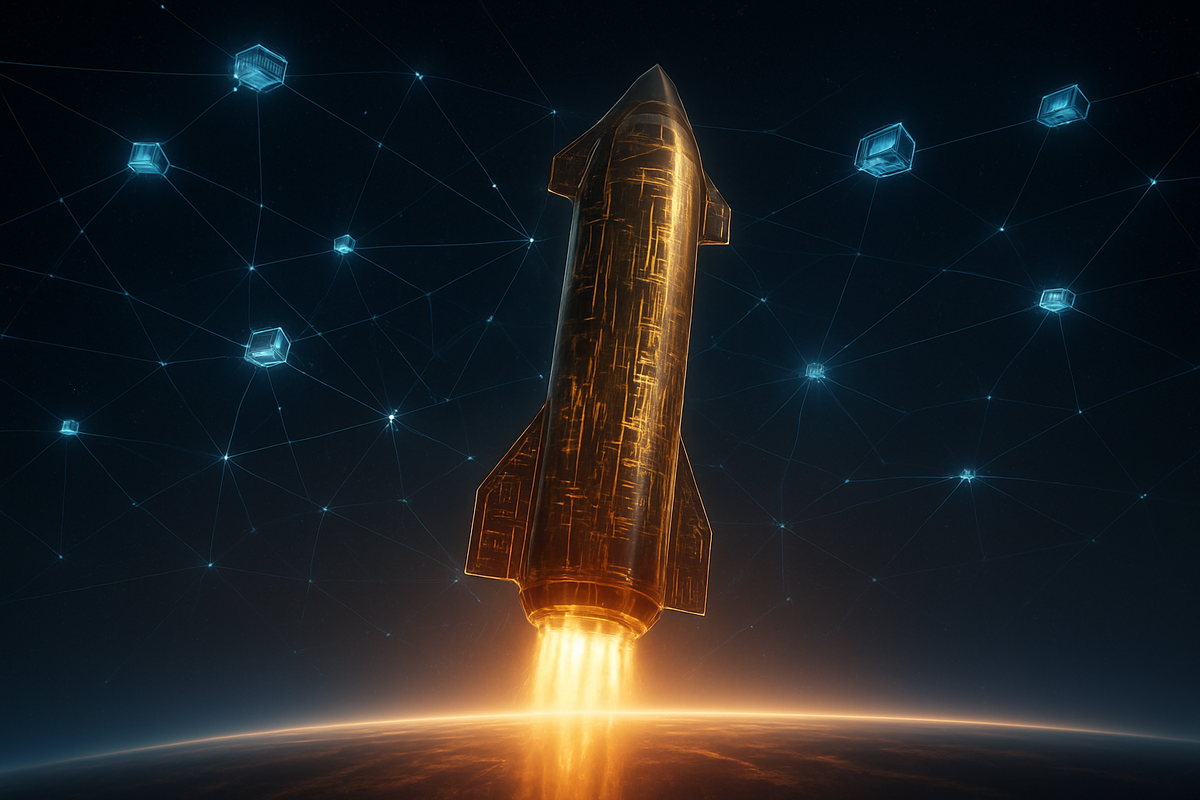
In a move that has sent shockwaves through both Silicon Valley and Wall Street, Elon Musk announced on February 2, 2026, the formal merger of his aerospace giant, SpaceX, and his artificial intelligence venture, xAI. The deal values the combined entity at a staggering $1.25 trillion, creating the world’s first private “super-conglomerate” focused on the convergence of off-world infrastructure and advanced cognitive computing. This consolidation marks a pivotal shift in Musk’s empire, bringing his most ambitious technological frontiers under a single corporate umbrella.
The immediate implications are profound: the merger effectively transforms SpaceX from a launch and telecommunications provider into a vertically integrated AI infrastructure powerhouse. By merging xAI’s "Grok" large language models with the global reach of the Starlink satellite constellation, Musk aims to bypass the terrestrial energy constraints currently bottlenecking AI development. Market analysts suggest this move is the ultimate "de-risking" strategy for xAI’s capital-intensive research, anchoring it to SpaceX’s multi-billion dollar government and commercial contracts.
The Birth of a Trillion-Dollar Titan: Timeline and Terms
The merger was finalized following a flurry of activity in late 2025. According to internal documents, the deal was structured as a share exchange, valuing SpaceX at approximately $1 trillion—bolstered by the success of its Starship HLS (Human Landing System) milestones—and xAI at $250 billion. The timeline leading to this moment began in December 2025, when SpaceX completed a secondary market tender offer that pegged its valuation at $800 billion. Simultaneously, xAI closed a $20 billion Series E round in January 2026, signaling investor appetite for a unified "Musk ecosystem."
Under the terms of the agreement, xAI investors received 0.1433 shares of SpaceX stock for every xAI share held. Key stakeholders, including early xAI backers like Sequoia Capital and Andreessen Horowitz, have reportedly voiced strong support for the merger, viewing it as the most viable path toward a liquidity event. The initial market reaction has been one of cautious awe; while the valuation is unprecedented for a private company, the strategic logic of using Starship to deploy "AI-optimized" satellites has silenced many skeptics who previously questioned xAI’s ability to compete with terrestrial giants.
The High-Stakes Battlefield: Winners and Losers
The merger creates clear winners in the hardware and semiconductor sectors. NVIDIA (NASDAQ: NVDA) is expected to see a surge in demand as SpaceX-xAI begins procurement for its "Orbital Data Center" initiative, which requires specialized, radiation-hardened AI chips. Similarly, Tesla (NASDAQ: TSLA) investors have reacted positively, as the merger clarifies the boundaries of Musk’s various ventures and opens the door for deeper AI integration between Tesla’s Optimus robotics and the new SpaceX-xAI intelligence core.
Conversely, traditional aerospace and defense contractors like Boeing (NYSE: BA) and Lockheed Martin (NYSE: LMT) face an existential threat. The combined SpaceX-xAI entity now offers a level of integrated software-hardware capability that legacy firms struggle to match, particularly in the realm of autonomous satellite operations and real-time orbital analytics. Terrestrial data center operators such as Equinix (NASDAQ: EQIX) and Digital Realty (NYSE: DLR) may also find themselves on the defensive as Musk’s vision of space-based, solar-powered computing challenges the sustainability and cost-efficiency of ground-based "server farms."
Strategic Rationale: The Orbital Computing Revolution
The broader significance of this merger lies in its solution to the "AI Energy Wall." As terrestrial AI models demand exponential increases in electricity and water for cooling, Musk’s strategy is to move the computation to where energy is abundant and cooling is "free": Low Earth Orbit (LEO). By utilizing the vacuum of space for thermal management and high-efficiency solar arrays for power, the SpaceX-xAI entity plans to launch a "million-satellite AI constellation." This fits into the broader industry trend of "edge computing," but on a planetary scale.
However, the merger is not without its hurdles. Regulatory bodies, including the Federal Communications Commission (FCC) and the Securities and Exchange Commission (SEC), are expected to scrutinize the deal. The sheer concentration of power—controlling the world's dominant launch system, a global internet backbone, and a leading AI model—raises significant antitrust and national security concerns. Comparisons are already being drawn to the historical breakup of Standard Oil, as critics argue that no single individual should control the primary infrastructure of the 21st-century digital and physical economy.
The Road to the Largest IPO in History
All eyes are now on the anticipated SpaceX-xAI Initial Public Offering, rumored to be scheduled for June 28, 2026. Internal memos suggest the company is targeting a public valuation of $1.5 trillion, which would make it the largest IPO in history, surpassing Saudi Aramco’s 2019 debut. In the short term, the company must execute a series of successful Starship launches specifically designed to carry the new "Grok-Sat" payloads. Any delay in the Starship flight cadence could dampen investor enthusiasm ahead of the listing.
The long-term pivot will require SpaceX to transition from a logistics company to a service-based AI utility. This shift presents significant technical challenges, including the development of reliable laser-mesh communications capable of handling the massive data throughput required for real-time AI inference from orbit. If successful, the company will not only dominate the space industry but also become a central utility for every AI-enabled device on Earth, from autonomous vehicles to military hardware.
Outlook for Investors and the Market
The SpaceX-xAI merger is more than just a corporate consolidation; it is a bet on the future of decentralized, off-planet infrastructure. For the market, this represents a new asset class—an "Extraterrestrial Intelligence" play. The key takeaways for investors are the aggressive valuation, the unique solution to AI's energy crisis, and the impending IPO that will likely redefine the benchmarks for the "Magnificent Seven" and the broader S&P 500.
As we move toward the mid-2026 IPO, investors should closely watch the "Starshield" government contracts and the technical reliability of the Grok-integrated Starlink nodes. While the "Musk Complexity Risk" remains a valid concern—given the CEO’s tendency to juggle multiple high-stakes roles—the financial synergy of this merger is undeniable. The market is moving toward a future where the sky is no longer the limit, but rather the foundation for the next era of artificial intelligence.
This content is intended for informational purposes only and is not financial advice