
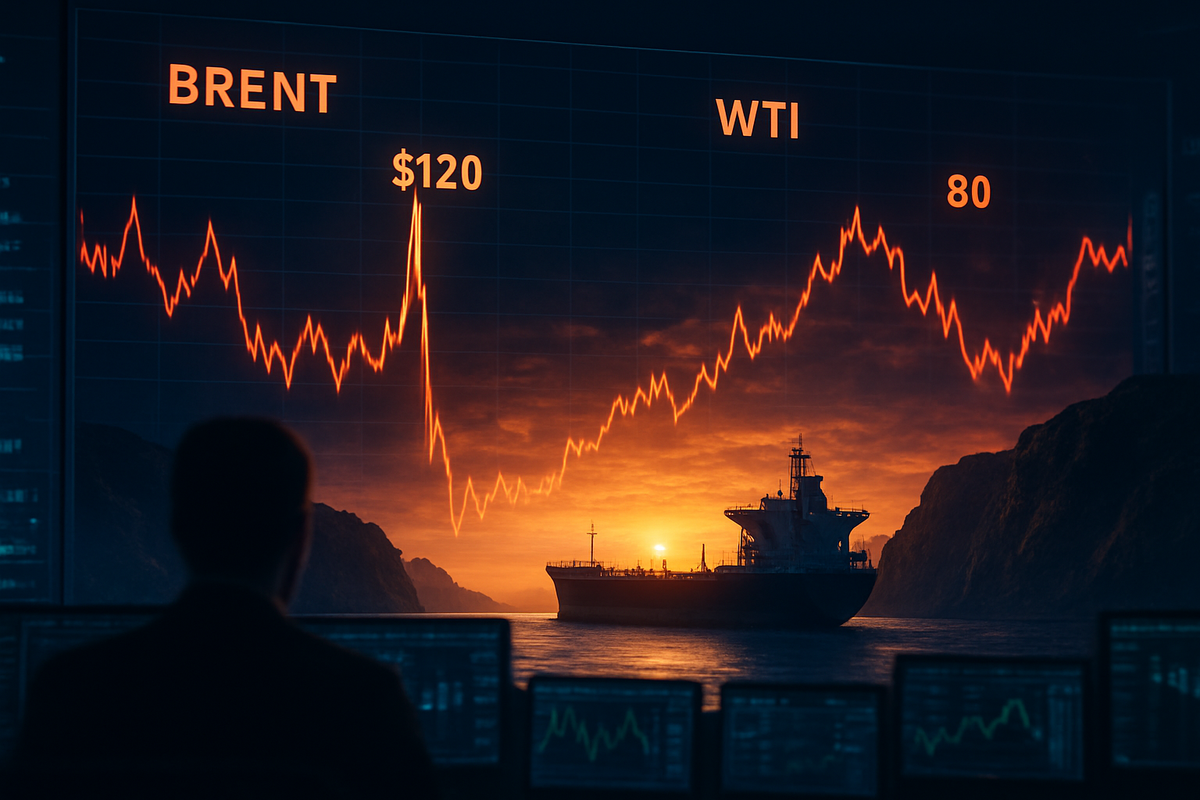
The global energy markets have just endured one of the most volatile 72-hour windows in modern history, as crude oil benchmarks executed a staggering round-trip from nearly $120 per barrel back down to the $80 range. This massive "war premium" was fueled by a rapid military escalation in the Middle East Gulf that threatened to permanently sever the world’s most vital energy artery, the Strait of Hormuz. While the immediate threat of a total blockade appears to have softened, the whiplash in pricing has left traders and global economies reeling from the sudden shift in supply-side risk.
As of today, March 11, 2026, Brent Crude and West Texas Intermediate (WTI) have settled into a shaky range between $85 and $89 per barrel. This comes after an intraday peak on Monday that saw prices touch levels not seen since the height of the 2022 energy crisis. The pullback was not driven by a resolution of the underlying geopolitical tensions, but rather by a massive, coordinated intervention by the G7 nations and signals from Washington regarding an "early exit" from the kinetic phase of the conflict. However, the market remains on a knife-edge as the physical reality of damaged infrastructure in the Persian Gulf begins to be assessed.
The 48-Hour Spike: A Timeline of Escalation and Intervention
The volatility began in earnest during the late hours of Sunday, March 8, following reports of precision strikes by U.S. and Israeli forces against Iranian energy and military command centers. By the market open on Monday, March 9, 2026, a panic-driven "war premium" had gripped the exchanges. Brent crude surged nearly 20% in a single session, hitting an intraday high of $119.50, while WTI briefly touched $119.48. The catalyst for this vertical move was the effective closure of the Strait of Hormuz, through which roughly 20 million barrels of oil—20% of global daily consumption—transits. Insurance for any vessel entering the Persian Gulf was summarily revoked, halting exports from Iraq, Kuwait, and Qatar.
The peak of the crisis saw Iranian-aligned forces launch retaliatory drone strikes against Saudi oil fields and a critical desalination plant in Bahrain, leading Bahrain’s national oil company to declare force majeure. For a few hours on Monday evening, the market priced in a "worst-case scenario" of a prolonged regional war. The structure of the market shifted into "extreme backwardation," where the price for immediate physical delivery traded at a record $14.20 premium over future contracts, indicating a desperate scramble for available barrels in Europe and Asia.
However, the rally hit a wall on Tuesday. The U.S. administration, led by President Trump, signaled that the military objectives had been "largely achieved" and that diplomatic backchannels were being utilized to de-escalate. Simultaneously, the G7 announced a record-breaking coordinated release of Strategic Petroleum Reserves (SPR), injecting millions of barrels into the market to offset the Gulf shortfall. By the morning of Wednesday, March 11, the panic had subsided into a tactical retreat, with prices cratering back into the mid-$80s as algorithmic traders liquidated long positions.
Winners and Losers: Energy Majors Caught in the Crossfire
The extreme price swings created a bifurcated reality for the world's largest energy companies. ExxonMobil (NYSE: XOM) saw its shares rise a modest 1.4% during the initial spike, but gains were capped by its deep exposure to the region. As a primary partner with QatarEnergy, ExxonMobil faced the immediate prospect of its liquefied natural gas (LNG) exports being trapped behind the Hormuz blockade. While the pullback to $85 has provided some stability, investors remain concerned about the long-term security of the company's multi-billion dollar Middle Eastern assets.
Similarly, Chevron (NYSE: CVX) experienced a brief rally toward the $190 mark before retreating. The company was forced to temporarily suspend operations at its major gas fields off the coast of Israel at the government’s request during the height of the missile exchanges. While Chevron benefits from high U.S. domestic production, the geopolitical "tax" on its Mediterranean and Middle Eastern portfolio has made it a volatile play for hedge funds. Meanwhile, BP (NYSE: BP) significantly underperformed its peers, dropping nearly 4% as news broke of drone strikes targeting its operations in southern Iraq, leading to the emergency evacuation of non-essential personnel.
On the other side of the ledger, Shell (NYSE: SHEL) found itself navigating a logistical nightmare. As the world’s largest LNG trader, Shell had to divert dozens of tankers around the Cape of Good Hope to avoid the Persian Gulf, a move that added weeks to delivery times and millions in fuel costs. Conversely, domestic U.S. shale-focused firms and Norwegian giants like Equinor (NYSE: EQNR) emerged as relative safe havens. With no physical assets in the line of fire, Equinor benefited from the surge in European gas and oil prices, positioning itself as the "security of supply" provider for a continent suddenly cut off from Middle Eastern barrels.
Geopolitical Realignment and the New Risk Floor
This week’s events fit into a broader trend of "energy fragmentation" that has been accelerating since late 2025. The transition from a decade of relative stability to a period of frequent "gray zone" maritime conflicts has forced a re-evaluation of the global supply chain. The $85 floor we are seeing now suggests that the market no longer believes in the $60-$70 range that dominated the latter half of 2025. Instead, a permanent "instability premium" is being baked into the price of every barrel, reflecting the reality that the Strait of Hormuz is no longer a guaranteed transit point.
The regulatory implications of this spike are also profound. The G7’s rapid use of the SPR has depleted reserves to historically low levels in an attempt to prevent a global recession. This leaves the West with very little "ammunition" should a second wave of conflict emerge this summer. Historically, this event mirrors the 1973 oil embargo and the 2022 invasion of Ukraine, yet it differs in the speed of the market's response. The role of high-frequency trading and AI-driven sentiment analysis meant that the entire "war cycle"—from $65 to $120 and back to $85—played out in less than a week, a pace of volatility that traditional policy-making cannot match.
Furthermore, this crisis has accelerated the shift toward domestic energy independence. In Washington and Brussels, the $120 spike is being used as political leverage to fast-track both nuclear energy projects and expanded offshore drilling in "safe" jurisdictions. For competitors in the green energy space, the volatility provides a dual-edged sword: it highlights the risks of fossil fuel dependency, but the economic shock of $120 oil simultaneously threatens the capital required for the green transition.
What Traders and Investors Are Watching Next
In the short term, the market is laser-focused on the physical state of the Persian Gulf. While the "blockade" has technically eased, commercial insurers have yet to normalize rates. Traders are watching for the first successful passage of an unescorted VLCC (Very Large Crude Carrier) through the Strait of Hormuz. If insurance premiums remain elevated, the "pullback" to $85 may prove to be a temporary dip before a secondary surge. Furthermore, the EIA’s next inventory report will be critical in determining how much the U.S. had to rely on its own stocks during the 48-hour Gulf shutdown.
Long-term, the strategic pivot for energy majors will be a move toward "geopolitical diversification." Companies that have heavily relied on Middle Eastern partnerships may look to increase their footprint in the Permian Basin or the Brazilian pre-salt fields. Investors should anticipate a period of high CAPEX as companies spend to secure their supply lines against future "flash" conflicts. The market is also bracing for the possibility of "stagflation" if the energy shock ripples into manufacturing and transport costs over the coming months.
The most likely scenario for the remainder of 2026 is a "high-floor, high-volatility" environment. The $80 mark appears to be the new "zero" for the market, with any hint of renewed tension likely to trigger another algorithmic spike. For the public, this translates to sustained higher prices at the pump and a continued inflationary drag on the global economy, even if the headline-grabbing $120 peaks remain brief.
Final Assessment: A Fragile Equilibrium
The events of early March 2026 have permanently altered the psychology of the energy markets. The brief journey to $120 oil was a "stress test" that exposed the fragility of global supply chains and the limited effectiveness of strategic reserves against modern, high-speed geopolitical conflicts. While the current retreat to the $85-$89 range offers a temporary sigh of relief for consumers and central banks, the fundamental triggers—territorial disputes in the Gulf and the erosion of maritime security—remain entirely unresolved.
Moving forward, investors must treat energy not just as a commodity play, but as a geopolitical barometer. The "winners" in this new era will be the firms with the most geographically insulated assets and the most flexible logistics chains. The "losers" will be those who failed to account for the return of high-intensity regional conflict. As we look toward the summer driving season, the market will remain hyper-sensitive to any headline from Tehran, Tel Aviv, or Washington.
In summary, the "Great Spike of 2026" was a warning shot. It proved that while the world is moving toward a transition, it remains fundamentally anchored to a region that is increasingly volatile. For the coming months, the watchword for every oil trader and energy investor will be "resilience" over "return."
This content is intended for informational purposes only and is not financial advice.