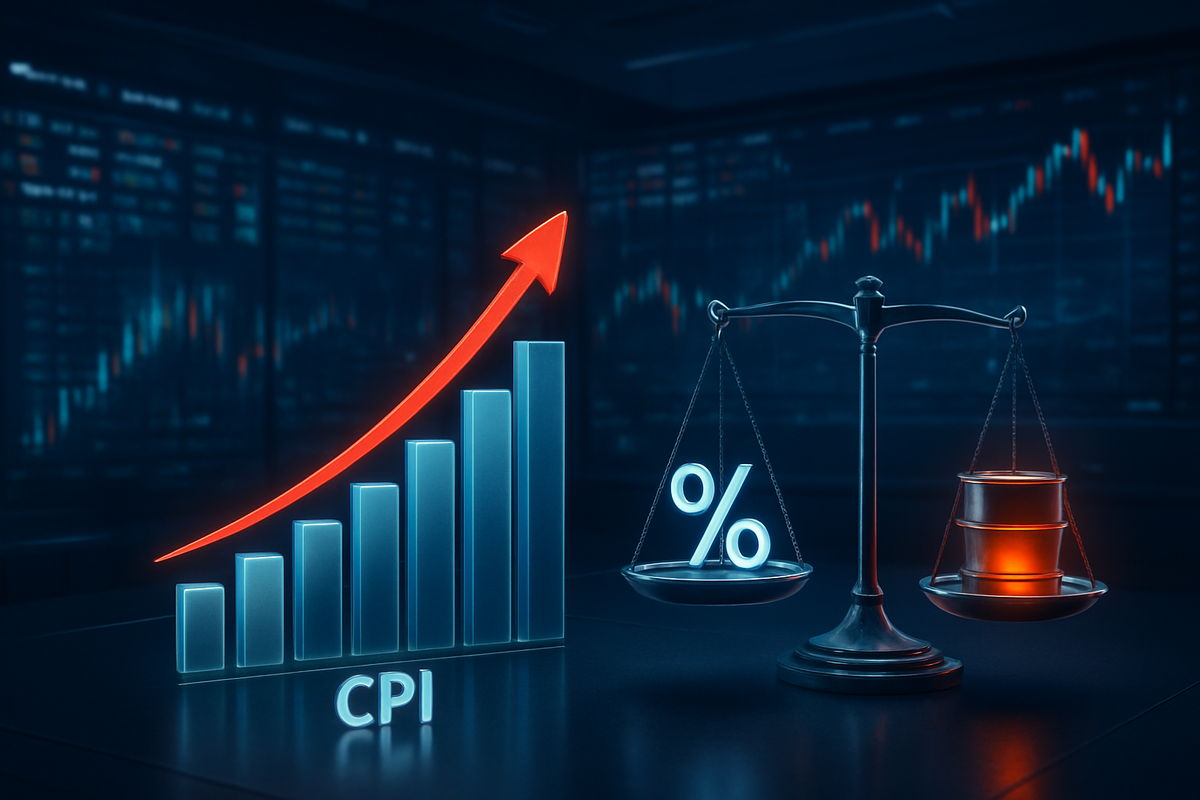
As the sun rises over Wall Street on Wednesday, March 11, 2026, the financial world is holding its collective breath for the release of the February Consumer Price Index (CPI) report. This particular data set has taken on outsized importance, as it arrives at a critical juncture for the U.S. economy—sandwiched between a cooling labor market and a sudden, violent spike in global energy prices. For investors, the numbers are not just a measure of past price increases; they are a definitive signal for whether the Federal Reserve will resume interest rate cuts in the second half of the year or be forced into a defensive pause to combat a potential second wave of inflation.
The immediate implications are stark. After three consecutive rate cuts in late 2025, the Federal Reserve, led by Chair Jerome Powell, moved to a "wait-and-see" stance in January 2026. The February report is expected to show headline inflation hovering around 2.4% year-over-year, a figure that remains stubbornly above the Fed's 2.0% target. With the "Iran-Israel conflict" causing Brent crude to surge toward $120 per barrel in late February, any sign of "sticky" core inflation in this morning's report could evaporate market hopes for a rate cut at the upcoming March 17-18 FOMC meeting, potentially locking the federal funds rate at its current 3.50%–3.75% range for months to come.
The Data Behind the Drama: A Stalemate in Disinflation
The road to this morning’s CPI release began in late 2025, a period that many economists initially dubbed the "soft landing finale." However, the narrative shifted abruptly in the first two months of 2026. While headline CPI had steadily drifted down from its 2022 peaks, the pace of decline has effectively stalled. Preliminary data for the February report indicates a month-over-month increase of 0.3%, mirroring the pace seen in January. Core CPI—which strips out volatile food and energy costs—is projected to remain at 2.5%, marking the lowest level since 2021 but failing to show the "further progress" the Fed has explicitly demanded.
Key stakeholders, including Federal Reserve Governors Christopher Waller and Stephen Miran, have become increasingly vocal about the "Great Divide" within the central bank. While Waller has hinted at the need for cuts to support a softening labor market—which saw a shocking loss of 92,000 jobs in February—more hawkish regional presidents have pointed to the 1.3% jump in apparel costs and persistent shelter inflation as reasons to keep the brakes on the economy. The initial market reaction to these "whisper numbers" has been one of extreme caution; the Dow Jones Industrial Average has already surrendered its 2026 gains, falling nearly 5% year-to-date as the "higher-for-longer" mantra returns to the trading floor.
Winners and Losers: Navigating a High-Yield Landscape
In this environment of sticky inflation and geopolitical instability, the corporate winners are those with direct leverage to commodities or defensive market positions. Exxon Mobil Corporation (NYSE: XOM) has emerged as a primary beneficiary, with its stock price rallying nearly 30% year-to-date. As a massive inflation hedge, Exxon is currently generating record-level cash flows as the conflict in the Strait of Hormuz keeps oil prices at four-year highs. Similarly, Walmart Inc. (NYSE: WMT), which recently transitioned to the Nasdaq-100, is reaping the rewards of "high-income migration." As 2.4% inflation erodes middle-class purchasing power, wealthier households are increasingly shifting their spending to value retailers, solidifying Walmart's status as a tech-retail hybrid powerhouse.
Conversely, the tech titans that drove the market to record highs in 2025 are finding the 2026 landscape far more treacherous. Apple Inc. (NASDAQ: AAPL) has seen its shares retreat nearly 6% over the last month as investors worry about the impact of rising memory prices—projected to climb 40% this year—and the weight of high interest rates on consumer financing. NVIDIA Corporation (NASDAQ: NVDA), while still a leader in the AI space, has seen its meteoric growth stabilize. Trading sideways at approximately $185, the company faces "valuation jitters" as the cost of capital remains high, making its massive R&D investments more expensive to finance. Other losers include real estate giants like Prologis, Inc. (NYSE: PLD), which are struggling with the dual burden of high borrowing costs and a cooling industrial leasing market.
The Shadow of Stagflation: Wider Economic Significance
The significance of the February CPI report extends far beyond a single percentage point; it represents a potential shift toward "stagflationary" conditions—a rare and painful mix of slow growth and persistent inflation. This event fits into a broader industry trend where the "easy wins" of the post-pandemic supply chain recovery have been exhausted. We are now in a "structural" inflation phase driven by deglobalization, higher energy costs due to geopolitical strife, and a tight but cooling labor market. The 4.4% unemployment rate reported on March 6 stands in direct conflict with the Fed’s inflation mandate, creating a policy trap that hasn't been seen with this intensity since the late 1970s.
Historically, this period draws comparisons to 1995, when the Fed successfully navigated a mid-cycle slowdown. However, the current "Iran War" oil spike adds a layer of volatility that 1995 lacked. If energy costs remain elevated, the ripple effects will be felt across the airline industry, manufacturing, and logistics, potentially forcing companies to pass costs down to consumers, thereby triggering a "second peak" in inflation. This has led to a regulatory environment where the Fed is less concerned with "market tantrums" and more focused on price stability, even at the risk of a technical recession in the second half of 2026.
The Road Ahead: Pivots and Scenarios for H2 2026
What comes next depends entirely on the "pass-through" of energy prices into the March and April reports. In the short term, the Federal Reserve is almost certain to maintain a pause at the March meeting, with the CME FedWatch Tool showing a 97.4% probability of no change. However, a strategic pivot may be required by June. If the labor market continues to shed jobs at the current rate of nearly 100,000 per month, the Fed may be forced to ignore the 2.4% inflation rate and cut rates purely to prevent a deep recession. This "emergency pivot" would likely send gold and Bitcoin soaring while potentially weakening the U.S. dollar.
Alternatively, if the G7 and IEA intervention succeeds in stabilizing oil prices back toward the $80 range, we could see a "Goldilocks" scenario return by October. In this case, the Fed would likely authorize two 25-basis-point cuts before the end of the year, providing a late-year rally for growth stocks like Oracle Corporation (NYSE: ORCL), which has already shown resilience through its robust AI earnings. Investors should prepare for a volatile summer where every "hot" data point is met with a swift market correction.
Summary: A Watchful Eye on the Horizon
The February CPI report confirms that the final mile of the inflation fight is the hardest. While the U.S. economy has avoided a total collapse, the stabilization of inflation at 2.4%—coupled with a rising unemployment rate—has stripped the Federal Reserve of its ability to move quickly. The "pause" that began in January 2026 looks increasingly likely to extend through the summer, leaving investors to grapple with a market that is no longer being lifted by the "Fed Put."
Moving forward, the market will be hyper-focused on energy prices and the upcoming GTC 2026 conference for signs of fundamental growth that can transcend macro headwinds. Key takeaways for the coming months include the importance of defensive positioning in staples and energy, a cautious approach to high-valuation tech, and a close monitoring of the March 17 FOMC statement for any changes in language regarding "labor market risks." The 2026 investment landscape is no longer about betting on the next cut; it is about surviving the wait.
This content is intended for informational purposes only and is not financial advice.