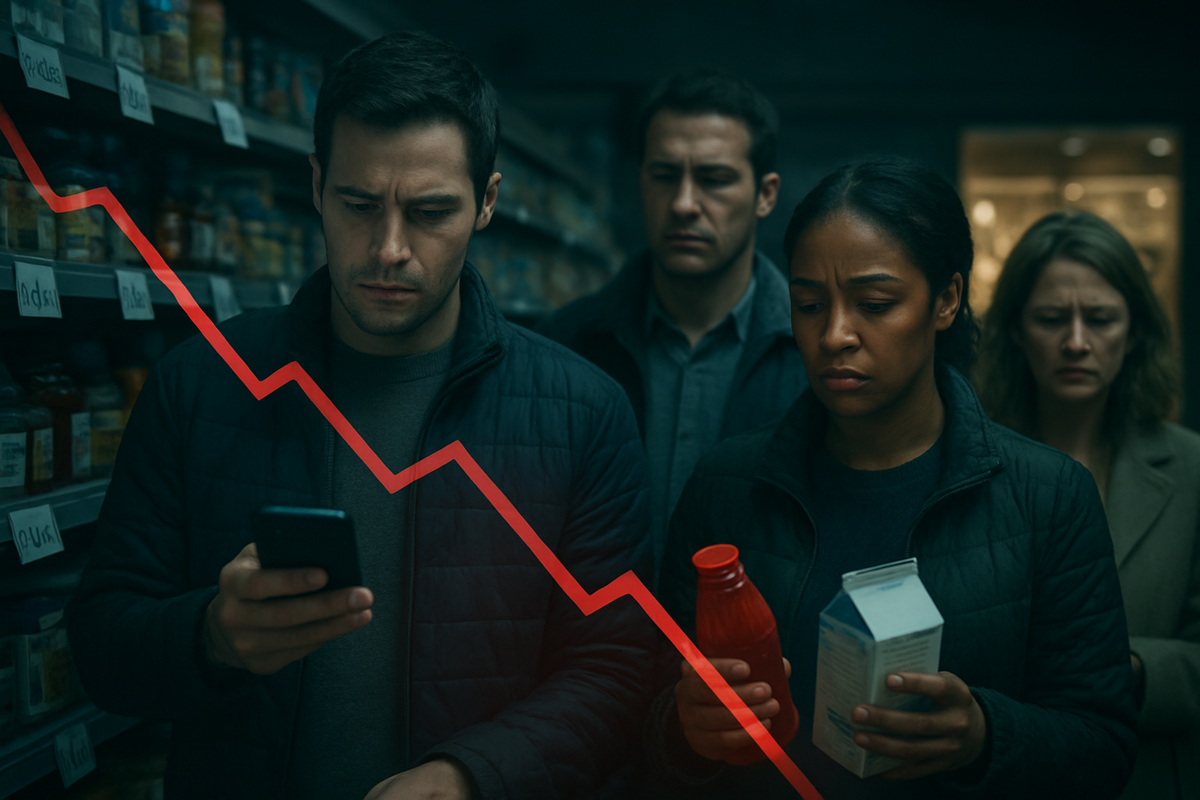
In a startling blow to economic optimism, American consumer sentiment took a sharp dive in January, hitting its lowest point in over a decade. The Conference Board’s latest reading has sent shockwaves through Wall Street, signaling a potentially rocky road ahead for the U.S. economy in 2026. The January Consumer Confidence Index plummeted to 84.5, a staggering drop from the revised December high of 94.2, significantly missing the consensus estimates of economists who had hoped for a stabilization of the post-holiday market.
The immediate implications of this decline are profound. With the "Expectations Index" falling well below the threshold that typically signals an impending recession, the data suggests that the American public is bracing for a sustained period of economic hardship. This sudden shift in sentiment, driven by a volatile cocktail of aggressive trade policies, persistent inflation in essential services, and a fractured political landscape, has forced investors to reconsider the "soft landing" narrative that dominated the close of 2025.
The Perfect Storm: Tariffs, Inflation, and Politics
The collapse of consumer confidence in January 2026 was not a result of a single event, but rather a "perfect storm" of economic pressures that converged at the start of the year. The primary catalyst cited by analysts was the implementation of the "Liberation Day" tariffs—a series of across-the-board duties ranging from 10% to 50% on nearly all imports, specifically targeting key trading partners like China, Mexico, and Canada. The resulting "shelf shock" was felt almost instantly, with consumers reporting price increases of nearly 12% on groceries and automotive parts overnight.
Leading up to this moment, the U.S. economy had been struggling with a 43-day government shutdown at the end of 2025, which created a vacuum of reliable economic data and fostered a sense of systemic instability. While the headline Consumer Price Index (CPI) hovered around a seemingly manageable 2.4%, the "cumulative impact" of soaring costs for non-discretionary items like insurance, healthcare, and housing continued to erode the purchasing power of the middle class. By the time The Conference Board released its January report, the Present Situation Index—a measure of current business and labor conditions—had fallen 9.9 points to 113.7.
The reaction from key stakeholders was swift. Labor advocates pointed to the drop as evidence of a "consumption freeze" among middle-income earners, while industry groups warned that the trade-driven price hikes were alienating "aspirational" buyers. On Wall Street, the S&P 500 and Nasdaq experienced a choppy start to February, as the "sentiment schism" became more pronounced. Interestingly, the data revealed a 50-point confidence gap between Republican-leaning consumers, who remained largely bullish on the new administration's policies, and Democrats and Independents, who increasingly viewed the economy as already being in a recession.
Winners and Losers in a K-Shaped Consumer Landscape
The market's reaction to the confidence hit has created a clear "K-shaped" divide between winners and losers. Among the primary beneficiaries are the discount giants and value-oriented retailers. Walmart Inc. (NYSE: WMT) saw its market capitalization touch a historic $1 trillion in early February as middle-class shoppers "traded down" from premium brands to save on essentials. Similarly, Costco Wholesale Corporation (NASDAQ: COST) and The TJX Companies, Inc. (NYSE: TJX) reported increased foot traffic as consumers sought refuge in bulk buying and off-price apparel.
Conversely, the luxury and discretionary sectors have borne the brunt of the downturn. Target Corporation (NYSE: TGT) has struggled with margin compression as it attempts to balance rising import costs with a customer base that is increasingly price-sensitive. In the automotive and tech sectors, the impact of the new tariff regime is even more visible. Apple Inc. (NASDAQ: AAPL) reported a nearly $900 million quarterly hit due to duties on Chinese-manufactured components, while domestic automakers like Ford Motor Company (NYSE: F) and General Motors Company (NYSE: GM) were punished by investors for their heavy exposure to Mexican import duties on parts and finished vehicles.
The travel sector has seen a mixed bag of results. While "experience-over-possessions" spending has kept companies like Royal Caribbean Cruises Ltd. (NYSE: RCL) and Expedia Group, Inc. (NASDAQ: EXPE) afloat, the lower end of the market is crumbling. The recent secondary bankruptcy filing of Spirit Airlines, Inc. (NYSE: SAVE) underscores the vulnerability of low-cost carriers as middle-income families cut discretionary domestic trips from their budgets. Meanwhile, high-end luxury icons like Ferrari N.V. (NYSE: RACE) have remained resilient, protected by a clientele that remains largely insulated from the cost-of-living crisis.
Broader Significance and Historical Echoes
The January drop fits into a broader trend of "bunker-minded" consumerism that has been brewing since the start of the current trade cycle. This event marks the 12th consecutive month that the Expectations Index has remained below the critical 80-point mark, a historical harbinger of recession. In past cycles, such as the 2008 financial crisis or the 1970s stagflation era, a sustained period of low expectations has almost always preceded a significant contraction in Gross Domestic Product (GDP).
From a policy perspective, the Federal Reserve now finds itself in a precarious "Catch-22." While the central bank may feel pressure to cut interest rates to stimulate a flagging economy, the inflationary pressure from the new tariffs makes such a move risky. This has led to a "policy paralysis" that is further rattling the markets. Furthermore, the ripple effects on international partners cannot be ignored. The retaliatory measures from China and Canada have begun to impact U.S. agricultural exports, creating a secondary wave of economic distress in the Midwest that could further depress national confidence figures in the coming months.
Historically, consumer confidence takes much longer to rebuild than it does to destroy. The current 11-year low mirrors the sentiment levels of May 2014, when the U.S. was still clawing its way back from the Great Recession. The difference today is that the downturn is being driven not by a credit collapse, but by a deliberate shift in trade and fiscal policy, making the path to recovery far more unpredictable for regulators and industry leaders alike.
Looking Ahead: A Long Winter or a Strategic Pivot?
In the short term, the market is looking toward the February and March retail sales data to see if the "consumption freeze" has thawed or deepened. Most analysts expect a period of high volatility as companies report Q1 earnings and provide guidance on how they plan to navigate the tariff-induced "shelf shock." Strategic pivots are already underway; many retailers are expected to increase promotional activity and lean into private-label brands to retain price-conscious customers.
Long-term, the American consumer’s behavior may undergo a fundamental shift. If the Expectations Index does not recover by mid-year, a consumer-led recession in late 2026 becomes a high-probability scenario. This would likely trigger a mass restructuring in the retail and automotive industries, favoring companies with domestic supply chains or those that can leverage AI-driven productivity gains to offset rising costs. Market opportunities may emerge in "defensive" sectors like utilities and healthcare, as investors flee the turbulence of consumer discretionary stocks.
Potential scenarios range from a "stagnation crawl," where the economy avoids a technical recession but grows at a negligible pace, to a more severe "trade-war contraction." The outcome will largely depend on whether the current administration chooses to de-escalate trade tensions or doubles down on the "America First" fiscal agenda. For now, the "wait-and-see" approach adopted by many corporations suggests that the business world is preparing for a "long winter" of suppressed consumer activity.
Summary and Market Outlook
The January drop in consumer confidence to 84.5 is a watershed moment for the 2026 economic outlook. It highlights the extreme sensitivity of the American public to price increases and political instability. The core takeaway is that the "Expectations Index" at 65.1 is screaming recession, and the disconnect between different segments of the population suggests a fractured economy that is becoming increasingly difficult to manage through traditional monetary policy.
Moving forward, the market is likely to remain in a defensive posture. The stellar performance of value-oriented stocks like Walmart and Costco serves as a reminder that even in a downturn, there are winners, but the overall health of the S&P 500 will depend on the resilience of the tech and luxury sectors. Investors should watch for any signs of a "thaw" in trade relations or a stabilization of the political environment as the primary indicators for a sentiment rebound.
The significance of this 11-year low cannot be overstated; it is a clear signal that the era of post-pandemic exuberance has officially ended, replaced by a "bunker-minded" reality. For the coming months, the focus should remain on the "Big Three" drivers: tariffs, inflation, and political stability. Until there is clarity on these fronts, the American consumer is likely to remain on the sidelines, holding their breath and their wallets.
This content is intended for informational purposes only and is not financial advice.