
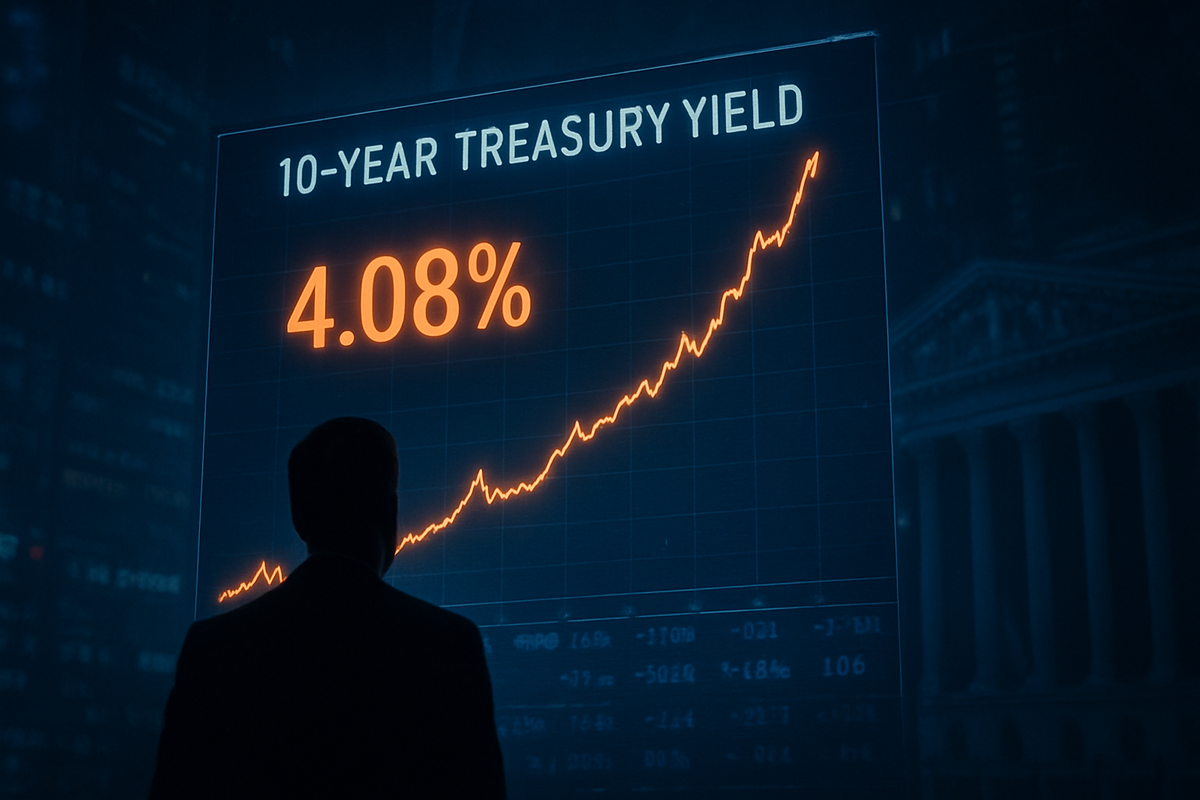
The U.S. Treasury market has been gripped by a sudden wave of volatility this March, as the benchmark 10-year yield decisively broke through the 4.08% threshold, sending a clear signal that the era of "easy money" expectations is firmly in the rearview mirror. This surge, fueled by resilient inflation data and a lackluster $16 billion 20-year bond auction, has reintroduced "valuation gravity" to the equity markets, forcing a painful repricing of high-growth technology stocks that had previously soared on hopes of aggressive Federal Reserve rate cuts.
As of March 12, 2026, the 10-year Treasury yield has continued its upward trajectory, touching 4.27%—its highest level in months. This movement reflects a growing consensus among institutional investors that the Federal Reserve will remain in a "steady today, conditional tomorrow" stance for longer than previously anticipated. The immediate implication is a tightening of financial conditions that is beginning to ripple through everything from mortgage rates to corporate borrowing costs, challenging the optimistic "soft landing" narrative that dominated the start of the year.
A 'Tailing' Auction and the March Yield Spike
The current turmoil was catalyzed by a disastrous $16 billion 20-year bond auction held in late February, the results of which were fully digested by the market in early March 2026. The auction "tailed" significantly, a technical term indicating that the Treasury had to offer a much higher yield than the prevailing market rate to entice buyers. This weak demand served as a "canary in the coal mine," signaling that investors are increasingly wary of locking in long-term rates in an environment where fiscal deficits remain high and inflation remains stubbornly above the Federal Reserve’s 2% target.
Following the auction, a series of hotter-than-expected economic indicators accelerated the sell-off in bonds. Industrial production data released in early March showed surprising strength, while the January Consumer Price Index (CPI) hovered between 2.4% and 2.5%, proving that the final mile of the inflation fight is the hardest. By March 4, the 10-year yield breached the 4.08% psychological barrier, and by mid-month, the selling intensified. The yield curve has undergone a "bear steepening," where long-term rates rise faster than short-term rates, reflecting a market that is pricing in stronger growth but also higher long-term inflation risks.
Key stakeholders, including primary dealers and global pension funds, have been forced to recalibrate their portfolios. The Federal Open Market Committee (FOMC), led by Chair Jerome Powell, has maintained the federal funds rate in the 3.50% to 3.75% range, but the market has effectively "done the Fed's work" by driving up market-based interest rates. This shift has also been exacerbated by political uncertainty, as investors eye the expiration of Chair Powell’s term in May 2026 and the potential nomination of Kevin Warsh as a more hawkish successor.
Winners and Losers in a Rising Rate Regime
The primary casualties of this yield surge have been the "Magnificent Seven" and other high-valuation tech giants. Companies like Nvidia Corp. (NASDAQ: NVDA) and Microsoft Corp. (NASDAQ: MSFT), whose valuations are heavily dependent on discounting future cash flows, have faced significant headwinds. As the 10-year yield climbs, the "discount rate" applied to those future earnings rises, mathematically lowering their present value. Alphabet Inc. (NASDAQ: GOOGL) and other AI-centric firms have similarly seen their price-to-earnings multiples compressed as the "risk-free rate" of a Treasury bond becomes a more attractive alternative to risky equities.
Conversely, the financial sector has emerged as a distinct winner. Large-cap banks, such as JPMorgan Chase & Co. (NYSE: JPM) and Bank of America Corp. (NYSE: BAC), stand to benefit from a steepening yield curve. Higher long-term rates allow these institutions to charge more for loans while keeping deposit costs relatively stable, thereby widening their net interest margins. Shares of these banking giants have shown resilience even as the broader S&P 500 has struggled to find its footing.
Interestingly, small-cap stocks, represented by the Russell 2000 Index, have shown surprising durability. This is partly due to the "One Big Beautiful Bill Act" (OBBBA) of 2025, which provided domestic-oriented companies with significant tax incentives and infrastructure support. Investors appear to be rotating out of expensive mega-cap tech and into these smaller, domestic-focused firms that may be better insulated from global geopolitical tensions and more sensitive to the underlying strength of the U.S. economy.
The Broader Significance: Inflation and Policy Shifts
This volatility is not happening in a vacuum; it fits into a broader trend of "sticky" inflation and shifting fiscal policy. The 2025 OBBBA legislation has pumped significant liquidity into the industrial and manufacturing sectors, which, while boosting GDP, has also kept upward pressure on wages and prices. This creates a paradox for the Federal Reserve: the economy is too strong to justify rate cuts, but the rising cost of servicing the national debt makes high rates increasingly painful for the federal budget.
Historically, periods of "bear steepening" have often preceded shifts in the economic cycle. The current scenario mirrors the late-1990s environment, where strong productivity gains from technology (then the internet, now AI) allowed the economy to run hot without immediate hyperinflation, yet still required higher nominal interest rates. The lackluster demand for the 20-year bond also highlights a growing "term premium"—the extra compensation investors demand for the risk of holding long-term debt—which had been largely absent for the previous decade.
Furthermore, the geopolitical landscape is playing a critical role. Continued tensions in the Middle East have kept energy prices volatile, adding another layer of "cost-push" inflation that the Fed cannot easily control with interest rate hikes alone. This has led to a sense of policy exhaustion, where market participants are no longer looking just at the Fed, but also at the Treasury Department's issuance strategy and the looming leadership change at the central bank.
What Lies Ahead: The Road to the May Transition
In the short term, all eyes are on the FOMC meeting scheduled for March 18, 2026. While no rate change is expected, the "dot plot" and Chair Powell’s press conference will be scrutinized for any shift in tone. If the Fed acknowledges that inflation is becoming "entrenched" at 2.5%, yields could easily push toward the 4.5% mark, further pressuring equity valuations. Strategic pivots will be required for portfolio managers who have been "long duration," as they may need to shift further into short-term "cash-like" instruments or value-oriented sectors.
Looking toward the summer of 2026, the potential transition from Jerome Powell to a new Fed Chair—possibly Kevin Warsh—represents a significant "regime change" risk. A more hawkish leadership could prioritize returning inflation to 2% at any cost, potentially even at the risk of a recession. Conversely, a pivot toward a more flexible inflation target could stabilize yields but at the cost of a weaker dollar. Market opportunities may emerge in "inflation-protected" securities (TIPS) and commodities if the market begins to doubt the Fed's resolve.
A New Anchor for the Global Economy
The surge in Treasury yields to 4.08% and beyond marks a definitive end to the post-pandemic era of extreme monetary accommodation. The market is now grappling with a new reality where capital has a significant cost, and "valuation gravity" is no longer an abstract concept but a daily market force. The failure of the 20-year auction serves as a stark reminder that the market’s appetite for government debt is not infinite, especially when fiscal and monetary policies appear to be at odds.
For investors, the coming months will require a focus on quality and cash flow over speculative growth. The "higher for longer" narrative has transitioned from a warning to a reality, and the decoupling of mega-cap tech from the rest of the market may continue. While the volatility is unsettling, it also represents a normalization of the financial system—a return to a world where yields reflect actual economic risks and rewards. Investors should keep a close watch on the March 18 Fed meeting and any headlines regarding the 2026 Fed Chair nomination, as these will be the primary drivers of the next leg of market movement.
This content is intended for informational purposes only and is not financial advice.