
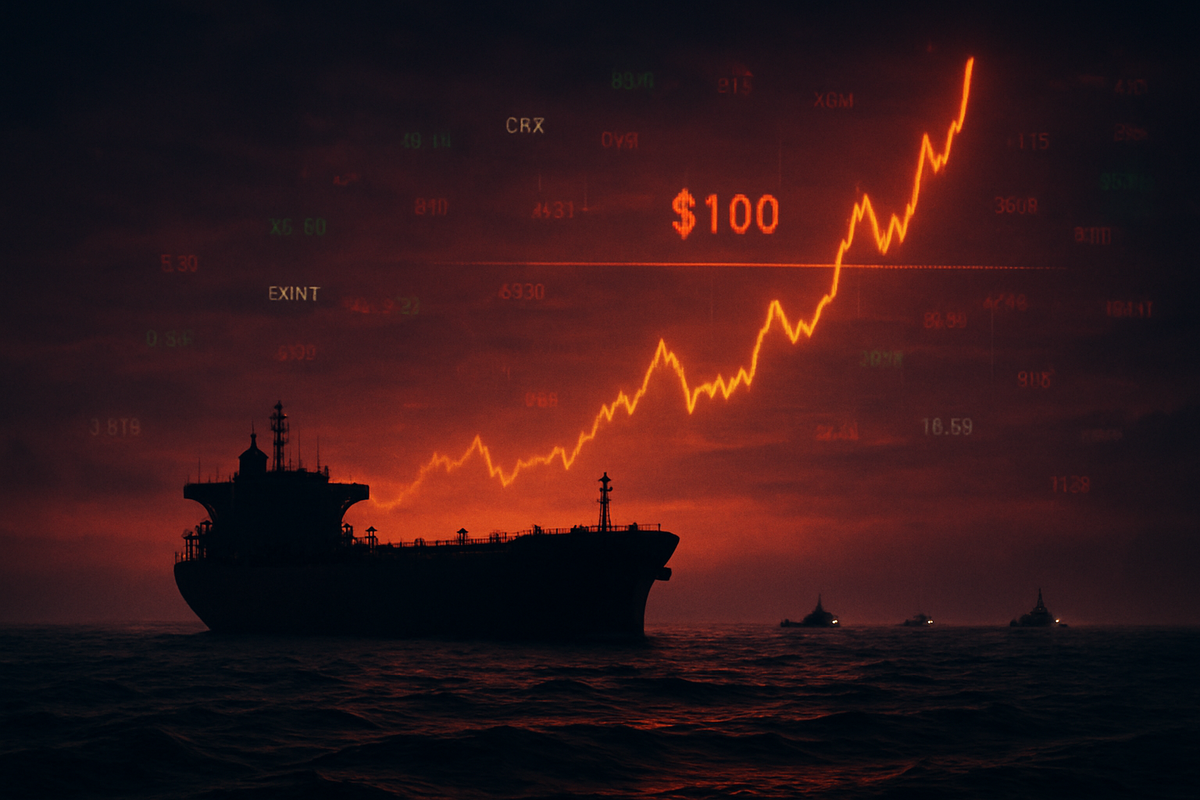
The global energy landscape has been thrust into chaos this week as Brent crude oil prices shattered the $100 per barrel threshold, surging to a two-year high of $111.45. This violent upward move follows the official confirmation of a blockade in the Strait of Hormuz, the world’s most critical maritime chokepoint, effectively severing the flow of nearly 20% of the world’s total petroleum liquids. As of March 13, 2026, the intensifying military conflict between a U.S.-led coalition and Iranian forces has transformed the Persian Gulf into a "no-go zone" for commercial shipping, sparking fears that energy prices could spiral toward $150 per barrel if the impasse is not resolved swiftly.
The immediate implications are nothing short of a "global supply shock" that threatens to derail the fragile economic recovery seen in the early part of the year. With approximately 21 million barrels of oil and roughly 20% of global liquefied natural gas (LNG) trapped behind the blockade, central banks are already recalibrating their inflation forecasts. The sudden scarcity of crude is not just a logistical nightmare for refineries in Asia and Europe; it is a direct tax on the global consumer that has sent shockwaves through equity and bond markets alike, with the S&P 500 experiencing its worst weekly decline since the regional banking crisis of 2023.
Operation Epic Fury and the Siege of the Strait
The crisis reached a tipping point in late February 2026, following the launch of "Operation Epic Fury," a coordinated military campaign by U.S. and Israeli forces aimed at neutralizing Iranian nuclear capabilities and defensive infrastructure. This escalation was the culmination of a tense 14-month period that began with the failure of the 2025 nuclear negotiations and was exacerbated by a series of regional skirmishes throughout the previous year. On March 8, 2026, the Iranian Revolutionary Guard Corps (IRGC) announced the deployment of advanced naval mines and anti-ship missile batteries along the narrowest points of the Strait of Hormuz, effectively daring the West to clear the passage.
The timeline of the current escalation has been rapid. Following the initial strikes on the Fordow and Natanz facilities in mid-2025, the Iranian regime pivoted toward a strategy of "asymmetric economic warfare." By January 2026, reports of harassed tankers had become a weekly occurrence. However, the total blockade established last week represents an unprecedented disruption. Market participants who had priced in a "surplus" for 2026 based on high production from the Americas were caught completely flat-footed. In a matter of days, the narrative shifted from a projected $60 Brent crude average to a fight for survival as Asian markets—which receive over 80% of the oil passing through the Strait—began panic-buying available supplies from West Africa and the North Sea.
Initial market reactions have been characterized by extreme volatility and a "flight to quality." While the International Energy Agency (IEA) and the U.S. Department of Energy have authorized a record-breaking release of 400 million barrels from Strategic Petroleum Reserves (SPR), the move has done little to soothe nerves. Traders recognize that existing pipelines in Saudi Arabia and the UAE can only bypass roughly 4 million barrels per day (mb/d), leaving a massive 16 mb/d deficit that cannot be easily filled.
The Corporate Battlefield: Energy Giants Surge as Transports Bleed
In the wake of the price spike, the equity markets have seen a stark divergence between energy producers and energy consumers. Heavyweight integrated oil companies have seen their valuations soar. Exxon Mobil Corp (NYSE: XOM) and Chevron Corp (NYSE: CVX) both saw their shares jump more than 12% this week, as investors bet on the profitability of their non-Middle Eastern assets. Similarly, ConocoPhillips (NYSE: COP) and Occidental Petroleum (NYSE: OXY) have emerged as significant winners, given their massive footprints in the Permian Basin, which is now being viewed as the primary bulwark against global supply shortages.
Conversely, the transportation and logistics sectors are facing a brutal reality. Major airlines, including Delta Air Lines (NYSE: DAL) and United Airlines Holdings (NASDAQ: UAL), have seen their stock prices crater by nearly 20% as jet fuel costs—already a significant portion of operating expenses—threaten to wipe out annual profit margins. Global logistics firms like FedEx Corp (NYSE: FDX) and United Parcel Service (NYSE: UPS) are also under immense pressure, with analysts predicting a wave of "fuel surcharges" that will likely stifle consumer demand and increase the cost of goods globally.
Interestingly, specialized shipping companies have seen a bifurcated impact. Tanker giants like Frontline plc (NYSE: FRO) are seeing soaring spot rates for vessels available outside the conflict zone, as European and Asian buyers scramble to secure tankers for longer, more expensive routes around the Cape of Good Hope. Meanwhile, the renewable sector has received a renewed "security premium" boost, with companies like First Solar (NASDAQ: FSLR) and Enphase Energy (NASDAQ: ENPH) gaining traction as the strategic necessity for energy independence becomes a national security priority for G7 nations.
The Return of the Inflation Dragon
This event fits into a broader trend of geopolitical fragmentation that has been building since the beginning of the decade. The weaponization of energy flows through the Strait of Hormuz is reminiscent of the 1973 oil embargo, but with the added complexity of a hyper-connected global supply chain. The potential ripple effects extend far beyond the gas pump. Rising energy costs are a primary driver of inflation; the IMF currently estimates that for every 10% sustained increase in oil prices, global inflation rises by approximately 0.4 percentage points. With Brent up 50% from its 2025 lows, the world is staring at a significant inflationary resurgence that could force the Federal Reserve to pause or even reverse its planned interest rate cuts.
Historically, periods of "energy-led" inflation are notoriously difficult to control without triggering a recession. In 1979 and 2008, similar spikes preceded significant economic downturns. Today, the risk is compounded by the high debt levels of many Western nations. Policy implications are already emerging: there is renewed pressure on the U.S. administration to fast-track drilling permits and ease environmental restrictions to boost domestic production. In Europe, the crisis is accelerating the "Fit for 55" energy transition, but the short-term reality is a desperate scramble for coal and any available LNG to prevent industrial shutdowns in Germany and Italy.
The Road to $150: What Comes Next?
In the short term, the market will remain in a state of "high-alert" as military efforts to clear the Strait of Hormuz begin. If the U.S. Navy and its allies can secure a corridor for shipping within the next 30 days, prices may stabilize in the $90 range. However, if the blockade persists or if Iran targets Saudi or Emirati oil infrastructure—specifically the East-West Pipeline or Abqaiq processing facilities—analysts at Goldman Sachs warn that $150 per barrel is not just possible, but likely. Such a scenario would almost certainly trigger a global recession, as consumer spending would be diverted entirely toward heating and transportation.
Market opportunities may emerge for companies specializing in "energy efficiency" and "grid resilience." Long-term, we expect a massive strategic pivot toward nuclear energy and long-duration battery storage as nations realize that relying on the stability of the Persian Gulf is no longer a viable policy. The "energy transition" is no longer just about carbon footprints; it is about national survival. Investors should look for a permanent shift in capital toward domestic energy security and decentralized power systems.
Navigating the New Energy Reality
The key takeaway for investors as of mid-March 2026 is that the "peace dividend" of the early 2020s has officially expired. The blockade of the Strait of Hormuz is a watershed moment that proves global energy security is more fragile than previously assumed. While the initial shock has favored the oil majors, the broader market stability is at risk. A sustained period of $100+ oil will test the resilience of the global economy and likely lead to a period of "stagflation" that hasn't been seen in decades.
Moving forward, the market will be hyper-sensitive to any updates regarding the de-mining of the Strait and the status of regional oil infrastructure. Investors should keep a close watch on the weekly inventory reports and the rhetoric coming from the de facto OPEC+ leaders. The lasting impact of this crisis will likely be a fundamental repricing of geopolitical risk across all asset classes. For now, the world waits to see if diplomacy—or a clear military victory—can reopen the world's most vital artery before the global economy bleeds out.
This content is intended for informational purposes only and is not financial advice.