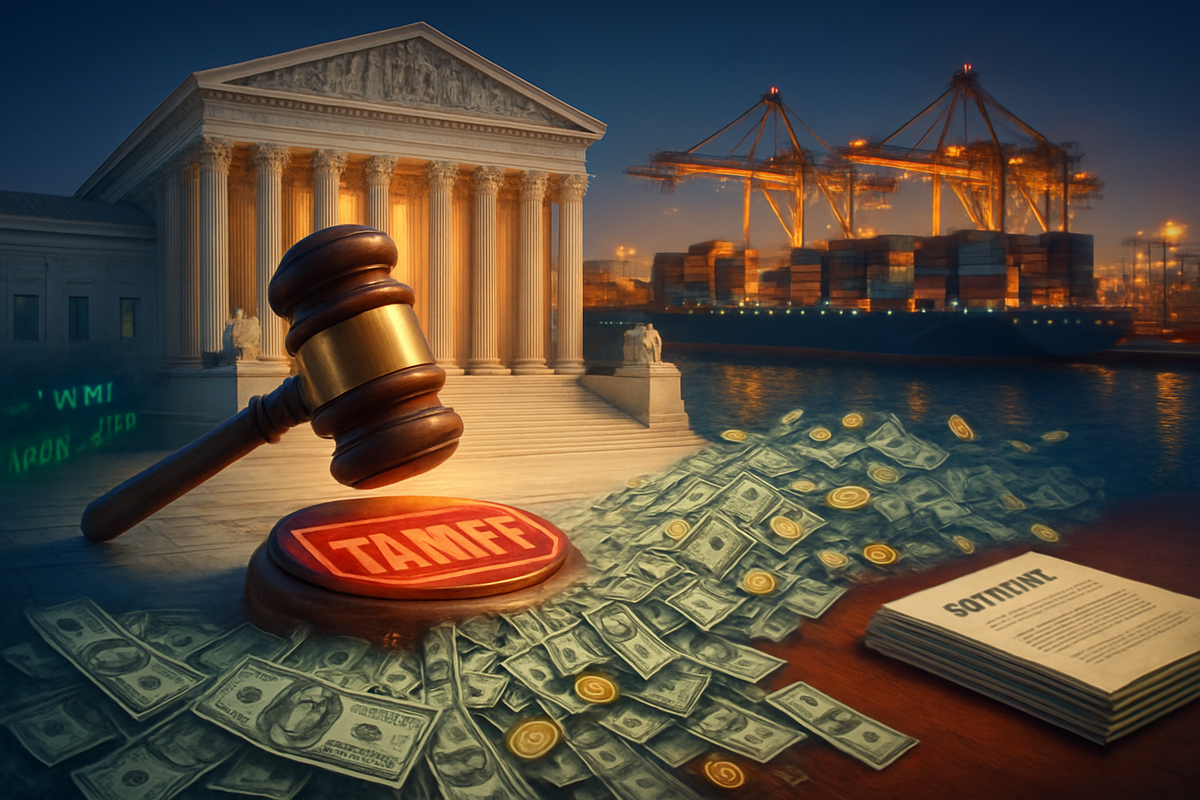
WASHINGTON, D.C. — In a historic blow to executive trade authority, the United States Supreme Court has struck down a series of sweeping tariffs imposed by President Trump, declaring his use of emergency powers to levy import taxes unconstitutional. The decision, handed down on February 20, 2026, has sent shockwaves through global markets and left the U.S. Treasury facing an staggering $175 billion refund liability to thousands of American businesses.
The ruling has triggered an immediate fiscal and regulatory scramble in the capital. While major retailers and tech giants celebrate a massive liquidity windfall, the administration is racing to launch a barrage of new "Section 301" investigations to plug the multi-billion-dollar hole in the federal budget. As of March 13, 2026, the Department of Commerce and the U.S. Trade Representative (USTR) are operating at a breakneck pace to transition the country’s trade protection from invalidated emergency decrees to more durable, sector-specific statutory frameworks.
The Death of the 'Emergency Tariff'
The Supreme Court’s 6–3 decision in the consolidated cases of Learning Resources, Inc. v. Trump and V.O.S. Selections v. United States centered on the International Emergency Economic Powers Act (IEEPA). For over a year, the administration had utilized IEEPA to bypass Congress and impose "reciprocal" tariffs on a wide array of goods. However, the Court’s majority ruled that while the President has broad powers to freeze assets or block transactions during a national emergency, the power to "lay and collect taxes and duties" remains a strictly legislative function under Article I of the Constitution.
Following the High Court’s lead, Senior Judge Richard Eaton of the U.S. Court of International Trade (CIT) issued a nationwide order on March 4, 2026, directing U.S. Customs and Border Protection (CBP) to begin the arduous process of "reliquidation." This process requires the government to refund every cent of the illegally collected duties, plus interest, to more than 330,000 importers of record. Estimates from the Penn Wharton Budget Model and trade analysts suggest the total payout will hit $175 billion—the largest single-event refund in the history of the U.S. government.
The timeline of this legal saga began in early 2025, shortly after the administration’s "Liberation Day" tariffs were first enacted. While the government argued that global trade imbalances constituted a "national emergency" justifying IEEPA's use, the Supreme Court ultimately sided with the plaintiffs, who argued that such a broad interpretation would essentially grant the President "the keys to the nation's checkbook." Market reactions were instantaneous: as the refund order was finalized, the S&P 500's retail sub-sector saw its largest single-day gain in over a decade.
Winners and Losers: A $175 Billion Windfall
The primary beneficiaries of this ruling are the nation’s largest importers, who have effectively been providing an interest-free loan to the federal government for the past 14 months. Walmart (NYSE: WMT) saw its shares surge to record highs following the March 4 order, as analysts estimated the retail giant could be eligible for billions in direct refunds. In fact, the "Refund Rally" helped Walmart become the first traditional retailer to surpass a $1.0 trillion market capitalization. Similarly, Target (NYSE: TGT) and Amazon (NASDAQ: AMZN) are expected to see massive boosts to their bottom lines, with Target already announcing a $2 billion expansion plan fueled by the anticipated refund.
In the technology sector, the impact has been equally profound. Nvidia (NASDAQ: NVDA) and Apple (NASDAQ: AAPL) are poised to reclaim significant capital that had been tied up in import duties for components and finished goods. For Apple, the refund offers a critical cushion as it navigates the transition of its supply chains. However, the victory for these giants is bittersweet; the administration has already signaled that new, legally bulletproof tariffs are on the horizon.
Conversely, domestic producers who thrived under the protective umbrella of the IEEPA tariffs now face a sudden "tariff cliff." Shares of United States Steel (NYSE: X) and Nucor (NYSE: NUE) have faced downward pressure as investors weigh the impact of renewed foreign competition. These companies are now lobbying heavily for the administration to expedite new trade barriers under different legal authorities to prevent a surge of low-cost imports from destabilizing the domestic market.
The Scramble for New Revenue: Section 301 and the 'Super 301' Push
With $175 billion set to leave the Treasury, the federal government is in a desperate search for replacement revenue. Within hours of the Supreme Court ruling, the administration invoked Section 122 of the Trade Act of 1974, which allows for a temporary 150-day import surcharge for balance-of-payments purposes. However, because Section 122 is temporary, the USTR has launched what trade insiders call a "Super 301" offensive—a series of fast-tracked Section 301 investigations targeting 16 major trading partners.
These investigations are designed to target sectors where the U.S. claims foreign "structural excess capacity" is harming domestic industry. Key targets include Electric Vehicles (EVs), semiconductors, and green energy components. This move is a strategic pivot; by using Section 301—the same authority used for the original China tariffs of 2018—the administration hopes to avoid the constitutional pitfalls of the IEEPA-based tariffs. First Solar (NASDAQ: FSLR) and other domestic green-tech firms are expected to be the primary focus of these new investigations, potentially gaining new protections just as the old ones expire.
This regulatory shift mirrors the "HMT Model" from the 1990s, when the Harbor Maintenance Tax was struck down on exports, leading to a decade-long process of litigation and refunds. By reviving this framework, the CIT is attempting to manage the massive volume of claims without paralyzing the federal court system. However, the broader implication is a significant erosion of executive power in trade; future administrations will likely be much more cautious about using "emergency" labels to enact permanent economic policy.
The Road Ahead: Short-Term Relief, Long-Term Volatility
In the short term, the $175 billion refund acts as a massive fiscal stimulus for the private sector. Investors should expect a series of "special dividends" or stock buyback announcements from major importers as the refund checks begin to arrive later this year. However, the administrative burden on CBP is immense, and many smaller companies may wait years before seeing their claims processed.
Long-term, the market must prepare for a more fragmented trade environment. As the administration pivots to Section 301 and Section 232 (National Security) authorities, we are likely to see a "whack-a-mole" approach to trade policy. Instead of broad, across-the-board tariffs, the U.S. will likely employ highly targeted duties on specific technologies and countries. This will require companies to maintain highly flexible supply chains and robust legal teams to navigate a constantly shifting map of trade barriers.
The "July 24 Cliff"—the date the temporary Section 122 surcharges expire—is the next major hurdle for the markets. If the USTR cannot conclude its new Section 301 investigations by then, the U.S. could face a period of zero-tariff trade that would delight consumers but panic domestic manufacturers.
Market Wrap-Up and Investor Outlook
The Supreme Court’s decision marks the end of an era of unprecedented executive overreach in trade policy. While the $175 billion refund is a massive win for retailers like Walmart (NYSE: WMT) and Amazon (NASDAQ: AMZN), it creates a fiscal nightmare for a government already grappling with a widening deficit. The resulting scramble for revenue through Section 301 investigations ensures that trade volatility will remain a permanent fixture of the investment landscape through 2026 and beyond.
For investors, the coming months will be defined by "refund timing" and "investigation outcomes." Companies that can successfully claim their share of the $175 billion "liquidity reservoir" will have a distinct competitive advantage. However, the looming Section 301 probes into semiconductors and EVs mean that tech-heavy portfolios may still face significant headwinds.
The key takeaway is clear: the era of the "unilateral executive tariff" is over, but the trade war has simply entered a new, more legally complex chapter. Watch for the USTR’s preliminary findings in May 2026 as the first indicator of where the new tariff walls will be built.
This content is intended for informational purposes only and is not financial advice.