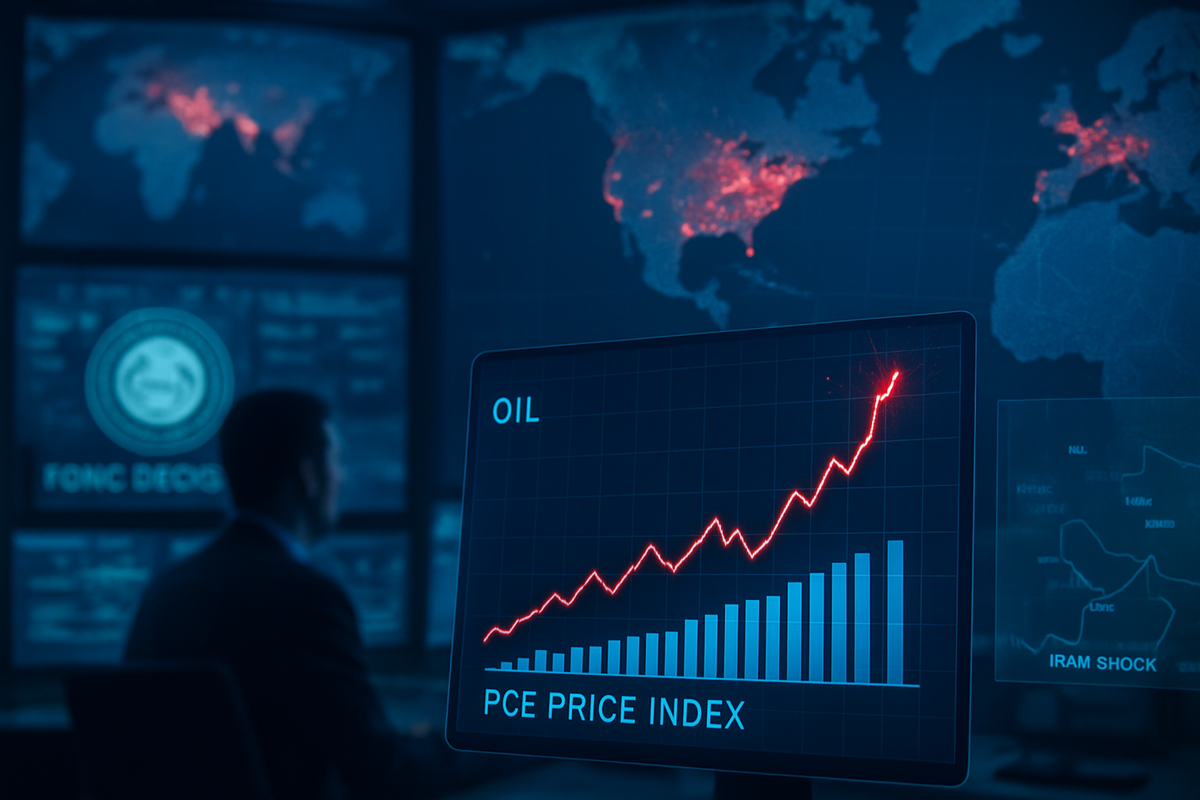
As the Federal Reserve prepares for its high-stakes policy meeting on March 17-18, 2026, all eyes are fixed on the upcoming Personal Consumption Expenditures (PCE) price index report. Following a dramatic and sudden spike in global energy prices—widely dubbed the "Iran Shock"—this specific data point has transformed from a routine economic update into the most critical catalyst for the Fed's next interest rate decision. What was once a steady path toward monetary easing has been derailed by geopolitical volatility, leaving investors and policymakers bracing for a potential reversal in the central bank’s recent strategy.
The surge in energy costs, which saw crude oil jump from $70 to over $120 per barrel in just weeks, threatens to bleed into "core" inflation metrics, complicating the Fed's dual mandate of price stability and maximum employment. With the current benchmark federal funds rate sitting between 3.50% and 3.75%, the market is now pricing in a "hawkish pause" or even a surprise hike if the upcoming PCE figures reflect a secondary wave of price increases across the broader economy.
The Perfect Storm: Geopolitics Meets Sticky Inflation
The current crisis traces its roots to late February 2026, when a series of military strikes against critical infrastructure in the Middle East severely disrupted traffic through the Strait of Hormuz. This chokepoint, responsible for nearly 20% of the world’s oil and liquefied natural gas (LNG) transit, saw a near-total shutdown for several days. The immediate market reaction was a 40% surge in crude prices, which quickly filtered down to American consumers. By mid-March 2026, retail gasoline prices in the U.S. jumped 20%, hitting an average of $3.60 per gallon, while diesel prices spiked by a staggering 25%.
The timeline of events leading to this moment has been a "perfect storm" for the Bureau of Economic Analysis (BEA). Prior to the energy spike, the January 2026 PCE data showed a headline increase of 2.8% year-over-year, while Core PCE—which excludes volatile food and energy—unexpectedly ticked up to 3.1%. This suggested that inflation was already "sticky" even before the geopolitical conflict erupted. Stakeholders, ranging from Wall Street hedge funds to Main Street small business owners, are now hyper-focused on the February report to see if the energy shock has triggered "second-round effects," where transport and production costs force a general hike in the price of services and consumer goods.
Market reactions have been swift and defensive. The bond market saw a sharp sell-off as yields on the 10-year Treasury note climbed toward 4.5%, reflecting fears that the Fed will be forced to keep rates "higher for longer." Equity markets have been characterized by extreme bifurcation, with traditional safe-havens failing to provide cover as the specter of "stagflation"—the combination of stagnant growth and high inflation—re-emerges for the first time in decades.
Winners and Losers in the Energy-Driven Economy
The energy price spike has created a stark divide between corporate winners and losers. The most immediate beneficiaries are the integrated oil and gas giants. Companies like ExxonMobil (NYSE: XOM) and Chevron (NYSE: CVX) have seen their margins expand as global supply tightens, with their stock prices decoupling from the broader indices. These companies are well-positioned to capitalize on the higher price floor, provided the conflict does not escalate to the point of total infrastructure destruction. Additionally, fertilizer producers such as CF Industries (NYSE: CF) and Mosaic Co (NYSE: MOS) may see increased demand and pricing power as natural gas—a key feedstock for nitrogen fertilizers—becomes more expensive and scarce.
Conversely, the logistics and transportation sectors are facing a brutal squeeze. United Parcel Service (NYSE: UPS) and FedEx (NYSE: FDX) are grappling with the 25% surge in diesel costs, forcing them to implement aggressive fuel surcharges that could dampen delivery volumes and erode consumer goodwill. Similarly, the airline industry is under immense pressure; Delta Air Lines (NYSE: DAL) and United Airlines (NYSE: UAL) are seeing their fuel hedges tested, likely leading to higher ticket prices and a potential slowdown in the post-pandemic travel boom that had sustained them through 2025.
Retail giants like Walmart (NYSE: WMT) and Target (NYSE: TGT) also face a double-edged sword. Not only are their supply chain costs rising, but their core customer base—lower and middle-income households—is seeing disposable income swallowed by $4.00-plus gasoline and rising utility bills. If the upcoming PCE report confirms that inflation is broadening, these retailers may face a significant contraction in discretionary spending as consumers pivot strictly to essentials.
Global Ripple Effects and Historical Echoes
The significance of this PCE report lies in how it challenges the prevailing industry narrative of a "soft landing." Throughout 2025, the narrative was that inflation was sustainably returning to the Fed's 2% target, allowing for a gradual reduction in interest rates. However, the "Iran Shock" of early 2026 has reintroduced supply-side volatility that the Fed cannot control with interest rates alone. This event fits into a broader trend of "deglobalization" and geopolitical fragmentation, where energy security is increasingly prioritized over cost efficiency.
The ripple effects extend far beyond the energy sector. A "hawkish pause" or a rate hike from the Fed could lead to a further strengthening of the U.S. Dollar, putting immense pressure on emerging markets that hold dollar-denominated debt. Furthermore, the regulatory environment is likely to shift; there is already renewed talk in Washington D.C. about emergency releases from the Strategic Petroleum Reserve (SPR) and potential windfall taxes on energy producers, echoing the policy debates of the early 1970s and 2022.
Historically, this moment draws comparisons to the 1979 oil crisis, where a supply shock forced a pivot in monetary policy that eventually led to a recession. The Fed is desperate to avoid the mistakes of the 1970s, where they cut rates too early, only to see inflation roar back. The upcoming PCE report will determine if they believe they are facing a temporary "blip" or a fundamental shift in the inflationary regime that requires a return to restrictive policy.
What Comes Next: Scenarios for the Second Half of 2026
In the short term, the market should prepare for extreme volatility following the PCE release. If the data shows that "Core" inflation remains resistant to cooling, the likelihood of a 25-basis-point hike at the March 18 FOMC meeting will skyrocket. Strategically, companies across all sectors will need to adapt by accelerating automation and energy-efficiency initiatives to decouple their operating margins from fossil fuel volatility. This "green pivot" may see renewed investment as a defensive necessity rather than just an ESG goal.
Long-term scenarios are bifurcated. In an optimistic scenario, the energy spike is short-lived, the Strait of Hormuz reopens fully, and the PCE report shows that inflation expectations remain anchored. In this case, the Fed may maintain its pause and eventually resume its cutting cycle by late 2026. However, a more dire scenario involves "second-round effects" taking hold, where labor unions demand higher wages to keep up with energy costs, creating a wage-price spiral that forces the Fed to push interest rates toward 5% or higher, almost certainly triggering a recession by 2027.
Market opportunities may emerge in the renewable energy and nuclear power sectors, as the volatility of the 2026 energy market highlights the risks of over-reliance on Middle Eastern oil. Investors will be watching for companies that can maintain pricing power in a high-inflation environment, often referred to as "quality" stocks with low debt and high margins.
Conclusion: Watching the Data for the Turning Point
The upcoming PCE report is more than just a data release; it is the definitive verdict on the Federal Reserve’s "wait-and-see" approach in the face of a geopolitical crisis. The key takeaways for investors are clear: headline inflation is expected to surge toward 3.5%, but the real danger lies in the Core PCE figures. If underlying inflation does not show signs of stabilization, the era of easy money—and the hope for lower mortgage and credit card rates—will remain a distant memory for the foreseeable future.
Moving forward, the market will be characterized by a "risk-off" sentiment until there is clarity on the duration of the energy shock and the Fed's willingness to tolerate a slowdown in GDP to fight inflation. Investors should watch for the divergence between headline and core data; a wide gap suggests a temporary shock, while a narrowing gap with both figures rising suggests a systemic problem. In the coming months, the resilience of the American consumer and the stability of global energy transit routes will be the two most important factors determining the health of the financial markets.
This content is intended for informational purposes only and is not financial advice.