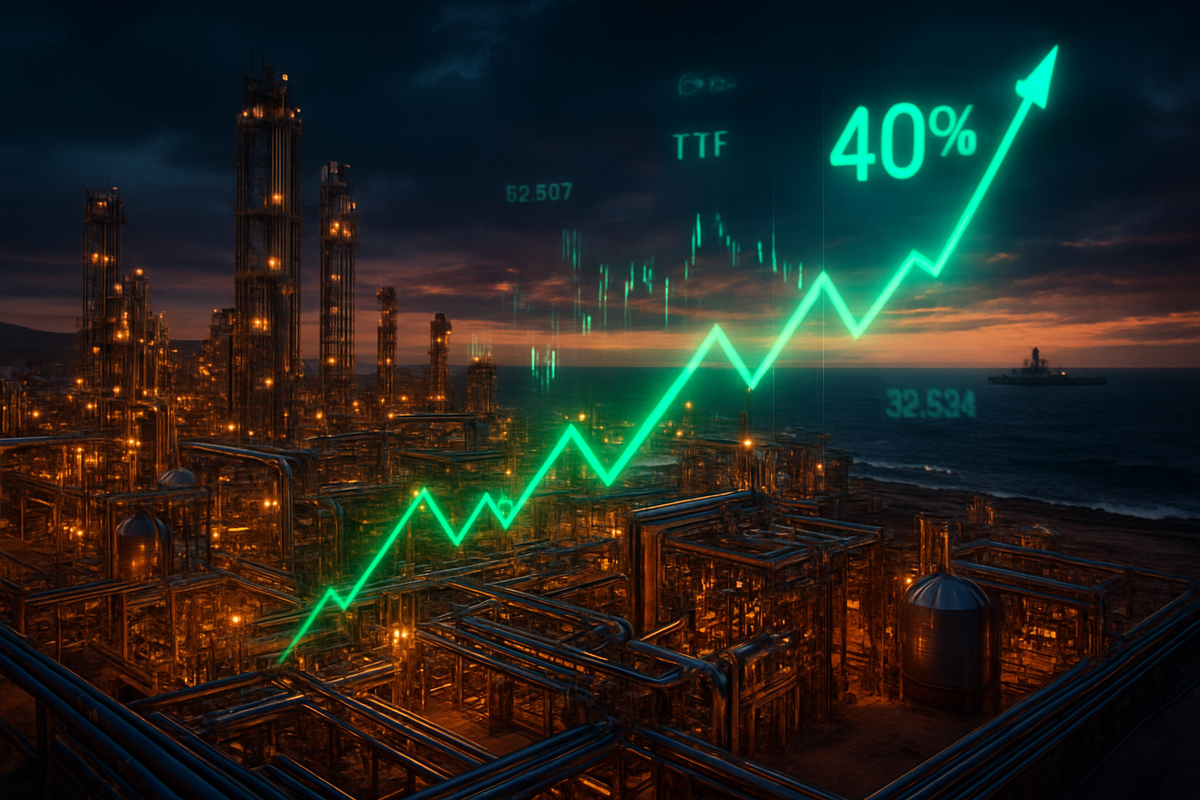
The global energy landscape was thrust into a state of high alert this week as QatarEnergy, the world’s leading exporter of liquefied natural gas (LNG), announced a total production halt at its crown jewel, the Ras Laffan Industrial City. The suspension, a direct consequence of a dramatic military escalation in the Middle East, sent shockwaves through the European energy markets. The Dutch Title Transfer Facility (TTF) front-month contracts—the benchmark for European gas—surged by a staggering 38% to 40% in a single trading session, as traders moved to price in the loss of nearly a fifth of the world’s LNG supply.
The immediate implications are dire for a European continent already struggling with depleted storage levels at the end of a long winter. With the Strait of Hormuz effectively closed to commercial traffic and Qatari facilities reporting physical damage from retaliatory strikes, the "security premium" on natural gas has returned with a vengeance. Analysts warn that if the disruption persists for more than two weeks, the resulting bidding war for Atlantic Basin cargoes could push European and Asian energy prices to levels not seen since the peak of the 2022 energy crisis.
Conflict at the Chokepoint: The Halt of Ras Laffan
The crisis began in earnest on February 28, 2026, following a coordinated military operation by U.S. and Israeli forces against strategic targets. The subsequent retaliation on March 1 and 2 saw a wave of drone and missile strikes across the Persian Gulf, specifically targeting critical energy infrastructure. By the morning of March 2, 2026, QatarEnergy officially confirmed that its massive LNG production and export hub at Ras Laffan Industrial City had sustained damage and would cease all operations for the safety of its personnel and assets.
By March 4, QatarEnergy took the extraordinary step of declaring force majeure on its global LNG shipments. This legal declaration, which allows a company to suspend contractual obligations due to "acts of God" or war, effectively paralyzed the delivery of approximately 77 to 82 million tonnes per annum (MTPA) of gas. The timing could not be worse; the Strait of Hormuz—the vital maritime artery through which Qatari and Emirati LNG must pass—was declared a "no-go zone" by the Iranian Revolutionary Guard Corps (IRGC), leading maritime insurers to cancel war-risk coverage for the region.
Initial market reactions were nothing short of chaotic. As news of the Ras Laffan shutdown reached trading floors in Amsterdam and London, the TTF front-month futures jumped from €32/MWh to over €45/MWh in hours. By the end of the week, prices had peaked at over €52/MWh, a total gain of nearly 54% from pre-escalation levels. This volatility reflects a market that has suddenly lost its primary buffer against supply shocks, leaving European utilities scrambling to secure alternative volumes from an already tight global market.
Winners and Losers: A Bifurcated Market
The sudden removal of Qatari supply has created a sharp divide between energy producers with assets outside the conflict zone and the energy-intensive industries that rely on cheap gas. Equinor ASA (NYSE: EQNR) has emerged as the primary "winner" in this crisis. As Norway’s state-backed energy giant and Europe’s largest remaining pipeline gas provider, Equinor's shares surged over 10% this week. Its supply, which flows via undersea pipelines directly to the UK and Continental Europe, carries a zero-risk profile regarding the Middle East, making it the continent's most prized energy asset.
In the United States, Cheniere Energy, Inc. (NYSE: LNG) and Venture Global LNG are reaping the rewards of their geographical insulation. Cheniere’s stock rose 6% as markets anticipated higher utilization of its export terminals. Venture Global, which sells a significant portion of its volumes on the spot market rather than through long-term contracts, saw its valuation jump nearly 20% as it captured the massive spread between U.S. Henry Hub prices and the spiking European TTF.
Conversely, the "Supermajors" partnered with Qatar face a complex financial hit. Exxon Mobil Corporation (NYSE: XOM), Shell PLC (NYSE: SHEL), TotalEnergies SE (NYSE: TTE), ConocoPhillips (NYSE: COP), and Eni S.p.A. (NYSE: E) all hold multi-billion dollar stakes in Qatar’s North Field expansion projects. While higher global oil prices (with Brent crude spiking toward $85/bbl) provide some hedge, the loss of high-margin LNG equity volumes and the potential multi-month delay of the North Field West expansion are major headwinds. ExxonMobil and QatarEnergy’s joint venture in the U.S., the Golden Pass LNG facility, is also facing logistical uncertainties just as it was nearing its 2026 startup date.
The hardest-hit sector, however, is European heavy industry. Chemical giant BASF SE (ETR: BAS) and fertilizer producer Yara International ASA (OTC: YARIY) are facing an existential threat from the price spike. BASF reportedly needs a 5% price increase on its entire product catalog just to offset the energy cost surge, while Yara remains largely unhedged for its 2026 gas needs. In the steel sector, ArcelorMittal (NYSE: MT) and ThyssenKrupp AG (ETR: TKA) have already begun withdrawing price offers for cold-rolled coil steel, citing "incalculable" energy costs that make production unsustainable.
Wider Significance: The End of the LNG "Safety Net"
This event marks a fundamental shift in the global energy security narrative. For the past four years, the European Union has congratulated itself on pivoting away from Russian pipeline gas toward a diversified LNG strategy, with Qatar and the U.S. as the twin pillars of that security. The March 2026 crisis has exposed the "Achilles' heel" of this strategy: the extreme vulnerability of maritime chokepoints. Unlike pipelines, which are static and often buried, LNG relies on a fragile chain of liquefaction plants and vulnerable shipping lanes.
The ripple effects are already being felt in policy circles. The European Commission has reactivated its "Energy Task Force," but the reality is that options are limited. European gas storage is currently at a precarious 30% capacity, far below the 54% average for this time of year. This leaves the EU with little choice but to enter a bidding war with Asian nations like India and China, the former of which relies on Qatar for 45% of its LNG imports and has already issued warnings of industrial gas rationing.
Historically, this event draws parallels to the 1973 oil embargo, but with a modern, high-tech twist. The use of precision drones to disable a facility as advanced as Ras Laffan suggests that the "energy weapon" has evolved. Regulators are now forced to reconsider the pace of the energy transition; while the crisis accelerates the argument for renewables, it also highlights the immediate, desperate need for stable baseload power that the current green infrastructure cannot yet provide.
What Comes Next: A Precarious Spring
In the short term, the market will remain in a state of "extreme backwardation," where current prices are significantly higher than future expectations, reflecting the immediate physical shortage. Investors should prepare for a period of intense volatility as every update from the Strait of Hormuz dictates the day's trading. If the Strait remains closed through April, we may see the first instances of mandatory industrial gas curtailments in Germany and Northern Italy since the winter of 2022.
Strategically, this crisis will likely trigger a massive acceleration of "de-risking" in energy portfolios. We can expect a wave of new investment into Atlantic Basin projects that bypass the Middle East entirely, such as expanded export capacity in the U.S. Gulf Coast and offshore projects in West Africa. However, these solutions are years away. For 2026, the primary pivot will be toward Azerbaijan’s Southern Gas Corridor, with the EU likely offering long-term contracts to any producer capable of delivering gas via pipeline.
The most likely scenario for the next three months is a "high-plateau" price environment. Even if a ceasefire is brokered tomorrow, the physical damage to the Ras Laffan trains and the backlog of shipping will take months to clear. Market opportunities may emerge for specialized service providers like Baker Hughes (NASDAQ: BKR) or Halliburton (NYSE: HAL), who will be called upon to repair and harden the damaged infrastructure in Qatar once the smoke clears.
Market Wrap-Up and Investor Outlook
The March 2026 Qatar LNG halt is a sobering reminder that the global energy transition remains tethered to the geopolitical stability of a few key regions. The 40% spike in TTF prices is not merely a "blip" but a structural repricing of risk for the entire European economy. Key takeaways for the coming weeks include:
- Diversification is King: Companies like Equinor (NYSE: EQNR) that offer geopolitical safety are currently the most defensive plays in the energy sector.
- Industrial Vulnerability: Avoid unhedged European industrials like Yara (OTC: YARIY) and Lanxess (ETR: LXS) until gas prices stabilize or a clear government subsidy plan is announced.
- US LNG Dominance: The U.S. export sector, led by Cheniere (NYSE: LNG), has solidified its role as the world’s "lender of last resort" for natural gas.
Moving forward, investors should watch for the status of the Strait of Hormuz and any signs of the conflict spreading to Saudi or Emirati energy hubs. If the disruption extends into the summer filling season, the "winter of 2026" could become a period of unprecedented economic hardship for the Eurozone. For now, the energy market is holding its breath, waiting to see if diplomacy can reopen the valves before the storage tanks run dry.
This content is intended for informational purposes only and is not financial advice.