Date: December 29, 2025
Sector: Energy / Land & Royalty
Exchange: NYSE: TPL
Introduction
As of late 2025, Texas Pacific Land Corporation (NYSE: TPL) stands as one of the most unique and profitable entities in the American equity markets. Often referred to as the "Landlord of the Permian," TPL owns approximately 882,000 surface acres and 207,000 net royalty acres in West Texas. While it is categorized within the energy sector, TPL is not an oil producer; rather, it is a high-margin royalty and infrastructure vehicle. In 2025, the company has dominated headlines not just for its record-breaking royalty production, but for its bold strategic pivot into AI data centers and industrial water desalination, proving that its century-old land holdings are as relevant to the "Digital Age" as they were to the "Oil Age."
Historical Background
TPL’s origins are among the most storied in American financial history. The company was born from the 1888 bankruptcy of the Texas and Pacific Railway. To satisfy bondholders, a massive tract of land—roughly 3.5 million acres—was placed into a liquidating trust. For over 130 years, the Texas Pacific Land Trust functioned by slowly selling off land and distributing the proceeds to "certificate holders."
However, the shale revolution in the 21st century transformed these "worthless" West Texas scrublands into some of the most valuable real estate on the planet. This culminated in the trust’s 2021 conversion into a Delaware C-Corporation, a move designed to modernize governance, attract institutional capital, and provide more flexibility for strategic growth—a transformation that has been fully realized as of late 2025.
Business Model
TPL operates an asset-light, high-margin business model centered on three primary revenue streams:
- Oil and Gas Royalties: TPL collects a "top-line" percentage of production from operators (like ExxonMobil and Diamondback Energy) drilling on its land. TPL pays zero drilling or capital costs (CapEx), making this essentially 100% margin revenue.
- Water Services and Operations (TPWR): Through its subsidiary, Texas Pacific Water Resources, the company provides full-cycle water solutions, including sourcing, gathering, treatment, and disposal. This segment has become a cornerstone of TPL's growth.
- Surface Leases and Easements (SLEM): TPL charges for the right to lay pipelines, power lines, and build infrastructure across its land. This segment is now expanding into renewable energy and data center leases.
Stock Performance Overview
The performance of TPL has been nothing short of legendary for long-term holders.
- 1-Year Performance: TPL outpaced the broader energy sector in 2025, buoyed by the 3-for-1 stock split in December and the announcement of its AI data center venture.
- 5-Year Performance: Since its conversion to a C-Corp in 2021, the stock has multiplied in value, reflecting its inclusion in the S&P 500 and its status as a "Permian Pure Play."
- 10-Year Performance: Over the past decade, TPL has consistently outperformed the S&P 500 and the XLE (Energy ETF), driven by the compounding nature of its zero-debt, high-cash-flow model.
Following the December 22, 2025, stock split, shares began trading in a more accessible range of $285–$300, significantly increasing liquidity for retail investors.
Financial Performance
Financial results for the fiscal year 2025 highlight TPL’s extraordinary efficiency:
- Revenue: Q3 2025 saw record revenues of $203.1 million.
- Margins: The company maintains an Adjusted EBITDA margin of 85%, a figure nearly unheard of in the traditional energy sector.
- Balance Sheet: TPL remains a fortress with $532 million in cash and zero debt.
- Capital Allocation: In October 2025, the company secured a $500 million revolving credit facility, signaling a readiness for larger-scale M&A in the Midland and Delaware Basins.
Leadership and Management
Led by CEO Tyler Glover, TPL’s management team has shifted from a passive stewardship model to an active growth strategy. Glover has been instrumental in professionalizing the corporate structure and resolving long-standing litigation with major shareholders like Horizon Kinetics.
In late 2025, the company completed its board declassification, meaning all directors are now elected annually. This "governance modernization" has removed a significant overhang on the stock, satisfying institutional demands for better shareholder alignment and proxy access.
Products, Services, and Innovations
TPL is no longer just a "land trust." Key innovations in 2025 include:
- Produced Water Desalination: TPL is completing its Orla Desalination Facility, which treats "produced water" (a byproduct of fracking) for industrial use. This solves a major environmental challenge while creating a new revenue stream.
- AI Data Center Hubs: In December 2025, TPL partnered with Bolt Data & Energy to develop AI campuses. TPL provides the land and water rights, positioning itself as a critical player in the power-hungry AI revolution.
Competitive Landscape
TPL’s primary "competitors" are other royalty companies like Viper Energy (NASDAQ: VNOM) or Kimbell Royalty Partners (NYSE: KRP). However, TPL is unique because of its surface ownership. While most royalty companies only own the minerals, TPL’s surface ownership allows it to control the entire ecosystem of the Permian—from the water used in drilling to the pipelines that carry the oil away. This "landlord" status gives it an insurmountable competitive moat.
Industry and Market Trends
- Permian Maturity: As the Permian Basin enters a more "mature" phase, operators are focusing on efficiency. TPL benefits from this as large-scale operators (Chevron, Occidental) consolidate acreage and increase lateral drilling lengths, which often cross TPL’s vast land tracts.
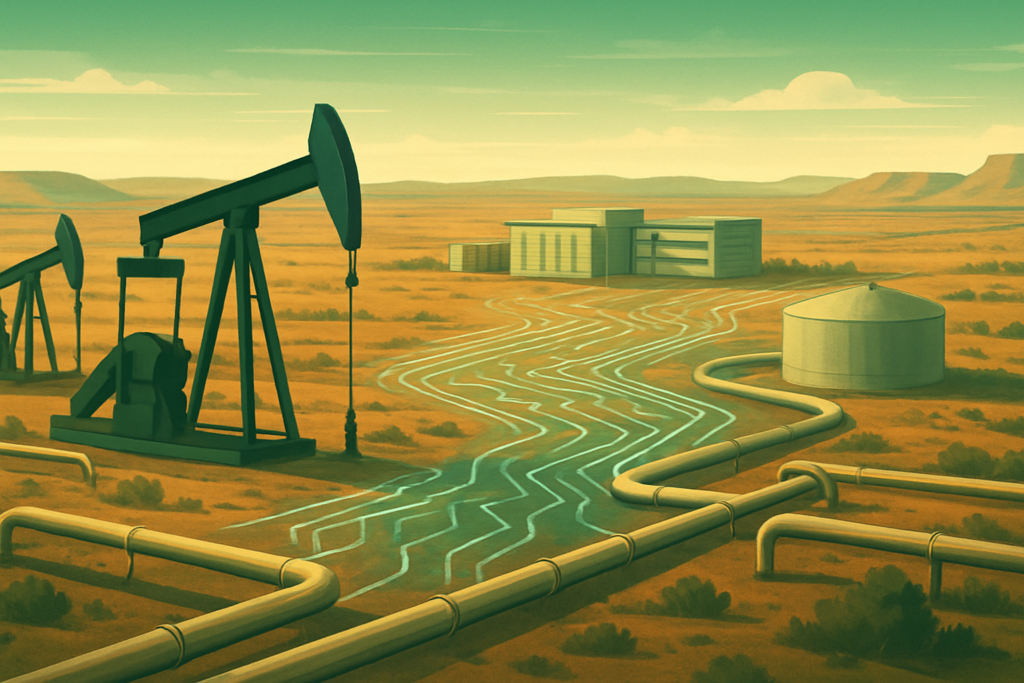
- The Energy-Water-Data Nexus: The convergence of energy production, water management, and high-performance computing (AI) is the dominant trend of 2025. TPL sits exactly at the intersection of these three sectors.
Risks and Challenges
- Commodity Price Volatility: While TPL has no CapEx, its royalty checks are smaller when oil and gas prices fall.
- Regulatory Scrutiny: Increased Texas or Federal regulation regarding water disposal and seismic activity (earthquakes) in the Permian could impact the Water Services segment.
- Concentration Risk: TPL’s fortunes are tied exclusively to the Permian Basin. Any regional downturn would disproportionately affect the company.
Opportunities and Catalysts
- M&A Activity: The $505 million Midland Basin acquisition in late 2025 proves TPL is willing to use its cash to expand its footprint.
- Energy Exports: Continued growth in Gulf Coast LNG and oil exports keeps the Permian active, ensuring a steady stream of royalty production for TPL.
- Monetization of Surface Rights: Solar, wind, and data center leases represent high-margin revenue that is completely independent of oil prices.
Investor Sentiment and Analyst Coverage
Investor sentiment turned overwhelmingly bullish in late 2024 and 2025 as the company resolved its internal governance battles. Wall Street analysts have increasingly re-rated TPL as a "Tech-Infrastructure" play rather than just a "Royalty" play. Institutional ownership remains high, with major positions held by Horizon Kinetics and passive index funds following its S&P 500 inclusion.
Regulatory, Policy, and Geopolitical Factors
In 2025, Texas remains the most pro-energy jurisdiction in the U.S., shielding TPL from much of the regulatory friction seen in other basins. Geopolitically, the continued reliance on U.S. shale to stabilize global energy markets ensures that the Permian Basin—and by extension, TPL—remains a strategic national asset.
Conclusion
Texas Pacific Land Corporation (NYSE: TPL) is a 19th-century land trust that has successfully reinvented itself for the 21st century. With a bulletproof balance sheet, industry-leading margins, and a new strategic focus on the AI-Energy nexus, TPL is much more than an oil play; it is a play on the very geography of American industrial productivity. While commodity price sensitivity remains a factor, TPL’s evolution into an infrastructure and technology enabler suggests it will remain a cornerstone of the Permian Basin for decades to come.
This content is intended for informational purposes only and is not financial advice.