
SAN FRANCISCO — January 16, 2026 — In a move that has sent shockwaves through both Silicon Valley and the global labor market, OpenAI has officially completed the global rollout of its most advanced model to date: GPT-5.2. Representing a fundamental departure from the "chatbot" paradigm of years past, GPT-5.2 introduces a revolutionary "Thinking" architecture that prioritizes reasoning over raw speed. The launch marks a decisive moment in the race for Artificial General Intelligence (AGI), as the model has reportedly achieved a staggering 70.9% win-or-tie rate against seasoned human professionals on the newly minted GDPval benchmark—a metric designed specifically to measure the economic utility of AI in professional environments.
The immediate significance of this launch cannot be overstated. By shifting from a "System 1" intuitive response model to a "System 2" deliberate reasoning process, OpenAI has effectively transitioned the AI industry from simple conversational assistance to complex, delegative agency. For the first time, enterprises are beginning to treat large language models not merely as creative assistants, but as cognitive peers capable of handling professional-grade tasks with a level of accuracy and speed that was previously the sole domain of human experts.
The 'Thinking' Architecture: A Deep Dive into System 2 Reasoning
The core of GPT-5.2 is built upon what OpenAI engineers call the "Thinking" architecture, an evolution of the "inference-time compute" experiments first seen in the "o1" series. Unlike its predecessors, which generated text token-by-token in a linear fashion, GPT-5.2 utilizes a "hidden thought" mechanism. Before producing a single word of output, the model generates internal "thought tokens"—abstract vector states where the model plans its response, deconstructs complex tasks, and performs internal self-correction. This process allows the model to "pause" and deliberate on high-stakes queries, effectively mimicking the human cognitive process of slow, careful thought.
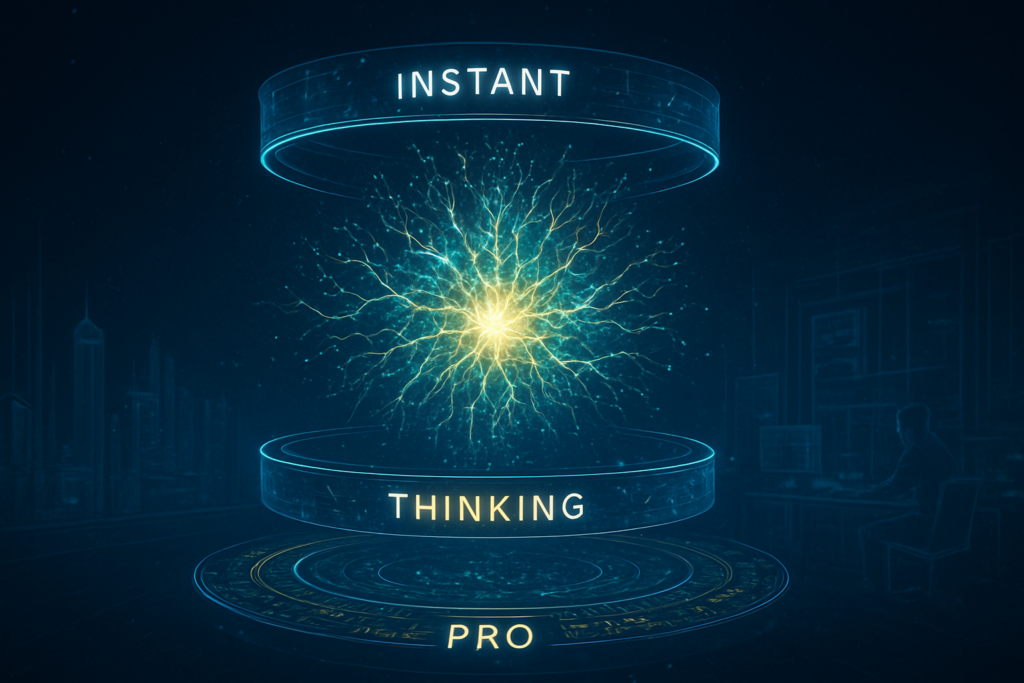
OpenAI has structured this capability into three specialized tiers to optimize for different user needs:
- Instant: Optimized for sub-second latency and routine tasks, utilizing a "fast-path" bypass of the reasoning layers.
- Thinking: The flagship professional tier, designed for deep reasoning and complex problem-solving. This tier powered the 70.9% GDPval performance.
- Pro: A high-end researcher tier priced at $200 per month, which utilizes parallel Monte Carlo tree searches to explore dozens of potential solution paths simultaneously, achieving near-perfect scores on advanced engineering and mathematics benchmarks.
This architectural shift has drawn both praise and scrutiny from the research community. While many celebrate the leap in reliability—GPT-5.2 boasts a 98.7% success rate in tool-use benchmarks—others, including noted AI researcher François Chollet, have raised concerns over the "Opacity Crisis." Because the model’s internal reasoning occurs within hidden, non-textual vector states, users cannot verify how the AI reached its conclusions. This "black box" of deliberation makes auditing for bias or logic errors significantly more difficult than in previous "chain-of-thought" models where the reasoning was visible in plain text.
Market Shakedown: Microsoft, Google, and the Battle for Agentic Supremacy
The release of GPT-5.2 has immediately reshaped the competitive landscape for the world's most valuable technology companies. Microsoft Corp. (NASDAQ: MSFT), OpenAI’s primary partner, has already integrated GPT-5.2 into its 365 Copilot suite, rebranding Windows 11 as an "Agentic OS." This update allows the model to act as a proactive system administrator, managing files and workflows with minimal user intervention. However, tensions have emerged as OpenAI continues its transition toward a public benefit corporation, potentially complicating the long-standing financial ties between the two entities.
Meanwhile, Alphabet Inc. (NASDAQ: GOOGL) remains a formidable challenger. Despite OpenAI's technical achievement, many analysts believe Google currently holds the edge in consumer reach due to its massive integration with Apple devices and the launch of its own "Gemini 3 Deep Think" model. Google's hardware advantage—utilizing its proprietary TPUs (Tensor Processing Units)—allows it to offer similar reasoning capabilities at a scale that OpenAI still struggles to match. Furthermore, the semiconductor giant NVIDIA (NASDAQ: NVDA) continues to benefit from this "compute arms race," with its market capitalization soaring past $5 trillion as demand for Blackwell-series chips spikes to support GPT-5.2's massive inference-time requirements.
The disruption is not limited to the "Big Three." Startups and specialized AI labs are finding themselves at a crossroads. OpenAI’s strategic $10 billion deal with Cerebras to diversify its compute supply chain suggests a move toward vertical integration that could threaten smaller players. As GPT-5.2 begins to automate well-specified tasks across 44 different occupations, specialized AI services that don't offer deep reasoning may find themselves obsolete in an environment where "proactive agency" is the new baseline for software.
The GDPval Benchmark and the Shift Toward Economic Utility
Perhaps the most significant aspect of the GPT-5.2 launch is the introduction and performance on the GDPval benchmark. Moving away from academic benchmarks like the MMLU, GDPval consists of 1,320 tasks across 44 professional occupations, including software engineering, legal discovery, and financial analysis. The tasks are judged "blind" by industry experts against work produced by human professionals with an average of 14 years of experience. GPT-5.2's 70.9% win-or-tie rate suggests that AI is no longer just "simulating" intelligence but is delivering economic value that is indistinguishable from, or superior to, human output in specific domains.
This breakthrough has reignited the global conversation regarding the "AI Landscape." We are witnessing a transition from the "Chatbot Era" to the "Agentic Era." However, this shift is not without controversy. OpenAI’s decision to introduce a "Verified User" tier—colloquially known as "Adult Mode"—marked a significant policy reversal intended to compete with xAI’s less-censored models. This move has sparked fierce debate among ethicists regarding the safety and moderation of high-reasoning models that can now generate increasingly realistic and potentially harmful content with minimal oversight.
Furthermore, the rise of "Sovereign AI" has become a defining trend of early 2026. Nations like India and Saudi Arabia are investing billions into domestic AI stacks to ensure they are not solely dependent on U.S.-based labs like OpenAI. The GPT-5.2 release has accelerated this trend, as corporations and governments alike seek to run these powerful "Thinking" models on private, air-gapped infrastructure to avoid vendor lock-in and ensure data residency.
Looking Ahead: The Rise of the AI 'Sentinel'
As we look toward the remainder of 2026, the focus is shifting from what AI can say to what AI can do. Industry experts predict the rise of the "AI Sentinel"—proactive agents that don't just wait for prompts but actively monitor and repair software repositories, manage supply chains, and conduct scientific research in real-time. With the widespread adoption of the Model Context Protocol (MCP), these agents are becoming increasingly interoperable, allowing them to navigate across different enterprise data sources with ease.
The next major challenge for OpenAI and its competitors will be "verification." As these models become more autonomous, developing robust frameworks to audit their "hidden thoughts" will be paramount. Experts predict that by the end of 2026, roughly 40% of enterprise applications will have some form of embedded autonomous agent. The question remains whether our legal and regulatory frameworks can keep pace with a model that can perform professional tasks 11 times faster and at less than 1% of the cost of a human expert.
A Watershed Moment in the History of Intelligence
The global launch of GPT-5.2 is more than just a software update; it is a milestone in the history of artificial intelligence that confirms the trajectory toward AGI. By successfully implementing a "Thinking" architecture and proving its worth on the GDPval benchmark, OpenAI has set a new standard for what "professional-grade" AI looks like. The transition from fast, intuitive chat to slow, deliberate reasoning marks the end of the AI's infancy and the beginning of its role as a primary driver of economic productivity.
In the coming weeks, the world will be watching closely as the "Pro" tier begins to trickle out to high-stakes researchers and the first wave of "Agentic OS" updates hit consumer devices. Whether GPT-5.2 will maintain its lead or be eclipsed by Google's hardware-backed ecosystem remains to be seen. What is certain, however, is that the bar for human-AI collaboration has been permanently raised. The "Thinking" era has arrived, and the global economy will never be the same.
This content is intended for informational purposes only and represents analysis of current AI developments.
TokenRing AI delivers enterprise-grade solutions for multi-agent AI workflow orchestration, AI-powered development tools, and seamless remote collaboration platforms.
For more information, visit https://www.tokenring.ai/.