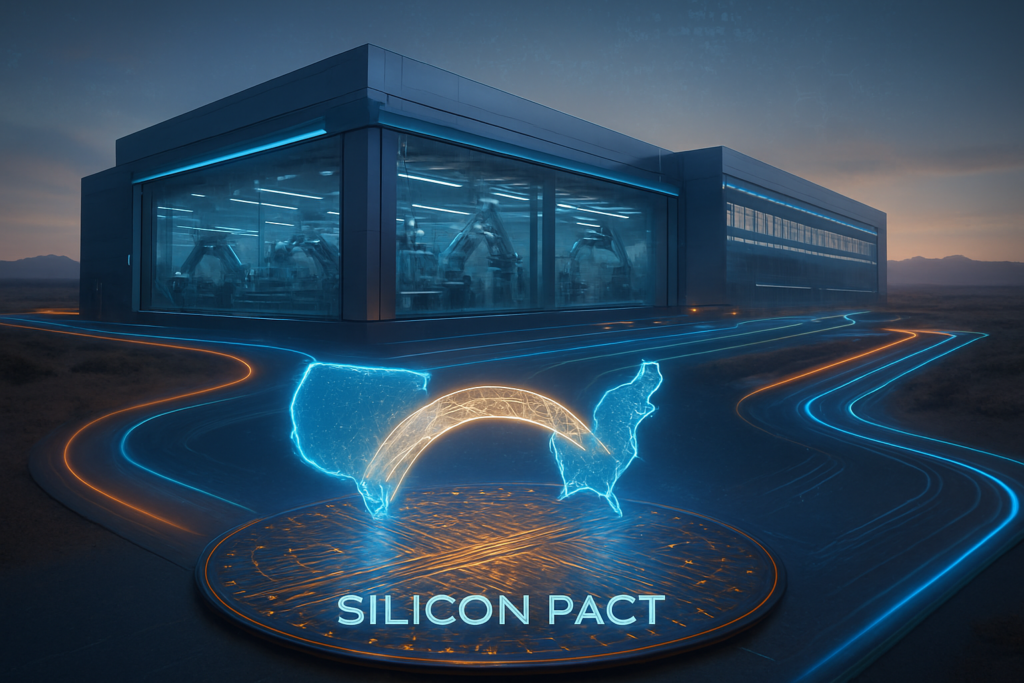
In a move that fundamentally redraws the map of the global technology sector, the United States and Taiwan officially signed the “Agreement on Trade & Investment” on January 15, 2026. Dubbed the “Silicon Pact” by industry leaders, this landmark treaty represents the most significant restructuring of the semiconductor supply chain in decades. The agreement aims to secure the hardware foundations of the artificial intelligence era by aggressively reshoring manufacturing capabilities to American soil, ensuring that the next generation of AI breakthroughs is powered by domestically produced silicon.
The signing of the deal marks a strategic victory for the U.S. goal of establishing “sovereign AI infrastructure.” By offering unprecedented duty exemptions and facilitating a massive influx of capital, the agreement seeks to mitigate the risks of geopolitical instability in the Taiwan Strait. For Taiwan, the pact strengthens its “Silicon Shield” by deepening economic and security ties with its most critical ally, even as it navigates the complex logistics of migrating its most valuable industrial assets across the Pacific.
A Technical Blueprint for Reshoring: Duty Exemptions and the 2.5x Rule
At the heart of the Silicon Pact are highly specific trade mechanisms designed to overcome the prohibitive costs of building high-end semiconductor fabrication plants (fabs) in the United States. A standout provision is the historic "Section 232" duty exemption. Under these terms, Taiwanese companies investing in U.S. capacity are granted "most favored nation" status, allowing them to import up to 2.5 times their planned U.S. production capacity in semiconductors and wafers duty-free during the construction phase of their American facilities. Once these fabs are operational, the exemption continues, permitting the import of 1.5 times their domestic production capacity without the burden of Section 232 duties.
This technical framework is supported by a massive financial commitment. Taiwanese firms have pledged at least $250 billion in new direct investments into U.S. semiconductor, energy, and AI sectors. To facilitate this migration, the Taiwanese government is providing an additional $250 billion in credit guarantees to help small and medium-sized suppliers—the essential chemical, lithography, and testing firms—replicate their ecosystem within the United States. This "ecosystem-in-a-box" approach differs from previous subsidy-only models by focusing on the entire vertical supply chain rather than just the primary manufacturing sites.
Initial reactions from the AI research community have been largely positive, though tempered by the reality of the engineering challenges ahead. Experts at the Taiwan Institute of Economic Research (TIER) note that while the deal provides the financial and legal "rails" for reshoring, the technical execution remains a gargantuan task. The goal is to shift the production of advanced AI chips from a nearly 100% Taiwan-centric model to an 85-15 split by 2030, eventually reaching an 80-20 split by 2036. This transition is seen as essential for the hardware demands of "GPT-6 class" models, which require specialized, high-bandwidth memory and advanced packaging that currently reside almost exclusively in Taiwan.
Corporate Winners and the $250 Billion Reinvestment
The primary beneficiary and anchor of this deal is Taiwan Semiconductor Manufacturing Co. (NYSE: TSM). Under the new agreement, TSMC is expected to expand its total U.S. investment to an estimated $165 billion, encompassing multiple advanced gigafabs in Arizona and potentially other states. This massive commitment is a direct response to the demands of its largest customers, including Apple Inc. (NASDAQ: AAPL) and Nvidia Corporation (NASDAQ: NVDA), both of which have been vocal about the need for a "geopolitically resilient" supply of the H-series and B-series chips that power their AI data centers.
For U.S.-based chipmakers like Intel Corporation (NASDAQ: INTC) and Advanced Micro Devices, Inc. (NASDAQ: AMD), the Silicon Pact presents a double-edged sword. While it secures the domestic supply chain and may provide opportunities for partnership in advanced packaging, it also brings their most formidable competitor—TSMC—directly into their backyard with significant federal and trade advantages. However, the strategic advantage for Nvidia and other AI labs is clear: they can now design next-generation architectures with the assurance that their physical production is shielded from potential maritime blockades or regional conflicts.
The deal also triggers a secondary wave of disruption for the broader tech ecosystem. With $250 billion in credit guarantees flowing to upstream suppliers, we are likely to see a "brain drain" of specialized engineering talent moving from Hsinchu to new industrial hubs in the American Southwest. This migration will likely disadvantage any companies that remain tethered to the older, more vulnerable supply chains, effectively creating a "premium" tier of AI hardware that is "Made in America" with Taiwanese expertise.
Geopolitics and the "Democratic" Supply Chain
The broader significance of the Silicon Pact cannot be overstated; it is a definitive step toward the bifurcation of the global tech economy. Taipei officials have framed the agreement as the foundation of a "democratic" supply chain, a direct ideological and economic counter to China’s influence in the Pacific. By decoupling the most advanced AI hardware production from the immediate vicinity of mainland China, the U.S. is effectively insulating its most critical technological asset—AI—from geopolitical leverage.
Unsurprisingly, the deal has drawn "stern opposition" from Beijing. China’s Ministry of Foreign Affairs characterized the pact as a violation of existing diplomatic norms and an attempt to "hollow out" the global economy. This tension highlights the primary concern of many international observers: that the Silicon Pact might accelerate the very conflict it seeks to mitigate by signaling a permanent shift in the strategic importance of Taiwan. Comparisons are already being drawn to the Cold War-era industrial mobilizations, though the complexity of 2-nanometer chip production makes this a far more intricate endeavor than the steel or aerospace races of the past.
Furthermore, the deal addresses the growing trend of "AI Nationalism." As nations realize that AI compute is as vital as oil or electricity, the drive to control the physical hardware becomes paramount. The Silicon Pact is the first major international treaty that treats semiconductor fabs not just as commercial entities, but as essential national security infrastructure. It sets a precedent that could see similar deals between the U.S. and other tech hubs like South Korea or Japan in the near future.
Challenges and the Road to 2029
Looking ahead, the success of the Silicon Pact will hinge on solving several domestic hurdles that have historically plagued U.S. manufacturing. Near-term developments will focus on the construction of "world-class industrial parks" that can house the hundreds of support companies moving under the credit guarantee program. The ambitious target of moving 40% of the supply chain by 2029 is viewed by some analysts as "physically impossible" due to the shortage of specialized semiconductor engineers and the massive water and power requirements of these new "gigafabs."
In the long term, we can expect the emergence of new AI applications that leverage this domestic hardware security. "Sovereign AI" clouds, owned and operated within the U.S. using chips manufactured in Arizona, will likely become the standard for government and defense-related AI projects. However, the industry must first address the "talent gap." Experts predict that the U.S. will need to train or import tens of thousands of specialized technicians and researchers to man these new facilities, a challenge that may require further legislative action on high-skilled immigration.
A New Era for the Global Silicon Landscape
The January 2026 US-Taiwan Trade Deal is a watershed moment that marks the end of the era of globalization driven solely by cost-efficiency. In its place, a new era of "Resilience-First" manufacturing has begun. The deal provides the financial incentives and legal protections necessary to move the world's most complex industrial process across an ocean, representing a massive bet on the continued dominance of AI as the primary driver of economic growth.
The key takeaways are clear: the U.S. is willing to pay a premium for hardware security, and Taiwan is willing to export its industrial crown jewels to ensure its own survival. While the "hollowing-out" of Taiwan's domestic industry remains a valid concern for some, the Silicon Pact ensures that the democratic world remains at the forefront of the AI revolution. In the coming weeks and months, the tech industry will be watching closely as the first wave of Taiwanese suppliers begins the process of breaking ground on American soil.
This content is intended for informational purposes only and represents analysis of current AI developments.
TokenRing AI delivers enterprise-grade solutions for multi-agent AI workflow orchestration, AI-powered development tools, and seamless remote collaboration platforms.
For more information, visit https://www.tokenring.ai/.