
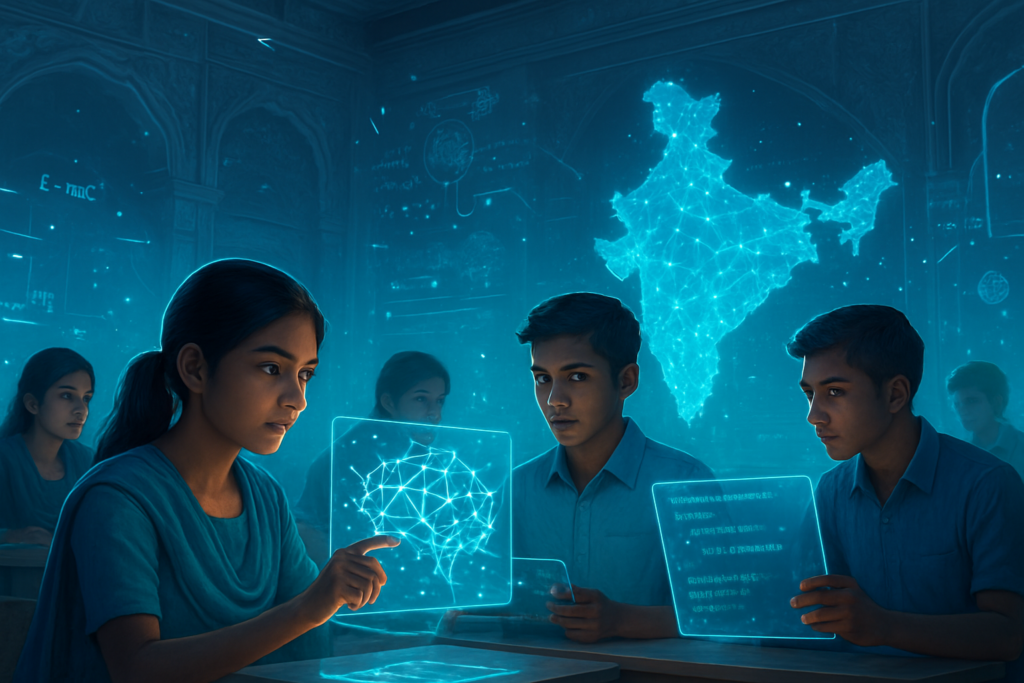
In a move that signals a paradigm shift in the global technology landscape, the Government of India has accelerated its "Skilling for AI Readiness" (SOAR) initiative, a monumental effort designed to transform the nation’s demographic dividend into an artificial intelligence powerhouse. Launched in mid-2025 and reaching a critical milestone this January 2026 with the national #SkillTheNation Challenge, the program aims to integrate AI literacy into the very fabric of the Indian education system. By targeting millions of students from middle school through vocational training, India is positioning itself not just as a consumer of AI, but as the primary laboratory and engine room for the next generation of global AI engineering.
The immediate significance of SOAR cannot be overstated. As of January 8, 2026, over 159,000 learners have already enrolled in the program’s first six months, marking the fastest adoption of a technical curriculum in the country's history. Unlike previous digital literacy campaigns that focused on basic computer operations, SOAR is a deep-tech immersion program. It represents a strategic pivot for the Ministry of Electronics and Information Technology (MeitY) and the Ministry of Skill Development and Entrepreneurship (MSDE), moving India away from its traditional "back-office" identity toward a future defined by AI sovereignty and high-value innovation.
Technical Depth: From Prompt Engineering to MLOps
The SOAR initiative is structured around a sophisticated, three-tiered curriculum designed to scale with a student’s cognitive development. The "AI to be Aware" module introduces middle-schoolers to the history of neural networks and the fundamentals of Generative AI, including hands-on sessions in prompt engineering. This is followed by "AI to Acquire," which dives into the mechanics of Machine Learning (ML), data literacy, and the coding fundamentals required to build basic algorithms. For older students and vocational trainees, the "AI to Aspire" track offers advanced training in Natural Language Processing (NLP), Retrieval-Augmented Generation (RAG), and Machine Learning Operations (MLOps), ensuring that graduates are ready to manage the entire lifecycle of an AI model.
What distinguishes SOAR from existing global initiatives like the U.S.-based AI4K12 is its scale and its integration with India’s indigenous AI infrastructure. The program utilizes the "Bhashini" language platform to teach AI concepts in vernacular languages, ensuring that the digital divide does not become an "AI divide." Furthermore, the curriculum includes specific modules on fine-tuning open-source models using techniques like Low-Rank Adaptation (LoRA), allowing students to experiment with Large Language Models (LLMs) on modest hardware. Initial reactions from the AI research community have been overwhelmingly positive, with experts noting that India is the first nation to treat AI engineering as a foundational literacy rather than an elective specialty.
Corporate Giants and the Global Talent War
The initiative has sparked a flurry of activity among global tech titans and domestic IT giants. Microsoft (NASDAQ: MSFT) has emerged as a primary partner, committing $17.5 billion to accelerate India’s AI journey and integrating its Azure OpenAI tools directly into the SOAR learning modules. Similarly, Google (NASDAQ: GOOGL) has invested $15 billion in a new AI data hub in Visakhapatnam, which will serve as the physical infrastructure for the projects developed by SOAR-certified students. NVIDIA (NASDAQ: NVDA), acting as the "arms dealer" for this revolution, has partnered with the Indian government to provide the H100 GPU clusters necessary for the IndiaAI Mission, which underpins the SOAR curriculum.
For Indian IT powerhouses like Tata Consultancy Services (NSE: TCS), Infosys (NSE: INFY), and Wipro (NYSE: WIT), the SOAR initiative is a vital lifeline. As the industry faces a reckoning with the automation of traditional coding tasks, these companies are aggressively absorbing SOAR graduates to staff their new AI Centers of Excellence. Infosys, through its Springboard Livelihood Program, has already committed ₹200 crore to bridge the gap between school-level SOAR training and professional-grade AI engineering. This massive influx of talent is expected to give Indian firms a significant strategic advantage, allowing them to offer complex AI orchestration services at a scale that Western competitors may struggle to match.
A "Third Path" in the Broader AI Landscape
The SOAR initiative represents what many are calling "India’s Second Tech Revolution." While the IT boom of the 1990s was built on cost arbitrage and service-level agreements, the AI boom of the 2020s is being built on democratic innovation. By making AI education inclusive and socially impactful, India is carving out a "Third Path" in the global AI race—one that contrasts sharply with the state-led, surveillance-heavy model of China and the private-sector, profit-driven model of the United States. The focus here is on "AI for All," with applications targeted at solving local challenges in healthcare, agriculture, and public service delivery.
However, the path is not without its obstacles. Concerns regarding the digital divide remain at the forefront, as rural schools often lack the consistent electricity and high-speed internet needed to run advanced AI simulations. There is also the looming shadow of job displacement; with the International Labour Organization (ILO) warning that up to 70% of current jobs in India could be at risk of automation, the SOAR initiative is a race against time to reskill the workforce before traditional roles disappear. Despite these concerns, the economic potential is staggering, with NITI Aayog estimating that AI could add up to $600 billion to India’s GDP by 2035.
The Horizon: Sovereignty and Advanced Research
Looking ahead, the next phase of the SOAR initiative is expected to move beyond literacy and into the realm of advanced research and product development. The Union Budget 2025-26 has already earmarked ₹500 crore for a Centre of Excellence in AI for Education, which will focus on building indigenous foundational models. Experts predict that by 2027, India will launch its own sovereign LLMs, trained on the country's diverse linguistic data, reducing its dependence on Western platforms. The challenge will be maintaining the quality of teacher training, as the "AI for Educators" module must continuously evolve to keep pace with the rapid breakthroughs in the field.
In the near term, we can expect to see the emergence of "AI-driven micro-innovation economies" in Tier 2 and Tier 3 cities across India. As students from the SOAR program enter the workforce, they will likely spearhead a new wave of startups that apply AI to hyper-local problems, from optimizing crop yields in Punjab to managing urban traffic in Bengaluru. The goal is clear: to ensure that by the time India celebrates its centenary in 2047—the "Viksit Bharat" milestone—it is a $35 trillion economy powered by an AI-literate citizenry.
Conclusion: A New Chapter in AI History
The SOAR initiative is more than just a training program; it is a bold statement of intent. By attempting to skill millions in AI engineering simultaneously, India is conducting the largest social and technical experiment in human history. The significance of this development will likely be remembered as the moment the global AI talent center of gravity shifted eastward. If successful, SOAR will not only secure India’s economic future but will also democratize the power of artificial intelligence, ensuring that the tools of the future are built by the many, rather than the few.
In the coming weeks and months, the tech world will be watching the progress of the #SkillTheNation Challenge and the first wave of SOAR-certified graduates entering the vocational market. Their success or failure will provide the first real evidence of whether a nation can truly "engineer" its way into a new era of prosperity through mass education. For now, India has placed its bet, and the stakes could not be higher.
This content is intended for informational purposes only and represents analysis of current AI developments.
TokenRing AI delivers enterprise-grade solutions for multi-agent AI workflow orchestration, AI-powered development tools, and seamless remote collaboration platforms.
For more information, visit https://www.tokenring.ai/.