
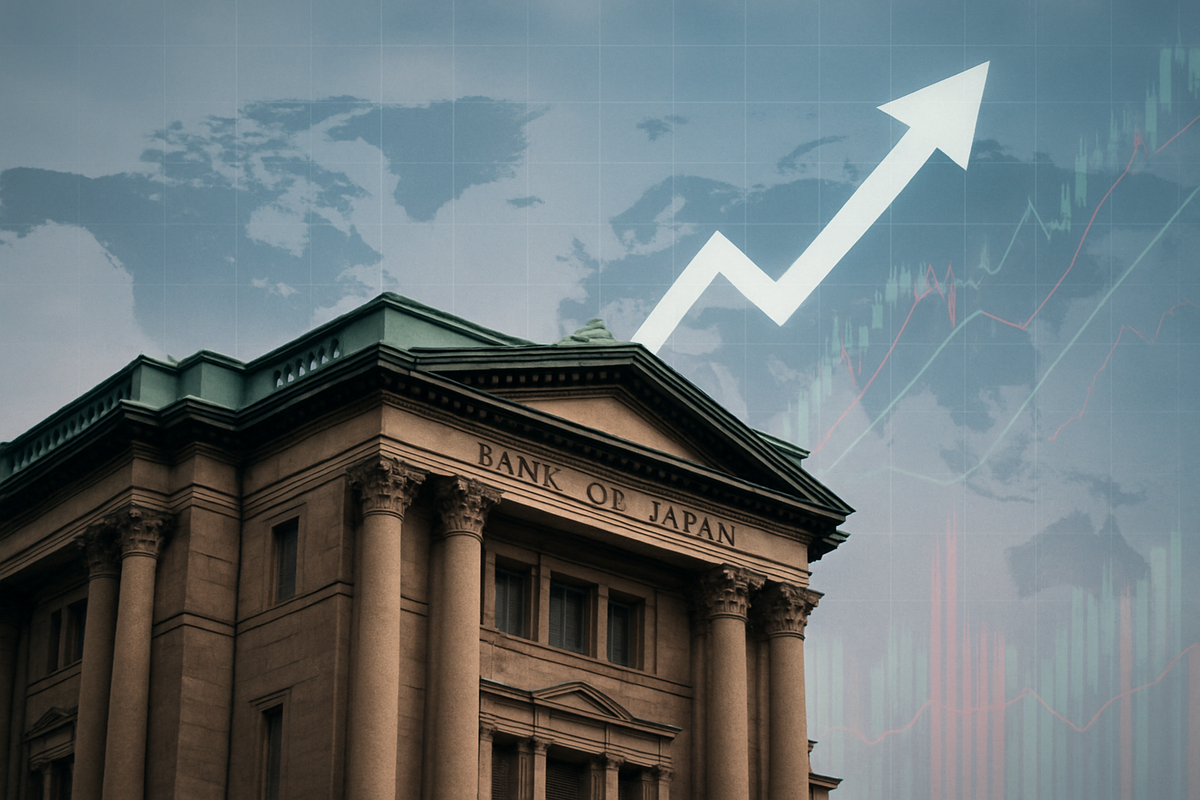
Tokyo, Japan – December 1, 2025 – The Bank of Japan (BoJ) Governor Kazuo Ueda delivered his clearest signal yet today, indicating a strong likelihood of an interest rate hike at the central bank's upcoming December 18-19 policy meeting. This pivotal announcement, made in a speech to business leaders, has sent immediate ripples across global financial markets, signaling a historic departure from decades of ultra-loose monetary policy and marking a new era for Japan's economic landscape.
Governor Ueda's remarks, suggesting the BoJ will "consider the pros and cons of raising the policy interest rate" and act "as appropriate," come amidst a backdrop of elevated corporate profits and receding economic uncertainties. This hawkish stance, while anticipated by some, has nevertheless ignited a surge in Japanese government bond yields and a strengthening of the yen, as traders now price in a high probability of a rate increase before the year's end. The implications for global bond markets, the unwinding of long-standing "carry trades," and the potential for capital reallocation are now at the forefront of investors' minds.
A Historic Pivot: Unpacking the BoJ's Path to Normalization
The BoJ's journey towards monetary policy normalization has been a gradual yet deliberate one. The first significant step came in March 2024, when the central bank ended its negative interest rate policy and yield curve control, a landmark decision that concluded years of aggressive monetary easing. This was followed by a further rate hike in January 2025, bringing the benchmark rate to 0.50%—its highest in 17 years.
More recently, the BoJ's Monetary Policy Meeting on September 19, 2025, saw a "hawkish hold," with two out of nine board members voting for an increase to 0.75%. While Governor Ueda initially downplayed these dissenting votes, he reiterated the BoJ's data-dependent approach, hinting that "rate hikes are possible if the economy and prices track forecasts." By November 26, 2025, a strengthening of hawkish sentiment within the BoJ became evident, with Ueda openly discussing the "feasibility and timing" of a rate hike, a topic he had previously avoided. This shift was largely driven by a renewed weakness in the yen, which reintroduced inflationary risks. Further bolstering the case for a hike, November 29, 2025, saw inflation data from Tokyo and robust industrial output growth, with former BoJ executive director Momma Kazuo stating the "possibility of a rate hike at the December monetary policy meeting is 'quite high'."
Today, December 1, 2025, Governor Ueda's comments explicitly linking the BoJ's decision to favorable economic conditions—including fading U.S. tariff risks and the increasing likelihood of economic and price projections being met—cemented market expectations. He emphasized the sustained mechanism of rising wages and prices as a key factor. Following his speech, Japanese 2-year bond yields surged to their highest levels since 2008, and the yen (JPY) strengthened against the U.S. dollar (USD), reaching 155.55. Global stocks and bonds began December on a negative note, with S&P 500 futures falling and cryptocurrencies sliding, as the prospect of an end to the "carry trade" loomed. Traders are now pricing in approximately an 80% chance of a rate hike at the upcoming December meeting.
Corporate Fortunes: Who Wins and Who Loses in a Higher Rate Environment?
The anticipated BoJ rate hike is set to redraw the lines of profitability for both Japanese and global public companies, ushering in a period of recalibration across various sectors.
Japanese Banking Sector: Financial institutions are poised to be significant beneficiaries. Higher interest rates directly expand banks' net interest margins (NIM), as the interest earned on loans and investments outpaces the interest paid on deposits. Major Japanese banks have already seen surging profits since the initial rate hike in March 2024. Sumitomo Mitsui Financial Group (TYO: 8316), Mitsubishi UFJ Financial Group (TYO: 8306), and Mizuho Financial Group (TYO: 8411) are all expected to see boosted profitability as rates climb further into December 2025 and beyond.
Export-Oriented Manufacturing: Conversely, a stronger yen, typically a consequence of higher rates, will pose headwinds for Japanese export-oriented companies. A more expensive yen makes Japanese goods less competitive internationally and reduces the yen value of repatriated overseas earnings. Automakers like Toyota Motor Corporation (TYO: 7203) and Subaru Corporation (TYO: 7270), which have historically benefited from a weak yen, could see their operating profits impacted. Similarly, electronics and technology companies with substantial international sales, such as Tokyo Electron (TYO: 8035), Advantest Corporation (TYO: 6857), Nikon Corporation (TYO: 7731), Renesas Electronics Corporation (TYO: 6723), and Fujikura Ltd. (TYO: 5803), may face reduced competitiveness and lower foreign earnings. Fast Retailing Co., Ltd. (TYO: 9983), owner of Uniqlo, with its significant global operations, could also see a negative impact on translated foreign earnings.
Real Estate Sector: Rising interest rates increase borrowing costs for real estate developers and investors, potentially compressing profit margins and dampening investment appetite. Japanese Real Estate Investment Trusts (J-REITs) and highly leveraged developers will be particularly sensitive to these changes. While prime residential prices in Tokyo might show resilience, sustained rate hikes could eventually affect overall investor sentiment.
Global Carry Trade Participants: The unwinding of the "yen carry trade," where investors borrowed low-interest yen to fund investments in higher-yielding assets globally, is a significant concern. As the cost of borrowing yen rises, these trades become less attractive, potentially leading to capital repatriation and tighter liquidity in global markets. This could indirectly affect global financial institutions and hedge funds heavily involved in these strategies, as well as companies in markets that have benefited from yen-funded liquidity, such as those in U.S. Treasuries, global stocks, and emerging markets. Even cryptocurrency-related companies could experience increased volatility due to rising leverage costs globally.
Wider Significance: Reshaping Global Monetary Dynamics
The BoJ's move towards tightening around December 2025 is a monumental shift that resonates far beyond Japan's borders, fitting into and, in some ways, diverging from broader global monetary policy trends.
While many major central banks, including the U.S. Federal Reserve, European Central Bank (ECB), and Bank of England (BoE), are cautiously eyeing or already implementing rate cuts by late 2025, Japan stands as an outlier. Its gradual tightening is a response to persistent domestic inflationary pressures after a prolonged battle with deflation. This divergence highlights a significant re-calibration in global monetary policy, with the BoJ finally stepping away from its long-standing unconventional measures.
The ripple effects on other economies and financial assets are profound. A stronger yen can make Japanese exports less competitive but helps alleviate import-driven inflation within Japan. More significantly, the surge in Japanese government bond yields, with the 10-year JGB yield reaching its highest since June 2008, has triggered a sell-off in sovereign bonds globally, including the U.S. and Europe, causing their yields to rise. The unwinding of the yen carry trade is a major concern, potentially leading to structural shifts in global capital flows, reduced liquidity in U.S. equities and Treasury markets, and volatility in emerging market currencies. Japanese institutional investors, such as pension funds and insurers, might also repatriate capital from foreign markets, further pushing up yields in other major economies.
From a regulatory and policy perspective, Japan faces a delicate balance: fostering wage-driven growth while preventing disruptive market shocks. Higher interest rates will directly impact borrowing costs for Japanese households and corporations. BoJ Governor Ueda has indicated that even with a hike, real interest rates would remain deeply negative, suggesting a continued accommodative stance—likened to "easing off the accelerator" rather than "applying the brakes." This also has implications for Japan's substantial government debt. For other nations, the BoJ's policy shift could necessitate monetary policy adjustments, especially for those deeply involved in yen carry trades, and a stronger yen could affect their export competitiveness.
Historically, this move marks a significant departure from Japan's two decades of unconventional monetary policy, which included negative interest rates and yield curve control. Japan was a pioneer in zero-interest-rate policy and quantitative easing. This current shift is a return to more conventional monetary policy, aligning Japan more closely with global practices. Past adjustments, such as the loosening of YCC in December 2022, led to sharp sell-offs in global bonds and equities, serving as a cautionary tale of potential market disruption. The BoJ's current strategy aims for "normalization without contraction," signaling a desire for a smooth transition.
What Comes Next: Navigating the New Economic Landscape
The BoJ's anticipated rate hike around December 1, 2025, heralds a new economic landscape for Japan and the world, presenting both short-term adjustments and long-term transformations.
In the short term, expect continued yen appreciation, surging Japanese Government Bond (JGB) yields, and increased borrowing costs for Japanese households and businesses. Equity markets, particularly in Japan, are likely to experience volatility as capital flows adjust. Globally, the unwinding of yen carry trades could lead to broader market turbulence and tighter financial conditions.
The long-term possibilities point towards a sustained monetary policy normalization, with the BoJ aiming for stable inflation around its 2% target, supported by consistent wage growth. This could lead to moderate, positive economic growth for Japan. However, it will also mean higher costs for servicing Japan's substantial government debt and a potential cooling of the real estate market.
Strategic pivots will be crucial for businesses and investors. Businesses will face a higher cost of capital, necessitating a re-evaluation of investment projects and debt management. Export-oriented companies will need robust currency risk management strategies to contend with a stronger yen. Investors will likely reallocate towards Japanese bonds, which offer increasingly attractive yields, and reassess their equity strategies, potentially favoring resilient sectors or those benefiting from domestic demand. The unwinding of the yen carry trade will require investors to adjust their global portfolio exposures and consider diversification and hedging tools.
Market opportunities may arise from a stronger yen, making imports cheaper for Japanese consumers and enhancing the value of overseas assets for Japanese investors. Higher JGB yields will make Japanese sovereign debt more appealing, and the financial sector could see improved profitability. However, challenges include reduced export competitiveness, increased corporate debt burdens, and potential headwinds for the real estate market.
Potential scenarios include a baseline of gradual normalization, where rates are hiked to 0.75% by early 2026, leading to stable inflation and moderate growth. An aggressive tightening scenario could occur if inflation persists, leading to a sharper economic slowdown and more pronounced global market volatility. Conversely, a delayed/passive action scenario could result in further yen weakness, exacerbating imported inflation and potentially eroding the BoJ's credibility. The success of this transition hinges on sustained wage growth, global central bank actions, and geopolitical stability.
Wrap-up: A Turning Point in Japan's Economic History
The Bank of Japan's hawkish signals on December 1, 2025, represent a definitive turning point in Japan's monetary history. Governor Ueda's clear intention to "consider the pros and cons of raising the policy interest rate" at the upcoming December meeting underscores the central bank's commitment to moving away from decades of ultra-loose policy.
Key takeaways include the BoJ's confidence in elevated corporate profits, receding U.S. tariff uncertainties, persistent inflation above target, and robust wage growth momentum as foundations for a rate hike. The Governor's assurance that even with a hike, real interest rates would remain accommodative, suggests a measured "adjustment in the degree of easing." Market reactions have been swift and decisive: a strengthening yen, surging JGB yields across the curve, and a sell-off in Japanese equities, alongside global bond market turbulence driven by carry trade unwinding concerns.
Moving forward, the market will be keenly focused on the BoJ's December 18-19 policy meeting for confirmation of the rate hike. Beyond this, investors should watch for subsequent wage data and the critical Spring Wage Negotiations (Shunto) for indicators of sustained wage growth, which is pivotal for future policy decisions. Inflation trends, the BoJ's forward guidance on future rate paths, and global economic data—particularly U.S. inflation and Federal Reserve actions—will also heavily influence market sentiment and currency dynamics. The interplay between the Japanese government's fiscal policy and the BoJ's monetary policy will remain a key area of observation.
The lasting impact of this policy shift will be profound. It aims to anchor inflation sustainably around the 2% target, redefine Japan's role in global fixed-income markets, and reshape cross-currency dynamics. While challenging, this normalization is crucial for Japan's long-term economic health and marks a significant step towards a more conventional monetary policy framework in a globally interconnected financial system.
This content is intended for informational purposes only and is not financial advice