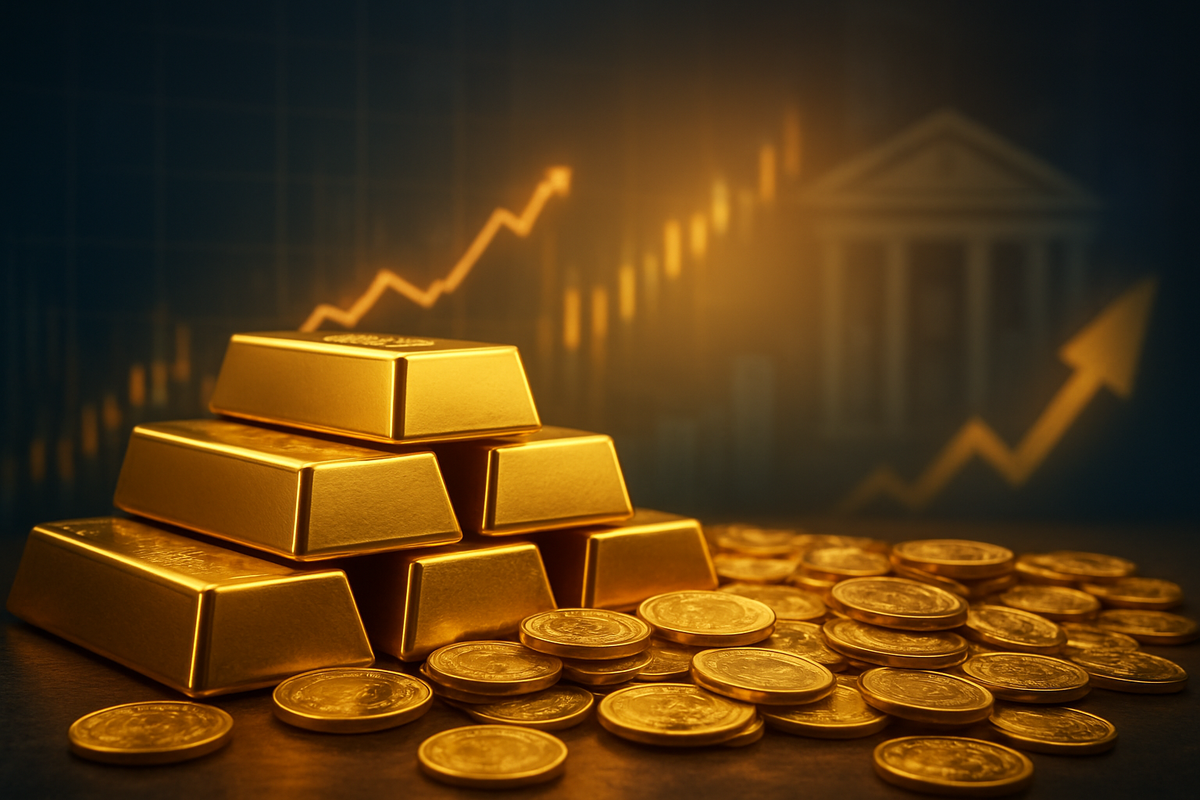
The global financial markets are buzzing with the unparalleled ascent of gold, which has seen its value skyrocket by over 60% in 2025, reaching more than 50 all-time highs throughout the year. As of December 11, 2025, spot gold prices are trading robustly between $4,210 and $4,219 per troy ounce, signaling a sustained bullish momentum. This extraordinary rally is intricately linked to shifting interest rate expectations, particularly the dovish pivot by major central banks, most notably the U.S. Federal Reserve, which is widely anticipated to continue its cycle of rate reductions.
The immediate implication for gold traders and investors is a reinforcing bullish outlook. Lower interest rates typically diminish the opportunity cost of holding non-yielding assets like gold, making it more attractive compared to interest-bearing alternatives such as bonds. Coupled with ongoing geopolitical uncertainties and a weakening U.S. dollar, these monetary policy shifts are creating a potent cocktail that could propel gold prices to unprecedented levels, drawing in both institutional and private capital.
A Year of Unprecedented Gains: Dissecting Gold's 2025 Surge
The year 2025 has been nothing short of historic for gold, witnessing a rally driven by a complex interplay of factors that extend beyond its traditional safe-haven appeal. The sheer scale of the 60% price surge and the frequent attainment of new all-time highs underscore a fundamental shift in market dynamics. Central bank purchases, particularly from emerging markets, have provided a crucial structural underpinning, with nations diversifying their reserves amidst a volatile global landscape. Geopolitical flashpoints, from persistent conflicts in the Middle East and Eastern Europe to escalating global trade tensions, have further amplified gold's risk premium, steering investors towards its perceived stability.
A significant timeline of events leading up to this moment includes the Federal Reserve's proactive monetary policy adjustments. The U.S. central bank implemented 25-basis-point interest rate cuts in September, October, and December 2025, bringing the federal funds rate to a target range of 3.50% to 3.75%. These actions followed earlier reductions in late 2024, culminating in a total of 175 basis points of cuts since September 2024. The December cut was largely priced in by markets, with probabilities soaring to 88-90%. Key players in this scenario include the Federal Reserve and other central banks globally, alongside a growing cohort of private investors whose "trend-chasing" behavior, facilitated by accessible gold ETFs, has significantly amplified the rally's momentum. Initial market reactions have been predominantly bullish, though some profit-taking has been observed following recent Fed announcements, reflecting a nuanced sentiment among traders who are closely watching for forward-looking policy signals.
Corporate Fortunes: Winners and Losers in the Gold Rush
The sustained gold rally and the prospect of continued rate cuts create a distinct landscape of winners and losers within the public markets. Companies primarily engaged in gold mining and exploration stand to be significant beneficiaries. Major gold producers like Barrick Gold Corp. (NYSE: GOLD) and Newmont Corporation (NYSE: NEM) are poised to see substantial increases in their revenues and profitability as the price of their primary commodity rises. Higher gold prices directly translate to fatter margins, increased cash flows, and potentially enhanced shareholder returns through dividends or share buybacks. Exploration companies, often more leveraged to gold price movements, could also see their prospects improve dramatically, making new projects economically viable and attracting fresh investment.
Beyond direct miners, companies involved in gold streaming and royalties, such as Franco-Nevada Corporation (NYSE: FNV), also stand to gain immensely. Their business models are inherently linked to gold production and prices, offering them a relatively low-risk way to benefit from rising metal values without the direct operational costs and risks of mining. Furthermore, exchange-traded funds (ETFs) that track gold prices, such as the SPDR Gold Shares (NYSEARCA: GLD), are experiencing increased investor interest and asset inflows, reflecting broader market participation in the gold rally. These financial instruments provide an accessible avenue for investors to gain exposure to gold, further contributing to demand.
While the direct "losers" from a gold rally are less clear-cut, the broader economic environment that often accompanies such rallies – characterized by lower interest rates and sometimes inflationary pressures – can impact different sectors unevenly. For instance, a significantly weaker U.S. dollar, a common byproduct of aggressive rate cuts, could negatively affect U.S. companies heavily reliant on imports or those with significant international operations denominated in other currencies, if not properly hedged. However, the primary and most direct corporate impact of a gold rally is overwhelmingly positive for entities directly involved in the precious metals sector.
Wider Significance: Gold's Evolving Role in a Shifting Economic Paradigm
This gold rally transcends a mere commodity price fluctuation; it signifies a broader industry trend where gold is increasingly viewed not just as a safe-haven asset, but also as a speculative instrument, particularly by private investors. The Bank for International Settlements (BIS) has highlighted this shift, noting that the current surge has a significant "trend-chasing" component, sometimes moving in tandem with equities – a historically unusual pattern. This suggests a re-evaluation of gold's role in diversified portfolios, potentially indicating a move away from traditional asset correlation.
The ripple effects of this phenomenon are considerable. A strong gold market often correlates with a weaker U.S. dollar, which can impact global trade balances and capital flows. It also signals investor skepticism about the long-term stability of fiat currencies and traditional financial assets, potentially leading to increased demand for other alternative investments. From a regulatory and policy perspective, the Federal Reserve's cautious outlook for 2026, projecting only one additional 25-basis-point cut, stands in contrast to market expectations for more aggressive easing. This divergence creates uncertainty and underscores the delicate balancing act central banks face between managing inflation, supporting economic growth, and maintaining financial stability. Historically, gold prices have shown a tendency to rise by an average of 6% in the 60 days following the commencement of a Fed rate-cutting cycle, providing a strong historical precedent for the current bullish sentiment.
What Comes Next: Navigating the Golden Horizon
Looking ahead, the trajectory of gold prices will largely hinge on the Federal Reserve's future monetary policy decisions and the broader macroeconomic landscape. In the short term, while the Fed's "dot plot" suggests a more conservative approach with potentially only one additional 25-basis-point cut in 2026, market futures are pricing in a slightly faster pace of easing, with some anticipating rates falling towards 3% or even lower. This divergence creates both opportunities and challenges. Should the Fed surprise with more aggressive cuts, gold could see another significant leg up. Conversely, any hawkish shift or unexpected economic strength that dampens rate cut expectations could lead to a period of consolidation or even a temporary pullback.
Long-term possibilities remain overwhelmingly positive for gold. Analysts like Morgan Stanley Research have revised their 2026 gold forecasts upward to $4,400 per ounce, while RBC Capital Markets projects an average of $4,600 in 2026 and $5,100 in 2027, citing ongoing geopolitical risks and softer monetary policy. More bullish predictions even suggest gold could soar to $10,000 per ounce under certain extreme scenarios, such as a deep U.S. recession prompting much more aggressive Fed easing. Market opportunities will continue to emerge for investors seeking inflation hedges or safe havens amidst persistent global uncertainties. However, challenges include potential volatility driven by shifts in market sentiment and the need for investors to distinguish between fundamental drivers and speculative "trend-chasing" behavior. Strategic pivots for investors might involve re-evaluating asset allocations to include a greater gold exposure, while gold-related companies may focus on optimizing production and exploring new deposits to capitalize on higher prices.
A Golden Future: Market Assessment and Investor Outlook
The current gold rally, largely propelled by evolving interest rate expectations and the Federal Reserve's dovish pivot, marks a significant moment in financial markets. The 60% surge in 2025, reaching over $4,200 per troy ounce, underscores gold's enduring appeal in times of economic uncertainty and monetary easing. Key takeaways include the increasing influence of central bank purchases, persistent geopolitical risks, a weakening U.S. dollar, and a notable shift in private investor behavior, treating gold with a degree of speculative interest.
Moving forward, the market is poised for continued strength in gold, albeit with an eye on central bank communications and economic data. While the Fed's cautious 2026 outlook presents a potential point of divergence with market expectations, the overarching sentiment points towards further rate cuts globally, which historically provide a tailwind for gold. Investors should watch for further guidance from the Federal Open Market Committee (FOMC), global bond yields, the trajectory of the U.S. dollar, and any escalation or de-escalation of geopolitical tensions. The confluence of these factors will dictate the pace and magnitude of gold's journey towards its anticipated new highs. For those seeking to preserve wealth and capitalize on market shifts, gold remains a compelling asset in the months to come.
This content is intended for informational purposes only and is not financial advice