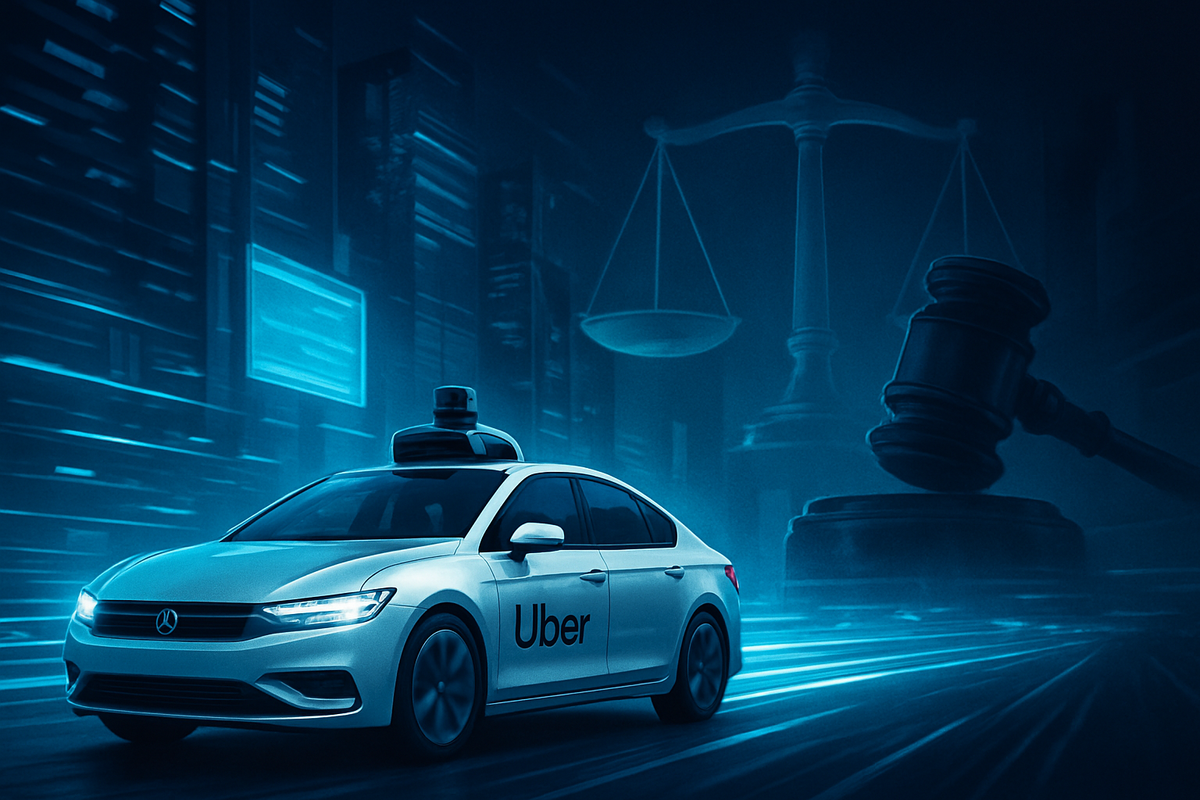
As 2025 draws to a close, Uber Technologies, Inc. (NYSE: UBER) finds itself at a historic crossroads, embodying the ultimate high-stakes balancing act of the modern tech era. On one side of the ledger, the company has successfully transitioned from a ride-hailing pioneer into the indispensable "operating system" for the global autonomous vehicle (AV) revolution. On the other, it is currently locked in a bruising legal battle with the Federal Trade Commission (FTC) that threatens to dismantle the very algorithmic and subscription-based engines that drive its record-high margins.
This dual narrative has forced Wall Street to completely re-evaluate the company’s valuation. No longer viewed simply as a labor-dependent service provider, Uber is being repriced as a capital-light technology gatekeeper. However, with an amended FTC complaint filed just days ago on December 15, 2025, alleging "dark patterns" and deceptive pricing, the market is now weighing whether Uber’s autonomous future can outrun its regulatory past.
The Legal Sledgehammer Meets the Robotaxi Surge
The most immediate pressure on Uber comes from a massive regulatory escalation. On December 15, 2025, the FTC, supported by a coalition of 21 states and the District of Columbia, filed an amended complaint targeting the "Uber One" subscription service. The filing alleges that Uber utilized "dark patterns" to trap users into recurring fees, reportedly requiring a labyrinthine 23 screens and 32 separate actions for a customer to successfully cancel their membership. This legal action follows a November 2025 probe into "algorithmic management," where regulators accused the company of using opaque computer code to implement dynamic pricing that potentially discriminates against both drivers and passengers.
While the legal department fights these fires, the operational side of the business is celebrating a string of unprecedented victories. Throughout 2025, Uber solidified its "multi-vendor" autonomous strategy, effectively turning former competitors into platform partners. In mid-2025, Uber successfully launched exclusive Waymo integrations in Austin and Atlanta, allowing users to hail Alphabet Inc. (NASDAQ: GOOGL) owned robotaxis directly through the Uber app. This was followed by the December 2025 launch of Avride’s robotaxi service in Dallas, utilizing modified Hyundai Ioniq 5 vehicles—a move backed by a significant investment from Uber into Avride’s parent company, Nebius Group N.V. (NASDAQ: NBIS).
The timeline of these events suggests a company moving at two different speeds. While the FTC investigation into "algorithmic wage setting" and driver "lockouts" in New York City (launched in January 2025) continues to simmer, Uber has simultaneously expanded its AV footprint into international markets. In late December 2025, Uber and its rival Lyft, Inc. (NASDAQ: LYFT) both announced landmark partnerships with Baidu, Inc. (NASDAQ: BIDU) to bring the "Apollo Go" robotaxi fleet to London in early 2026. This rapid-fire expansion has kept investors bullish despite the looming threat of billion-dollar civil penalties.
Winners and Losers in the Autonomous Ecosystem
The primary winner in this shifting landscape appears to be Uber itself, which has successfully avoided the "existential threat" of being bypassed by AV developers. By positioning itself as a "demand aggregator," Uber has made its massive user base of over 150 million monthly active users too large for AV companies to ignore. Alphabet’s Waymo has seen its utilization rates soar in cities where it is integrated with Uber, proving that the "platform-as-a-service" model is more efficient than building a standalone ride-hailing app from scratch.
Conversely, Tesla, Inc. (NASDAQ: TSLA) remains the most prominent outlier and a potential loser in the platform wars. Unlike Waymo or Avride, Tesla has doubled down on a "walled garden" approach, launching its own limited, supervised robotaxi network in San Francisco and Austin in late 2025. While Tesla enthusiasts argue for the superiority of their vertically integrated model, Wall Street analysts have begun to favor Uber’s diversified approach, which hedges against the failure of any single AV technology. Tesla’s refusal to join the Uber network has created a "dueling supremacy" that could isolate the electric vehicle giant if Uber’s multi-brand ecosystem becomes the industry standard.
Lyft also finds itself in a precarious but stabilizing position. By following Uber’s lead and partnering with international players like Baidu, Lyft is fighting to remain a relevant second-place player. However, the smaller firm lacks Uber’s massive capital for investment in companies like Nebius and Wayve, leaving it vulnerable to a "winner-takes-most" dynamic. Meanwhile, traditional automakers who failed to develop their own AV software are increasingly looking to Uber as their only viable path to a driverless future, effectively turning them into hardware suppliers for Uber’s network.
The Wider Significance: Algorithmic Accountability
The clash between Uber’s growth and the FTC’s oversight represents a broader industry trend toward "algorithmic accountability." For years, gig economy platforms operated in a regulatory gray area, using AI to match supply and demand with little transparency. The FTC’s focus on "deceptive savings" and "opaque computer code" in late 2025 marks a turning point. If the government succeeds in forcing Uber to simplify its subscription exits and disclose its "take-rate" algorithms, it could set a precedent that affects every AI-driven service from Amazon to DoorDash.
Furthermore, Uber’s successful pivot to an "asset-light" AV model has significant implications for the future of urban labor. By transitioning from human drivers to third-party robotaxi fleets, Uber is effectively offloading its most significant legal and operational headache—labor relations—onto the AV providers and the algorithms themselves. This shift represents a fundamental change in the "social contract" of the gig economy, moving away from the "independent contractor" debate and toward a future where the primary conflict is between regulators and the code that manages city-wide transportation.
The historical precedent for this moment can be found in the early days of the internet, where platforms like Microsoft or Google faced antitrust and consumer protection suits just as their technologies reached mass adoption. Like those predecessors, Uber is attempting to settle into its role as a utility. The company’s ability to navigate the FTC’s "junk fee" crackdown while simultaneously launching Level 4 trials in London with Wayve suggests a maturity that was absent during its "move fast and break things" era under previous leadership.
What Comes Next: The Road to 2026
In the short term, investors should prepare for a period of high volatility as the FTC’s amended complaint moves toward a potential trial or a massive settlement. A settlement would likely involve a total overhaul of the Uber One interface and a significant payout, but it would also remove the "regulatory overhang" that currently prevents the stock from reaching its full potential. Analysts at major firms like Wedbush and Deutsche Bank have maintained "Strong Buy" ratings, with price targets hovering near $110, suggesting they believe the legal risks are a manageable cost of doing business.
Long-term, the focus will shift to the international "Robotaxi Wars." The scheduled 2026 rollout of Baidu’s Apollo Go in London and Tokyo will be the first true test of how US and Chinese AV technologies compete in neutral urban environments. Uber’s role as the host for these competing fleets will be critical. If Uber can maintain its neutrality and provide a seamless experience for users across different AV brands, it will likely cement its status as the "Amazon of Transportation."
A Comprehensive Wrap-Up for Investors
As of December 23, 2025, Uber Technologies, Inc. has proven its resilience, ending the year with a 30% YTD gain despite a constant barrage of legal challenges. The key takeaway for the market is that Uber has successfully "de-risked" the threat of autonomous vehicles by becoming their primary distributor. The "AV Gatekeeper" narrative has largely replaced the "Ride-sharing" narrative, providing a much higher ceiling for the company’s long-term valuation.
However, the "regulatory trap" remains the primary downside risk. The FTC’s aggressive stance on "dark patterns" and algorithmic transparency is not just a nuisance; it is a direct challenge to the high-margin subscription models that Wall Street has come to love. If the FTC succeeds in significantly lowering Uber’s "take rate" or making its subscription services less "sticky," the growth story could hit a significant speed bump.
In the coming months, investors should keep a close eye on two things: the first court dates for the FTC’s amended complaint and the production milestones of Tesla’s "Cybercab." If Tesla struggles to scale its independent network while Waymo and Avride continue to thrive on the Uber app, Uber’s position as the industry’s central hub will be undeniable. For now, Uber remains a high-growth tech giant operating in a legal minefield—a position that offers both immense reward and persistent risk.
This content is intended for informational purposes only and is not financial advice.