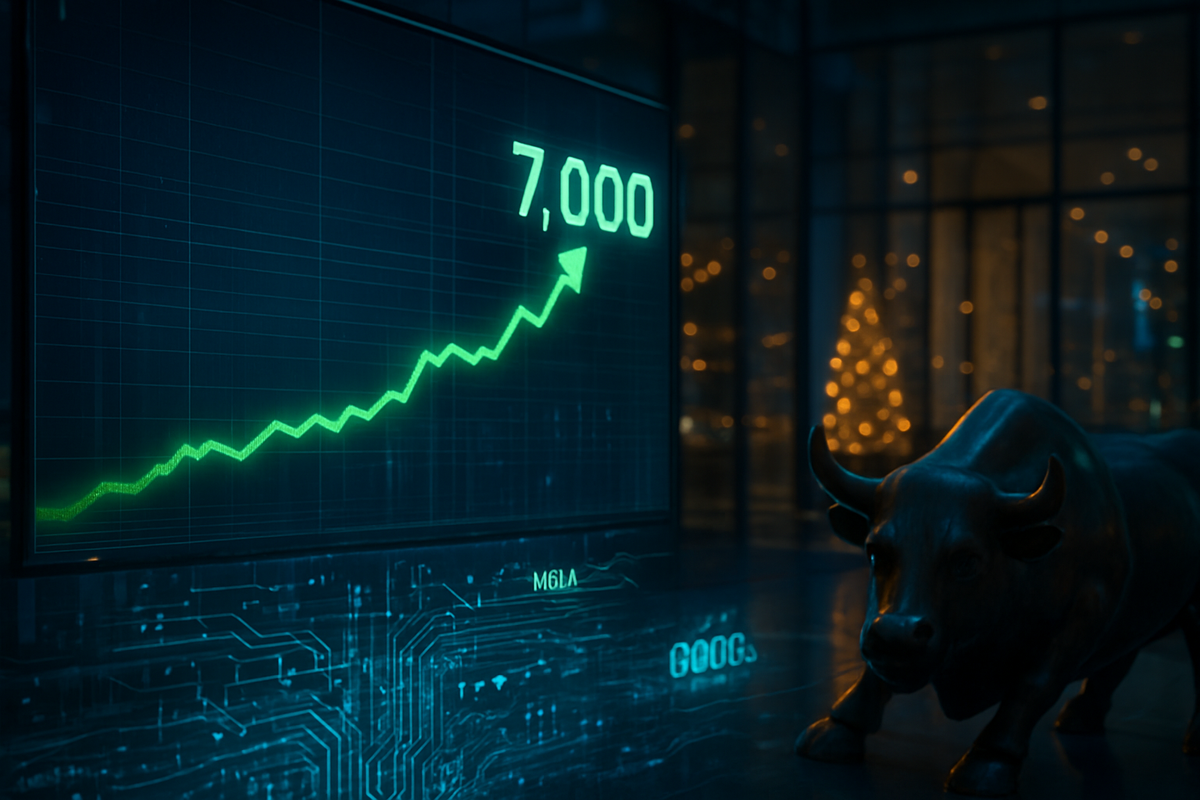
As the closing bell approaches on December 23, 2025, Wall Street is holding its collective breath, watching the ticker tapes for the first signs of the legendary "Santa Claus Rally." With the S&P 500 (INDEXSP: .INX) hovering near the 6,916 mark—up nearly 18% for the year—investors are questioning whether the traditional year-end surge will push the index past the psychological milestone of 7,000 or if the market has already exhausted its holiday spirit.
The atmosphere in the financial district is one of cautious optimism. After a year defined by extreme volatility, including a 43-day government shutdown and the "Tariff Tuesday" shock in April, a year-end rally would serve as a triumphant capstone to a resilient 2025. Historically, the Santa Claus Rally—defined as the final five trading days of December and the first two of January—has a 79% success rate, averaging a 1.3% gain. However, with valuations at record highs, the "January Effect" may be arriving early, or perhaps not at all.
A Year of Recovery and Resilience
The road to this week's market position has been anything but smooth. The 2025 calendar year began with significant turbulence as "Tariff Tuesday" in April triggered the sharpest single-day sell-off since the 2020 pandemic. This was followed by a grueling 43-day government shutdown that only concluded on November 13, 2025. During that period, the Federal Reserve and private investors were essentially "flying blind," as key economic data like October’s CPI and employment figures were delayed.
Despite these hurdles, the market found its footing in late November. The Federal Reserve, led by Chair Jerome Powell, provided a much-needed catalyst by enacting its third consecutive 25-basis-point interest rate cut in December, bringing the federal funds rate down to a range of 3.50%–3.75%. While some members of the Federal Open Market Committee (FOMC) remained hesitant, the "hawkish cut" signaled a commitment to a soft landing as inflation cooled to 2.7% in November. This easing cycle, combined with a late-year surge in AI-driven earnings, has set the stage for the current rally attempt.
The Winners and Losers of the 2025 Holiday Season
The primary beneficiaries of the 2025 market environment have been the titans of artificial intelligence and essential retail. Nvidia (NASDAQ: NVDA) continues to be the undisputed heavyweight champion of the year, recently reporting Q4 revenue of $39.3 billion—a staggering 78% increase year-over-year. The relentless demand for AI data center infrastructure has made NVDA the linchpin of the S&P 500's performance. Similarly, Alphabet (NASDAQ: GOOGL) has seen its shares soar nearly 60% this year, bolstered by the success of its Gemini 3 AI model and a lucrative $1 billion licensing agreement to integrate its tech into Apple (NASDAQ: AAPL) services. Apple itself remains a winner, posting record fiscal Q4 revenue of $102.5 billion on the back of strong iPhone 17 sales.
On the retail front, a clear divide has emerged. Walmart (NYSE: WMT) has emerged as a dominant winner, successfully capturing market share in the grocery sector as consumers remain price-sensitive despite cooling inflation. Conversely, Target (NYSE: TGT) has struggled to maintain momentum, facing headwinds in discretionary spending categories as high borrowing costs for much of the year weighed on household budgets. In the financial sector, the "Great Rotation" of 2025 has benefited value-oriented firms like HSBC (NYSE: HSBC) and Deutsche Bank (NYSE: DB), which have outperformed as investors diversified away from pure-play tech growth.
Broader Significance and Historical Precedents
The potential 2025 Santa Claus Rally is significant not just for its immediate gains, but for what it signals about the broader structural shifts in the global economy. This year marked a transition from the narrow, tech-only rally of 2024 to a broader market participation. The rise of "Old Economy" sectors like energy and financials suggests that the market is finally pricing in a sustainable, diversified recovery rather than a speculative bubble.
Historically, when the Santa Claus Rally fails to materialize, it has often been a harbinger of a "flat" or "bearish" January. In 2000 and 2008, the absence of a year-end surge preceded significant market downturns. However, the 2025 context is unique due to the "AI euphoria" which acts as a persistent floor for the tech sector. Furthermore, the resolution of the government shutdown in mid-November released a wave of pent-up institutional capital that had been sitting on the sidelines, providing a liquidity injection that mirrors the post-election rallies of previous cycles.
The Road to 2026: What Comes Next
As we look toward the first quarter of 2026, the market faces several strategic pivots. The most immediate challenge is the 7,000 level on the S&P 500. Technical analysts suggest that if the index cannot break this resistance during the Santa Claus window, we may see a period of consolidation or "tax-loss harvesting" in early January. Additionally, the Federal Reserve has remained tight-lipped about its 2026 roadmap, leaving investors to wonder if the current easing cycle will continue or if the "sticky" 2.7% inflation rate will force a pause.
Short-term opportunities may lie in the energy sector, particularly natural gas, which saw a 9.1% inflation spike in late 2025 due to an unseasonably harsh winter and the massive power requirements of new AI data centers. Longer-term, the market will be watching to see if the "Great Rotation" into value stocks holds, or if the lure of AI-driven growth pulls capital back into a concentrated group of mega-cap tech stocks.
Summary and Investor Outlook
The 2025 Santa Claus Rally is more than just a seasonal tradition; it is a test of the market's fundamental strength after a year of geopolitical and domestic upheaval. Key takeaways for investors include the continued dominance of AI infrastructure led by Nvidia, the resilience of value-based retail like Walmart, and the stabilizing influence of a Federal Reserve that is finally leaning toward easing.
Moving forward, the market appears poised for a strong start to 2026, provided the current momentum can overcome the 7,000 resistance level. Investors should keep a close eye on upcoming January jobs data and any further "hawkish" commentary from the Fed. While the ghost of "Tariff Tuesday" and the recent shutdown still haunt the charts, the underlying earnings growth of the S&P 500 suggests that St. Nick may indeed have one last gift for Wall Street before the year is out.
This content is intended for informational purposes only and is not financial advice.