
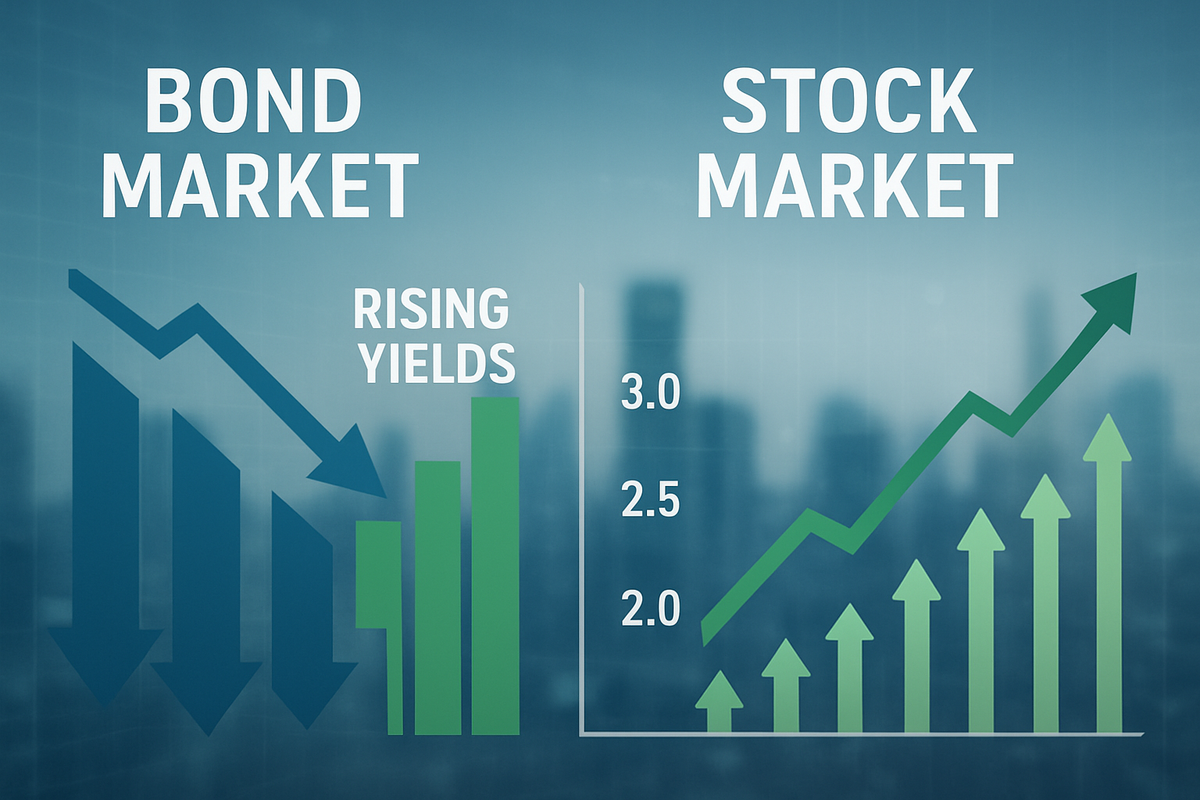
As of December 4, 2025, the financial markets are navigating a complex landscape where the bond market exhibits a nuanced dance of rising and falling yields, leading to varied movements in bond prices. This intricate dynamic unfolds against a backdrop of remarkable stability, and even gains, in the stock market, largely fueled by burgeoning investor expectations for an imminent Federal Reserve interest rate cut. The immediate implications for global finance are profound, with market participants meticulously scrutinizing every signal from central banks and incoming economic data to gauge the future trajectory of monetary policy and asset valuations.
The bond market's current state is characterized by a push and pull of forces. While some longer-dated Treasury yields have shown upward pressure throughout 2025 due to factors like reduced institutional demand and ongoing quantitative tightening, recent days have seen a counter-movement. Specifically, on December 3rd, US Treasury yields across the curve experienced a notable decline following an unexpected decrease in private payrolls for November, as reported by the ADP survey. This weaker labor market data significantly bolstered market expectations for a Federal Reserve rate cut in the near term, with the sensitive 2-year Treasury yield dropping to 3.485%. Conversely, on December 4th, the benchmark US 10-year Treasury note yield edged higher, reversing some of the previous day's decline, reflecting a continuous reassessment of economic outlooks and global monetary policy stances. This inverse relationship between bond yields and prices means that when yields rise, bond values generally slide, and vice-versa.
Detailed Coverage: Navigating the Nuances of Yield Movements
The current fluctuations in the bond market are a culmination of several key events and ongoing trends throughout 2025. The year has been marked by significant differentiation in yield movements across various geographies and maturities. Longer-dated bonds, in particular, have faced headwinds, with their yields generally increasing over the year. This ascent has been attributed to a confluence of factors, including a perceived "buyer's strike" from institutional investors, the persistent quantitative tightening efforts by global central banks aimed at reducing their balance sheets, and lingering concerns over elevated fiscal deficits in major economies. The US Treasury's methodology for deriving par yield curves, which incorporates a zero-yield floor for nominal securities, also plays a subtle but important role in how the market assesses the safety and returns of cash flows, particularly in environments where rates have been historically low.
Leading up to the current moment, the Federal Reserve's (Fed) cautious stance on inflation and its data-dependent approach have kept market participants on edge. However, recent economic indicators have begun to shift the narrative. The unexpected decline in private payrolls for November, reported by the ADP, served as a significant catalyst on December 3rd, intensifying bets on a Fed rate cut. This data point, suggesting a cooling labor market, was immediately interpreted by the market as increasing the likelihood of the Fed easing its monetary policy sooner rather than later. This perception directly led to a drop in Treasury yields across the curve, as lower future interest rates make existing, higher-yielding bonds more attractive, thereby pushing their prices up and yields down.
Key players in this evolving scenario include the Federal Reserve, whose upcoming policy meeting next week (December 10th) is now heavily anticipated, and major institutional investors, whose demand (or lack thereof) for government bonds significantly influences yield movements. Initial market reactions have been swift and decisive: a clear flight towards the expectation of lower rates, manifested in bond yield declines and a corresponding boost to equity markets. On December 3rd, most US stocks advanced, with the S&P 500 (INDEXSP:.INX), Dow Jones Industrial Average (INDEXDJX:.DJI), and Nasdaq Composite (INDEXNASDAQ: .IXIC) all gaining. This trend continued into December 4th, with US and European shares generally edging higher, underscoring the market's optimism surrounding potential rate cuts. The S&P 500 (INDEXSP:.INX), for instance, was up approximately 0.3% on December 3rd, on track for another robust year, having already risen nearly 18% year-to-date.
Companies Navigating the Shifting Sands: Winners and Losers
The current bond market dynamics, characterized by fluctuating yields and the overarching expectation of a Federal Reserve rate cut, will inevitably create winners and losers across various sectors of the economy. Companies with high debt burdens or those heavily reliant on borrowing for expansion are poised to benefit significantly from a lower interest rate environment.
Companies that stand to win:
- Real Estate Investment Trusts (REITs): Companies like Prologis (NYSE: PLD) or Simon Property Group (NYSE: SPG) often carry substantial debt to finance their property portfolios. Lower interest rates reduce their borrowing costs, improving profitability and making their dividend yields more attractive compared to bond yields.
- High-Growth Technology Companies: Many tech firms, especially those not yet consistently profitable, like Palantir Technologies (NYSE: PLTR) or emerging biotech firms, rely on readily available and affordable capital for research, development, and scaling. Lower rates make their future earnings streams more valuable in present terms and reduce the cost of financing growth.
- Utilities: Regulated utilities such as NextEra Energy (NYSE: NEE) are capital-intensive and frequently issue bonds to fund infrastructure projects. A decline in interest rates directly lowers their cost of capital, potentially leading to higher earnings and improved dividend sustainability.
- Consumer Discretionary: Companies in this sector, like Amazon (NASDAQ: AMZN) or Target (NYSE: TGT), often see increased consumer spending when borrowing costs for big-ticket items (cars, homes) decrease, freeing up disposable income.
- Banks with Strong Deposit Bases: While lower rates can compress net interest margins, banks with robust, low-cost deposit bases, such as JPMorgan Chase (NYSE: JPM) or Bank of America (NYSE: BAC), may experience increased loan demand and could benefit from a steeper yield curve if long-term rates remain relatively higher than short-term rates.
Companies that might face challenges (or see reduced benefits):
- Companies with Large Cash Reserves and Low Debt: While generally a sign of financial health, firms like Apple (NASDAQ: AAPL) or Alphabet (NASDAQ: GOOGL) that hold significant cash and equivalents might see a reduction in interest income from those holdings as rates fall.
- Insurance Companies: Insurers like Berkshire Hathaway (NYSE: BRK.A) or MetLife (NYSE: MET) often invest their float (premiums collected but not yet paid out in claims) in conservative, fixed-income instruments. Lower bond yields can reduce their investment income, impacting profitability.
- Commodity Producers (indirectly): While not a direct bond market effect, a weaker US dollar (a common outcome of anticipated Fed rate cuts) can make dollar-denominated commodities cheaper for foreign buyers, potentially boosting demand for companies like ExxonMobil (NYSE: XOM) or Chevron (NYSE: CVX). However, the primary impact is not directly from bond yields themselves.
- Companies with High Floating-Rate Debt: While many benefit, some companies might have structured their debt in a way that doesn't fully capture the benefits of falling rates, or they might be less sensitive to the immediate movements if their debt is long-term fixed rate.
The overarching theme is that a lower interest rate environment generally favors growth stocks and sectors that are sensitive to borrowing costs, while potentially posing challenges for income-oriented investments or those reliant on high interest income from cash reserves.
Wider Significance: A Broader Economic Tapestry
The current state of the bond market and its interaction with stock stability are not isolated events but rather integral threads in a broader economic tapestry, reflecting and influencing wider industry trends. The market's strong reaction to weaker labor data, immediately pricing in rate cuts, underscores a significant shift in the narrative from inflation vigilance to growth concerns, or at least a balancing act between the two. This event fits into a broader trend of central banks globally grappling with the dual mandate of price stability and maximum employment, often leading to divergent monetary policies. While the US Fed appears poised for a potential cut, other major economies might still exhibit hawkish tendencies, creating cross-currency and cross-market ripple effects.
The potential ripple effects on competitors and partners are substantial. For instance, a sustained period of lower interest rates in the US could put pressure on other central banks to consider similar easing measures to prevent their currencies from appreciating too much against the US dollar, which could harm their export competitiveness. This could lead to a global easing cycle, benefiting multinational corporations and facilitating cross-border investments. Conversely, if other central banks maintain tighter policies, it could create capital flow imbalances and currency volatility.
Regulatory and policy implications are also significant. A shift towards rate cuts could ease pressure on government budgets by reducing the cost of servicing national debt, potentially creating more fiscal space for public spending or tax cuts. However, it also raises questions about the long-term sustainability of fiscal policies if governments become too reliant on cheap borrowing. Regulators will be keenly watching for signs of excessive risk-taking in financial markets, as lower rates can sometimes fuel asset bubbles, particularly in sectors like real estate or high-growth equities.
Historically, periods of significant bond market shifts and anticipated Fed pivots have often preceded notable economic transitions. For example, during the dot-com bubble burst in the early 2000s or the lead-up to the 2008 financial crisis, bond market signals (like inverted yield curves) often provided early warnings. While the current situation isn't signaling an immediate crisis, the market's sensitivity to labor data and its aggressive pricing of rate cuts echo periods where the Fed has had to adjust its stance rapidly in response to economic deceleration. The current situation also draws parallels to late 2018/early 2019, when the Fed paused and eventually reversed its tightening cycle amidst market volatility and slowing global growth concerns, ultimately boosting equity markets. The key difference this time is the backdrop of persistent, albeit cooling, inflation and a labor market that, despite recent softness, has remained relatively robust for much of 2025.
What Comes Next: Navigating the Future Landscape
Looking ahead, the financial markets are poised for a period of dynamic adjustments, with both short-term volatility and long-term strategic shifts on the horizon. In the short term, the immediate focus will be on the Federal Reserve's upcoming policy meeting on December 10th. A 25-basis-point interest rate cut is now widely anticipated, and the market's reaction to the Fed's statement and any forward guidance will be crucial. Further economic data, including US weekly jobless claims, the PCE index due later this week, and the December 5th Employment Situation report, will also play a pivotal role in confirming or challenging the current rate cut expectations, potentially introducing significant market swings.
In the long term, the trajectory of inflation, global economic growth, and geopolitical stability will dictate the sustained direction of bond yields and their interaction with equity markets. If inflation continues to moderate and economic growth slows further, a more extended period of lower interest rates could ensue, potentially leading to a prolonged bull market for equities, particularly growth stocks. Conversely, a resurgence of inflation or unexpected economic resilience could force the Fed to temper its easing, leading to renewed upward pressure on bond yields and a more challenging environment for risk assets.
Potential strategic pivots or adaptations will be required across the investment landscape. Investors may need to re-evaluate their asset allocations, potentially increasing exposure to interest-rate-sensitive sectors or adjusting their bond portfolios to favor shorter-duration instruments if long-term yields remain volatile. Corporations, especially those with significant debt, may seize the opportunity to refinance at lower rates, improving their balance sheets and freeing up capital for investment or shareholder returns. However, businesses also need to prepare for potentially tighter lending standards from banks if economic conditions deteriorate, even with lower benchmark rates.
Market opportunities could emerge in sectors that are heavily leveraged or have historically underperformed in higher-rate environments. For instance, small-cap stocks and value stocks, which have been noted as undervalued as of late November 2025, could see a resurgence as lower rates reduce their cost of capital and improve their earnings outlook. Challenges include the potential for elevated stock market valuations, particularly in the tech sector, to become unsustainable if earnings growth doesn't keep pace with investor expectations. Furthermore, policy uncertainty and ongoing fiscal risks remain underlying vulnerabilities that could trigger periods of market volatility. Potential scenarios range from a "soft landing" where the Fed successfully engineers a rate cut without triggering a recession, leading to sustained market growth, to a more challenging "hard landing" if rate cuts prove insufficient to stave off an economic downturn, potentially leading to a deeper market correction.
Wrap-Up: Assessing the Market Moving Forward
The current state of the bond market, characterized by fluctuating yields and the strong anticipation of a Federal Reserve rate cut, represents a critical juncture for financial markets. The key takeaway is the heightened sensitivity of markets to economic data, particularly labor market indicators, which are now heavily influencing monetary policy expectations. The inverse relationship between bond yields and prices, coupled with the stock market's resilience in the face of bond market volatility, highlights a significant divergence in investor sentiment driven by the prospect of cheaper money.
Moving forward, the market will be a delicate balance of optimism surrounding rate cuts and underlying economic realities. While the immediate outlook for equities appears positive due to the anticipated easing, vulnerabilities persist. Elevated valuations in certain segments of the stock market and the potential for unforeseen economic shocks or policy missteps could introduce volatility. The long-term struggles of bonds throughout 2025, influenced by fiscal and quantitative factors, remain a medium-term concern that investors should not overlook, even amidst short-term yield declines driven by rate cut expectations.
Investors should closely watch for several key indicators in the coming months. The Federal Reserve's communications and decisions will be paramount, offering clues about the pace and extent of future rate adjustments. Beyond that, inflation data, employment reports, and corporate earnings will provide essential insights into the health of the economy and the sustainability of current market trends. Diversification across asset classes, a focus on fundamentally strong companies, and a careful assessment of risk will be crucial as markets navigate this evolving landscape. The interplay between bond yields, monetary policy, and equity performance will continue to define the investment environment, demanding vigilance and adaptability from all market participants.
This content is intended for informational purposes only and is not financial advice