
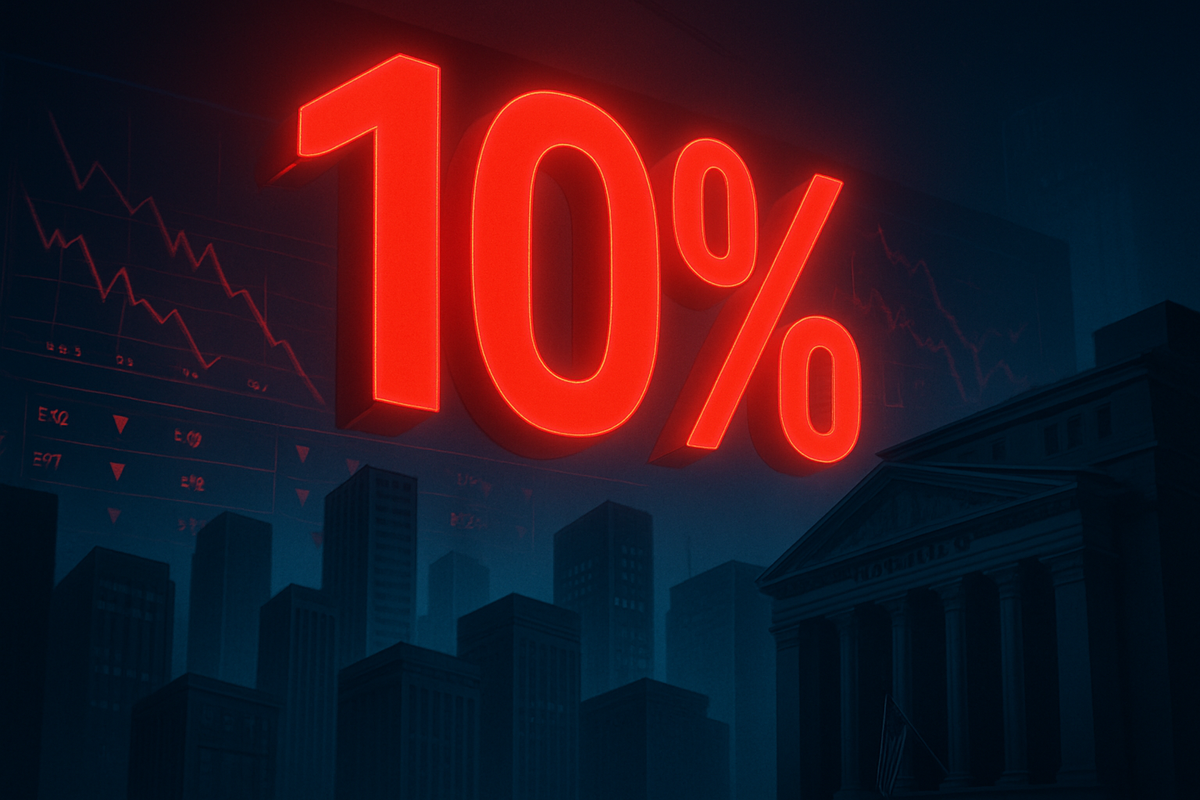
The financial markets opened to a sea of red this Monday morning as President Donald Trump’s latest economic offensive—a proposed 10% cap on credit card interest rates—sent shockwaves through the banking sector. The announcement, which the President teased in a late-night social media post on January 9, 2026, aims to slash the national average APR from its current levels of over 21% to a hard ceiling of 10% for at least one year. While framed as a populist victory for the American consumer, the immediate market reaction has been one of alarm, with billions in market capitalization evaporating in the first hours of trading on January 12, 2026.
The proposal represents a dramatic escalation of the "affordability" agenda that has defined the early years of the second Trump administration. By targeting the high-margin interest income of major lenders, the administration is challenging the fundamental profitability model of the consumer credit industry. Investors are now scrambling to price in the "regulatory risk" of a policy that could save consumers an estimated $100 billion annually but potentially destabilize the balance sheets of the nation’s largest financial institutions.
The Path to the 10% Cap
The current turmoil traces its roots back to a campaign promise made in September 2024, when then-candidate Trump first floated the idea of a 10% cap during a rally in Uniondale, New York. At the time, he labeled existing rates of 25% to 30% as "loan sharking." Following his inauguration, the momentum for this policy grew through 2025, fueled by a rare "populist convergence" in Congress. Senators like Bernie Sanders (I-VT) and Josh Hawley (R-MO) introduced the "10 Percent Credit Card Interest Rate Cap Act" (S. 381) in February 2025, providing the legislative framework that the President is now looking to enact.
The timeline of the current crisis accelerated on January 9, 2026, when President Trump set a target date of January 20, 2026—the one-year anniversary of his second inauguration—to implement the cap. While the mechanism of implementation remains murky, with legal experts debating whether this can be achieved via executive order or requires the final passage of the Sanders-Hawley bill, the market has not waited for clarity. The banking industry, led by the American Bankers Association (ABA) and the Bank Policy Institute (BPI), immediately issued a joint statement warning that such a cap would "eviscerate" credit access for millions of Americans.
Initial market reactions on Monday morning were swift and severe. Major credit card issuers saw their stocks plunge as the opening bell rang. The volatility has been compounded by the recent history of the Consumer Financial Protection Bureau (CFPB), which saw its 2024 attempt to cap late fees at $8 vacated by federal courts in 2025. This legal back-and-forth has created a climate of extreme uncertainty, leaving investors to wonder if the 10% interest cap will face a similar judicial fate or if the populist momentum in Congress is now too strong to stop.
Winners and Losers in the Banking Sector
The primary "losers" in this scenario are the specialized credit card issuers and large retail banks that rely heavily on net interest margin (NIM) from consumer revolving debt. Capital One Financial Corporation (NYSE: COF) was among the hardest hit in early trading, with shares plummeting between 9% and 11%. Given its high concentration of credit card assets and its pending merger with Discover Financial Services (NYSE: DFS)—whose shares also dropped approximately 8%—Capital One is uniquely exposed to a mandated rate ceiling. For these firms, a 10% cap would likely render their subprime and near-prime portfolios unprofitable, as the cost of risk and capital would exceed the allowable return.
Major diversified lenders are also reeling. American Express Company (NYSE: AXP) saw its stock fall 4.4%, a significant move for the premium card issuer. While American Express caters to a higher-income demographic, it operates as both a lender and a network, and a 10% cap would disrupt its closed-loop ecosystem and potentially force a radical restructuring of its famous rewards programs. Similarly, JPMorgan Chase & Co. (NYSE: JPM), the nation's largest credit card lender, saw its shares retreat by 3.0%. Citigroup Inc. (NYSE: C) also faced a 4.1% decline, as analysts warned that the bank’s significant exposure to consumer credit lines would lead to sharp revenue contractions.
Conversely, potential "winners" are harder to find in the financial sector, though some analysts suggest that credit counseling services and debt consolidation firms might see a surge in demand if traditional credit dries up. Consumer advocacy groups and populist politicians are the clear political winners, framing the move as a necessary correction to "predatory" banking practices. However, even for consumers, the victory may be pyrrhic; if banks cannot price for risk at 10%, they are widely expected to tighten credit standards, potentially leaving millions of low-to-middle-income households without access to any formal credit.
Broader Significance and Historical Context
This event fits into a broader global trend of economic populism where traditional market-based pricing is being challenged by government intervention. It mirrors historical precedents such as the 1970s usury laws, which many states eventually abandoned to allow for the expansion of the modern credit card industry. The 10% cap proposal effectively seeks to reverse decades of financial deregulation, signaling a shift toward a "utility" model of banking where profit margins are strictly controlled in the interest of social stability.
The ripple effects extend far beyond the banks themselves. Payment networks like Visa Inc. (NYSE: V) and Mastercard Incorporated (NYSE: MA) saw their stocks dip about 2% on fears of a "credit crunch." If banks respond to the cap by lowering credit limits or canceling cards for high-risk borrowers, transaction volumes across these networks would inevitably decline. Furthermore, the retail sector could face headwinds; if consumers lose access to credit, discretionary spending—the engine of the U.S. economy—could stall, leading to a broader economic slowdown.
Regulatory and policy implications are profound. The move represents a direct challenge to the Federal Reserve's autonomy in managing the cost of credit through interest rate hikes. By imposing a hard cap, the administration is effectively decoupling consumer borrowing costs from the Fed’s benchmark rates. This creates a complex policy environment where the central bank may be trying to cool inflation while the administration is attempting to lower borrowing costs, potentially leading to conflicting economic signals and increased market volatility.
What Comes Next: Legal Battles and Credit Crunches
In the short term, the financial sector is expected to launch a massive lobbying and legal offensive to block the proposal. We are likely to see a flurry of lawsuits filed in friendly jurisdictions, arguing that a 10% cap constitutes an unconstitutional "taking" of bank property or exceeds executive authority. Strategically, banks may begin preemptively "de-risking" their portfolios, which means closing the accounts of subprime borrowers before the January 20 deadline. This could lead to a sudden contraction in consumer liquidity, creating a "credit desert" for those who need it most.
Long-term, if the cap remains in place, the credit card industry will be forced to undergo a fundamental transformation. The era of "free" credit cards with lucrative cash-back and travel rewards would likely end, as those programs are largely subsidized by interest income. Banks may pivot toward fee-based models, introducing high annual fees or "service charges" to recoup lost interest revenue—though the Sanders-Hawley bill specifically includes anti-evasion language to prevent such workarounds. We may also see the rise of non-bank "shadow" lenders who operate outside the reach of federal caps, though they would likely face their own set of regulatory hurdles.
Summary and Investor Outlook
The proposal to cap credit card interest at 10% is perhaps the most significant challenge to the American banking model in a generation. It pits the immediate financial relief of millions of Americans against the stability and profitability of the financial institutions that facilitate modern commerce. For investors, the takeaway is clear: the era of predictable, high-margin consumer lending is under direct threat from a bipartisan populist movement that shows no signs of slowing down.
Moving forward, the market will be hyper-focused on the legal viability of the President's plan and the progress of S. 381 through the Senate. Investors should watch for "credit tightening" indicators, such as the Federal Reserve’s Senior Loan Officer Opinion Survey, to see how quickly banks are pulling back. The lasting impact of this event may not just be in the interest rates themselves, but in a permanent repricing of regulatory risk for the entire financial sector. As the January 20 deadline approaches, the tension between Wall Street and Washington is set to reach a fever pitch.
This content is intended for informational purposes only and is not financial advice.