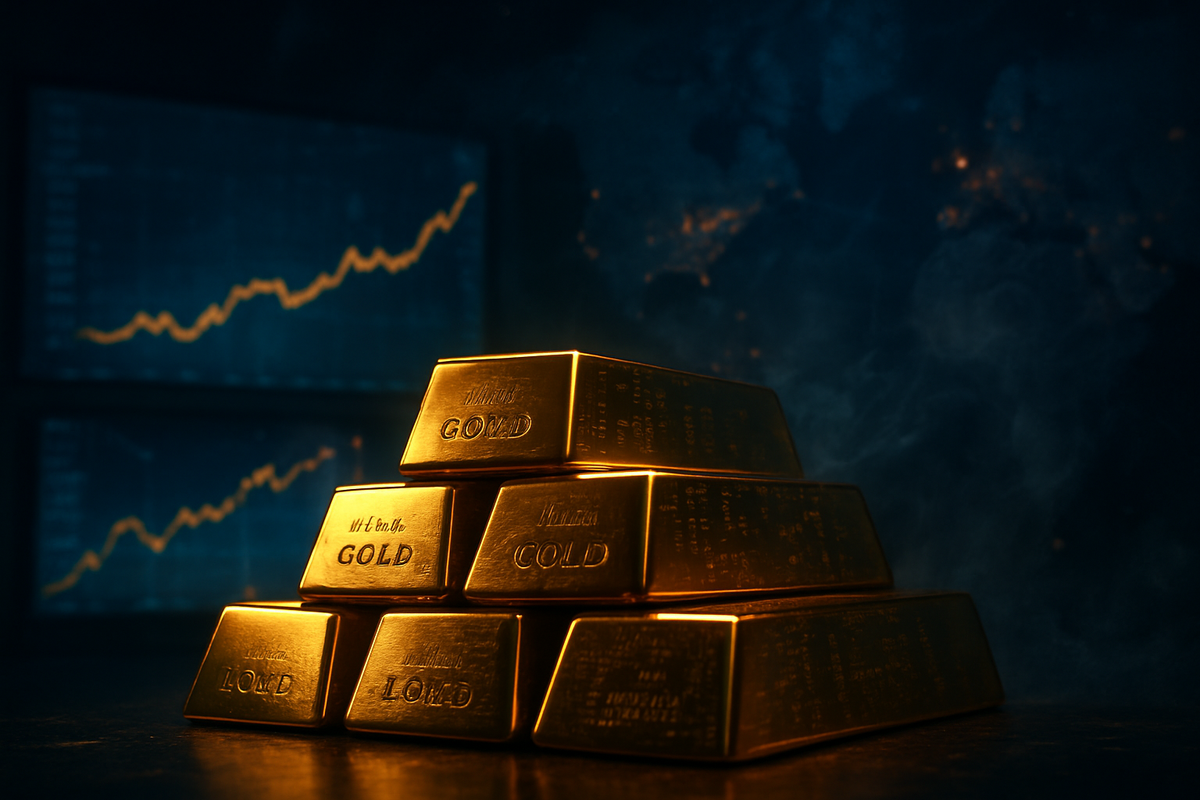
In a historic surge that has recalibrated the global financial landscape, gold futures touched an unprecedented all-time high of $4,650 an ounce on January 16, 2026. This monumental rally marks a paradigm shift in investor sentiment, as a perfect storm of institutional instability in the United States, escalating geopolitical tensions in the Middle East, and a deepening global debt crisis has driven a massive flight to safety. The psychological and technical barrier of $4,500 was breached early in the week, with momentum accelerating as traders reacted to a direct challenge to the independence of the world’s most powerful central bank.
The immediate implications of this price action are profound. While the yellow metal has traditionally served as a hedge against inflation, its current trajectory suggests it is now being utilized as an "anti-fiat" insurance policy against systemic collapse. As the U.S. dollar faces pressure from internal political friction and international efforts to diversify reserves, the surge to $4,650 signals a lack of confidence in traditional "risk-free" assets like U.S. Treasuries. For the broader market, this move has ignited a vertical rally in mining equities and precious metal exchange-traded funds, while simultaneously raising alarms about the sustainability of the current global fiscal trajectory.
A Perfect Storm: The Path to $4,650
The ascent to $4,650 was not an overnight phenomenon but the culmination of several months of escalating volatility. The primary catalyst arrived on January 12, 2026, when the U.S. Department of Justice launched a criminal investigation into Federal Reserve Chair Jerome Powell. The probe, centered on testimonies regarding a multi-billion dollar renovation of the Fed’s headquarters, was immediately labeled by Powell as a "pretext" to undermine central bank independence. This unprecedented clash between the executive branch and the Fed sent shockwaves through the currency markets, forcing institutional investors to look toward gold as the only remaining neutral asset.
Parallel to the domestic crisis in the U.S., a significant supply shock in South America further squeezed the market. Resource-grabbing policies and maritime trade disruptions in late 2025 created a vacuum in physical gold delivery, causing futures contracts to trade at a significant premium. Meanwhile, tensions in the Middle East reached a boiling point in early January. With 20% of the world’s energy demand potentially threatened in the Strait of Hormuz, the market ignored oil—which remained in an oversupplied state—and piled into gold as the definitive hedge against regional conflict.
The timeline of this rally reveals a market that has been "climbing a wall of worry." Since late 2025, global debt has ballooned to a record $340 trillion, making the "debasement trade" a central theme for hedge funds and sovereign wealth funds alike. Central banks, which had already been buying gold at record levels in 2024 and 2025, doubled down in early 2026. The World Gold Council reported that 95% of central banks now plan to increase their bullion reserves, a structural shift that provided the floor for the current $4,650 price point.
Winners and Losers in the Golden Era
The primary beneficiaries of this historic price surge are the major gold producers, whose profit margins have expanded to levels once thought impossible. Newmont (NYSE: NEM), the world’s largest gold producer, has seen its stock price nearly double over the past year as its massive reserves are revalued at the $4,650 mark. Similarly, Agnico Eagle Mines (NYSE: AEM) has emerged as a top-tier performer, benefiting from its low-cost operations in stable jurisdictions like Canada, which have shielded it from the geopolitical chaos affecting other regions.
The rally has also breathed new life into the junior and mid-tier mining sectors. U.S. Gold Corp (NASDAQ: USAU) and Eldorado Gold (NYSE: EGO) have seen triple-digit gains as previously dormant projects become economically viable at these elevated prices. Investors seeking direct exposure to the metal without the operational risks of mining have poured billions into ETFs such as the SPDR Gold Shares (NYSE Arca: GLD) and the iShares Gold Trust (NYSE Arca: IAU). Speculative capital has shifted toward the VanEck Junior Gold Miners ETF (NYSE Arca: GDXJ), which has outperformed the broader market as investors bet on high-growth potential in a $4,600+ gold environment.
Conversely, the "losers" in this scenario include traditional fiat-heavy portfolios and industries reliant on stable currency values. The U.S. dollar, while still the global reserve currency, is facing a crisis of confidence that could increase borrowing costs for the U.S. government. Furthermore, industrial consumers of gold—particularly in the high-end electronics and jewelry sectors—are facing crushing input costs. Companies that failed to hedge their precious metal requirements in late 2025 are now seeing their margins eroded by the relentless climb of futures prices.
Broad Significance and the New Monetary Reality
This event marks a departure from historical precedents where gold was primarily a response to consumer price inflation. In early 2026, headline CPI in the U.S. sat at a relatively modest 2.7%. However, the rally to $4,650 suggests that the market is no longer pricing in inflation, but rather "institutional decay." The investigation into the Fed leadership is a watershed moment that parallels the historical shifts seen during the collapse of the Bretton Woods system in 1971, albeit in a modern, hyper-financialized context.
The ripple effects are reaching far beyond the commodities pits. Competitors in the currency space, including digital assets, are also seeing increased interest. Interestingly, corporate entities have begun following the lead of central banks. Reports indicate that major private firms and stablecoin issuers like Tether have significantly increased their physical bullion holdings, treating gold as a necessary balance-sheet asset to offset the volatility of sovereign debt. This "institutionalization" of gold ownership creates a new floor for the market, making a return to sub-$2,000 levels appear highly unlikely in the foreseeable future.
Moreover, the regulatory implications are starting to surface. There is growing talk in Washington and Brussels about new "windfall taxes" on mining companies that are reaping extraordinary profits from the crisis. If enacted, such policies could dampen the rally in mining stocks even as the price of the metal itself remains high. Historical comparisons to the 1970s "stagflation" era are frequent, yet the current crisis is more complex due to the sheer volume of global debt and the speed of digital information flow.
What Comes Next: The Road to $5,000?
In the short term, all eyes are on the Federal Reserve’s upcoming leadership transition. With Jerome Powell’s term ending in May 2026, the appointment of a successor will be the most watched financial event of the year. If the administration appoints a staunchly dovish chair to facilitate easier fiscal spending, gold could easily blast past the $5,000 mark. Conversely, any resolution to the DOJ investigation that restores faith in the Fed's independence could trigger a sharp, albeit likely temporary, correction.
Strategically, mining companies like Barrick Gold (NYSE: GOLD) are expected to accelerate corporate restructuring and joint ventures to maximize efficiency. We may also see a wave of mergers and acquisitions as larger players use their high-priced equity to swallow up junior explorers who hold untapped reserves. For the broader market, the challenge will be managing the "liquidity drain" as capital exits riskier tech and growth sectors in favor of the safety and perceived permanence of gold.
Scenario planning for the rest of 2026 suggests two paths: a "Stability Reset" where political tensions ease and gold stabilizes between $4,000 and $4,200, or a "Fiscal Breakout" where a failure to manage the U.S. debt leads to gold becoming the de facto global unit of account for large-scale international settlements. Most analysts are currently leaning toward the latter, citing the "sticky" nature of geopolitical risks in the current era.
Summary and Investor Outlook
The surge of gold futures to $4,650 an ounce is more than just a commodity rally; it is a signal of a world in transition. The key takeaways for investors are clear: the era of central bank independence is under threat, global debt levels are reaching a tipping point, and gold has reclaimed its throne as the ultimate arbiter of value. The market moving forward will likely remain highly sensitive to political headlines and any signs of further "de-dollarization" in international trade.
Investors should closely monitor the VanEck Gold Miners ETF (NYSE Arca: GDX) for signs of exhaustion or further strength, as mining stocks often lead the metal's price action. Furthermore, the upcoming May 2026 Fed appointment will be the ultimate litmus test for the dollar's future. While the $4,650 high is a historic milestone, the factors that drove it there—geopolitical instability, fiscal excess, and institutional distrust—show no signs of abating. In this environment, gold is no longer just a "side investment"; for many, it has become the foundation of a modern survivalist portfolio.
This content is intended for informational purposes only and is not financial advice.