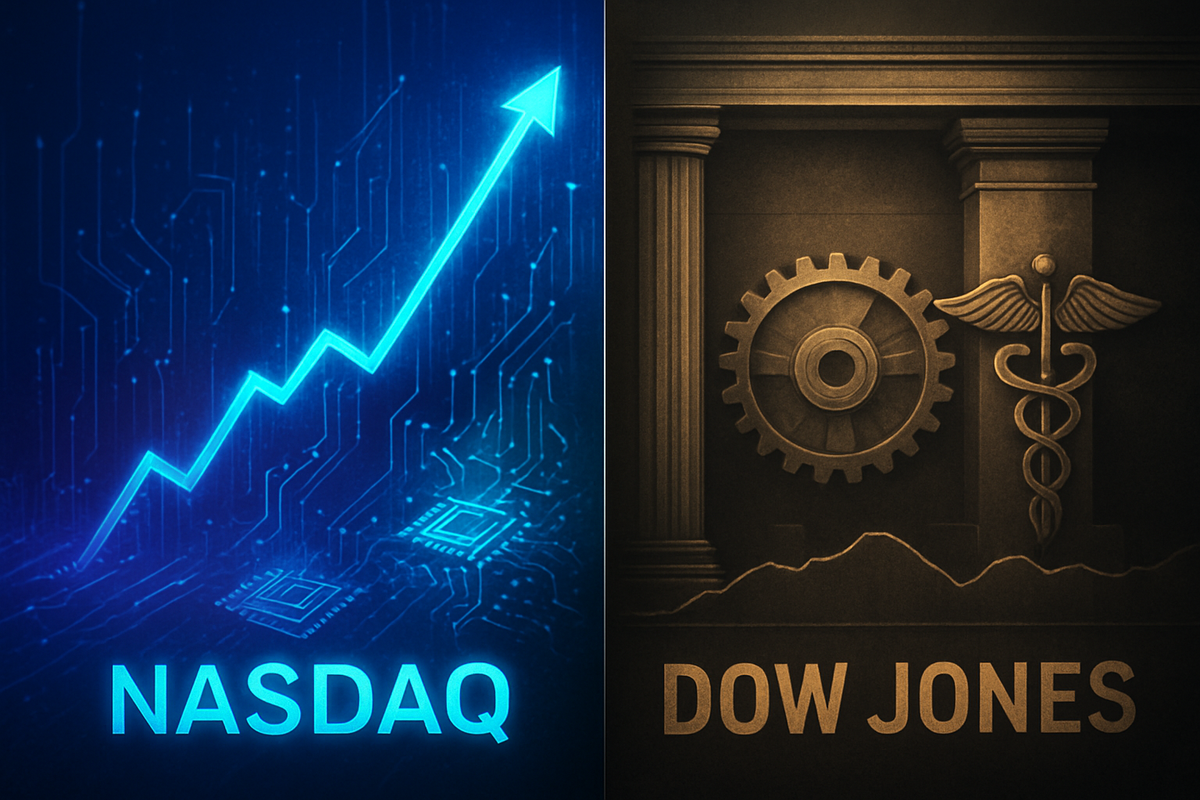
The first trading session of 2026 has revealed a stark divergence in the American equity markets, setting a polarized tone for the new year. As of January 2, 2026, the tech-heavy Nasdaq Composite has surged by more than 1.3%, fueled by an insatiable investor appetite for artificial intelligence infrastructure and semiconductor giants. In contrast, the Dow Jones Industrial Average (DJIA) struggled to find its footing, finishing the day nearly flat as heavyweights in the healthcare and legacy technology sectors continued to weigh on the blue-chip index.
This widening performance gap underscores a market that remains bifurcated between high-growth innovation and traditional value. While the Nasdaq is extending its 20.4% gain from the previous year, the Dow is grappling with a "valuation reset" among its largest components. The divergence suggests that while the broader economy shows signs of resilience, the "AI trade" remains the primary engine of capital appreciation, leaving traditional industrial and defensive sectors in the rearview mirror.
A Tale of Two Indices: The First Session of 2026
The trading day began with a clear "risk-on" sentiment that favored the Nasdaq Composite, which climbed 1.34% in early trading. The primary catalyst was a flurry of activity in the semiconductor space, sparked by news from Asia that Baidu (NASDAQ: BIDU) had filed to take its AI chip unit, Kunlunxin, public. This move reignited global optimism regarding the longevity of the AI hardware cycle, sending shares of semiconductor equipment makers and chip designers into a tailspin of buying activity. By the closing bell, the Nasdaq had solidified its lead, marking one of its strongest season openers in recent years.
Conversely, the Dow Jones Industrial Average faced a more turbulent path. Despite a late-December attempt at a rally, the index was dragged down by its price-weighted structure, which disproportionately felt the impact of a decline in International Business Machines (NYSE: IBM) and a stagnant performance from UnitedHealth Group (NYSE: UNH). The Dow’s inability to capture the morning's momentum highlighted a growing concern among institutional investors: the "old guard" of the American economy is struggling to keep pace with the rapid digital transformation that is rewarding the Nasdaq’s top constituents.
The timeline leading into this divergence was shaped by a pivotal New Year’s Eve executive order. On December 31, 2025, the Trump administration announced a one-year delay on scheduled tariff hikes for furniture and kitchen cabinets. While this provided a significant boost to consumer discretionary stocks, it was not enough to offset the structural weaknesses in the Dow’s industrial and healthcare components. Meanwhile, the Nasdaq benefited from a favorable interest rate outlook, with traders pricing in 60 basis points of Federal Reserve rate cuts for 2026, a macro environment that historically favors high-multiple growth stocks.
Winners and Losers: The AI Vanguard vs. The Value Laggards
The undisputed winners of the 2026 opening bell were the semiconductor titans. Nvidia (NASDAQ: NVDA) rose 1.78%, pushing its market capitalization further toward the $4.5 trillion mark, as it remains the primary beneficiary of the AI infrastructure build-out. Micron Technology (NASDAQ: MU) and ASML (NASDAQ: ASML) saw even more dramatic gains, rising 7.3% and 8% respectively, as investors bet on a supply-side squeeze for high-bandwidth memory and advanced lithography tools. Even Intel (NASDAQ: INTC), which has faced years of restructuring, found favor with a 5.6% jump, suggesting a broad-based recovery for the domestic chip industry.
On the losing side, the narrative was dominated by specific corporate headwinds. Tesla (NASDAQ: TSLA) saw its shares slide 2% after reporting Q4 2025 deliveries of 418,227 units, missing the consensus estimate of 422,850. This marked the second consecutive annual decline in deliveries for the EV pioneer, raising questions about its growth trajectory in an increasingly competitive global market. In the Dow, UnitedHealth Group remained a significant drag; after a disastrous 2025 in which the stock fell 34% due to rising medical care ratios, the healthcare giant failed to rebound, closing the day flat as regulatory hurdles in Medicare Advantage continue to cloud its earnings outlook.
Microsoft (NASDAQ: MSFT) also found itself in an unusual position as a relative laggard on the first day of the year. Shares slipped nearly 2.1% as investors rotated out of mega-cap software names to fund positions in more aggressive semiconductor plays. Despite Microsoft's Azure cloud division reporting 40% revenue growth late in 2025, the market appears to be demanding more immediate evidence of AI monetization at the software level, leading to a temporary "wait-and-see" approach for the Redmond-based giant.
Analyzing the Macro Shift: AI Infrastructure and Policy Pivots
The divergence between the Nasdaq and the Dow is more than just a momentary fluctuation; it represents a fundamental shift in how the market perceives value in 2026. We are currently in the "build-out phase" of the AI revolution, where the companies providing the "picks and shovels"—the hardware and chips—are seeing unprecedented capital inflows. This mirrors the late 1990s internet build-out, though analysts argue that today's leaders possess significantly stronger balance sheets and actual earnings compared to the dot-com era.
Furthermore, the delay in furniture and cabinet tariffs has created a localized boom for consumer-facing companies. Wayfair (NYSE: W) and RH (NYSE: RH) surged 7% and 10% respectively on the news, providing a rare bright spot for the non-tech sectors. This policy shift suggests a tactical approach by the administration to ease inflationary pressures on the American consumer, which may eventually provide a tailwind for the Dow’s more consumer-centric components if the trend continues into other sectors like retail or automotive.
From a regulatory standpoint, the market is closely watching the Federal Reserve. With three rate cuts already delivered in 2025, the "higher-for-longer" narrative has shifted toward a "managed descent." This environment is a double-edged sword: it supports the high valuations of Nasdaq growth stocks but creates uncertainty for the Dow’s financial components, such as Goldman Sachs (NYSE: GS) and JPMorgan Chase (NYSE: JPM), which must navigate narrowing net interest margins.
The Road Ahead: Strategic Pivots and Market Scenarios
Looking forward, the market faces several potential "pivot points" in the first quarter of 2026. For the Nasdaq to maintain its lead, the focus must shift from AI infrastructure to AI application. Investors will be looking at the upcoming earnings season to see if companies like Microsoft and Alphabet (NASDAQ: GOOGL) can translate their massive capital expenditures into bottom-line growth. If software monetization fails to meet lofty expectations, the Nasdaq could see a sharp "mean reversion" as capital rotates back into undervalued Dow components.
For the Dow, the path to recovery lies in the healthcare and industrial sectors. All eyes are on UnitedHealth’s earnings call scheduled for January 27. A stabilization in medical loss ratios could signal that the worst is over for the healthcare giant, potentially triggering a massive relief rally in the price-weighted index. Additionally, Boeing (NYSE: BA), which entered 2026 as a "Dog of the Dow" pick after a 26% recovery in 2025, remains a wild card. If the aerospace leader can continue its operational turnaround, it could provide the necessary lift to help the Dow close the gap with its tech-heavy counterpart.
Investor Takeaway: Monitoring the Great Divide
The start of 2026 has confirmed that the "Great Divide" in the U.S. stock market is alive and well. The Nasdaq’s dominance is currently anchored by the semiconductor industry's strength and a favorable interest rate environment, while the Dow is being held back by structural challenges in legacy sectors. For investors, the key takeaway is the importance of sector selection over broad market exposure.
Moving forward, the market will be hypersensitive to the Federal Reserve's January minutes and the initial batch of Q4 earnings reports. While the "AI trade" has the momentum, the extreme valuation gap between tech and value suggests that any disappointment in growth metrics could lead to a rapid and violent rotation. Investors should watch for signs of "bottoming out" in healthcare and industrials, as these laggards may offer the best risk-reward profile for the remainder of the year if the economic expansion broadens.
This content is intended for informational purposes only and is not financial advice