
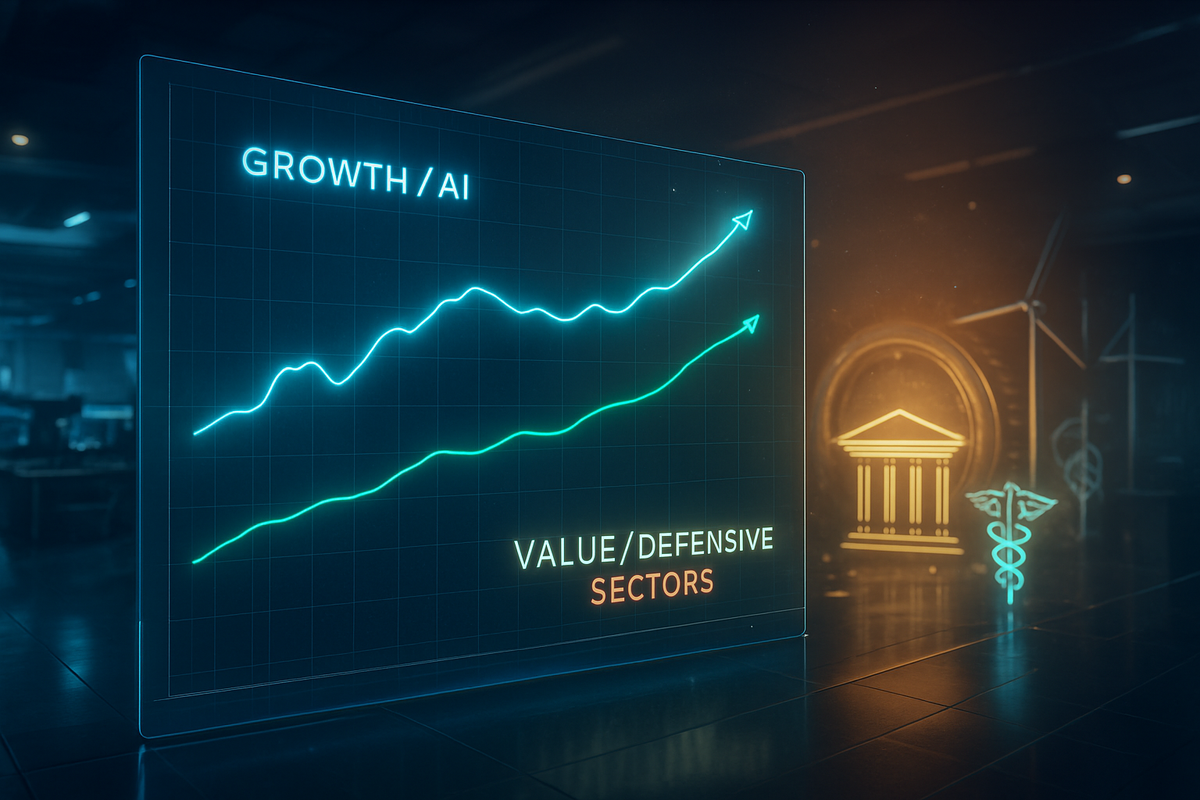
As the opening bells of 2026 ring across Wall Street, the financial landscape is undergoing a profound structural shift. After two years of unprecedented dominance by mega-cap technology and artificial intelligence "builders," the market is witnessing a determined rotation into value and defensive sectors. While the S&P 500 Index (INDEXSP: .INX) hovers near the psychological milestone of 7,000, the "New Year Cheer" that typically lifts all boats is being applied selectively. Investors are no longer rewarding promise alone; they are demanding dividends, earnings stability, and tangible returns on the massive capital expenditures of the previous 24 months.
The immediate implication of this rotation is a "broadening out" of the market rally. The extreme concentration in the "Magnificent Seven" that characterized 2024 and much of 2025 is yielding to a more egalitarian market where small-caps, utilities, and financials are taking the lead. This transition is driven by a realization that while AI remains a long-term economic engine, the "infrastructure phase" of the cycle has peaked, leaving high-multiple tech stocks vulnerable to valuation resets if they cannot prove immediate monetization.
The ROI Gap and the 2026 Rebalancing
The narrative of early 2026 is defined by what analysts are calling the "ROI Gap"—the widening disconnect between the billions spent on AI chips and the actual revenue generated by AI software applications. Throughout late 2025, the market began to sour on companies that could not demonstrate a clear path to profitability from their AI investments. This skepticism has culminated in a New Year sell-off for several high-flying growth names, as institutional desks reallocate capital toward "Old Economy" sectors that are now integrating AI to slash operational costs rather than just selling the tools to build it.
This shift did not happen overnight. The timeline leading to this moment was paved by a series of Federal Reserve "wait-and-see" pauses in late 2025, which kept the federal funds rate in the 3.50%–3.75% range. With inflation cooling to a sticky but manageable 2.5%, the "higher for longer" mantra has been replaced by "steady for now." This stability has removed the immediate tailwind for speculative growth stocks, which thrive on rapidly falling rates, and instead favored companies with robust balance sheets and consistent cash flows. Key stakeholders, including major hedge funds and pension managers, have spent the final weeks of December 2025 preparing for this "Great Rebalancing," moving billions into sectors that were largely ignored during the 2024 AI frenzy.
Winners and Losers in the Value Migration
In this new environment, the traditional defensive sectors are emerging as the primary beneficiaries. NextEra Energy, Inc. (NYSE: NEE) and Exelon Corporation (NASDAQ: EXC) have seen significant inflows as utilities are rebranded as "AI-adjacent growth" stocks. The insatiable power demand from data centers has turned these formerly sleepy dividend payers into essential infrastructure plays. Similarly, in the energy space, nuclear and clean-energy firms like Oklo Inc. (NYSE: OKLO) and Bloom Energy Corporation (NYSE: BE) are capturing the spillover from tech’s energy needs, providing a unique blend of value-style stability with growth-style upside.
On the losing end are the "builders" who have seen their multiples stretched to the breaking point. NVIDIA Corporation (NASDAQ: NVDA), the undisputed champion of the last two years, faces a challenging start to 2026 as the market questions the sustainability of triple-digit growth in hardware sales. While still fundamentally strong, the stock is no longer the "easy trade" it once was. Alphabet Inc. (NASDAQ: GOOGL) and other software giants are also under pressure to prove that their generative AI products can protect search margins against a rising tide of specialized competitors. Meanwhile, the financial sector is seeing a resurgence, with JPMorgan Chase & Co. (NYSE: JPM) and Citigroup Inc. (NYSE: C) benefiting from a revival in M&A activity and a flurry of high-profile IPOs expected later this year.
Broader Industry Trends and Macro Ripples
The 2026 rotation fits into a broader historical pattern of market cycles where extreme concentration eventually leads to a mean reversion. Much like the post-dot-com era or the 2022 tech correction, the market is currently digesting the excesses of a technological breakthrough. However, unlike 2000, the companies leading the charge today are highly profitable, which prevents a total collapse and instead facilitates a controlled migration of capital. This "soft rotation" is a sign of a maturing bull market rather than the beginning of a bear cycle.
Regulatory and policy implications are also playing a significant role. With Jerome Powell’s term as Fed Chair set to expire in May 2026, the market is already pricing in a "shadow chair" dynamic. The uncertainty over his successor is driving a flight to quality, as investors prefer the predictability of healthcare and consumer staples over the high-beta volatility of tech. Furthermore, drug-pricing reforms and new antitrust scrutinies are forcing investors to pick winners within the healthcare sector based on their ability to navigate a more restrictive regulatory environment, further favoring established value players over speculative biotech.
The Road Ahead: Strategic Pivots and Scenarios
In the short term, the market will be hyper-focused on the Q1 2026 earnings season. If tech giants can demonstrate that the "ROI Gap" is closing through increased software subscriptions and operational efficiencies, the growth-to-value rotation may pause. However, the more likely scenario is a continued "catch-up trade" for the Russell 2000 Index (INDEXRUSSELL: RUT). Small-caps, which were severely punished by high rates in 2024, are projected to see earnings growth of nearly 17% in 2026, making them an attractive alternative to overpriced mega-caps.
Strategically, companies will need to pivot from "growth at all costs" to "profitable adoption." We expect to see a wave of consolidation in the AI software space as larger, cash-rich value companies acquire struggling AI startups that have run out of venture capital. This will create a hybrid market where the lines between "tech" and "industry" become increasingly blurred. Investors should prepare for a year where "boring" is beautiful, and the ability to pay a dividend is a more valuable signal than a flashy product demo.
Summary of the 2026 Market Landscape
The start of 2026 marks the end of the AI-monolith era and the beginning of a more diversified, value-conscious market. While the "New Year Cheer" has kept the S&P 500 near record highs, the underlying machinery of the market has changed. The rotation into utilities, financials, and healthcare is not a retreat into fear, but a sophisticated reallocation toward sectors that offer both stability and a new form of "industrial-tech" growth.
Moving forward, investors should watch for the Fed’s signals in March and the announcement of Powell’s potential successor. These macro events will dictate whether the value rotation becomes a permanent fixture of 2026 or a temporary pitstop. For now, the takeaway is clear: the market is rewarding discipline over hype. The high-multiple tech stocks that carried the indices for two years are now passing the baton to the sectors that will power the next phase of the global economy.
This content is intended for informational purposes only and is not financial advice.