
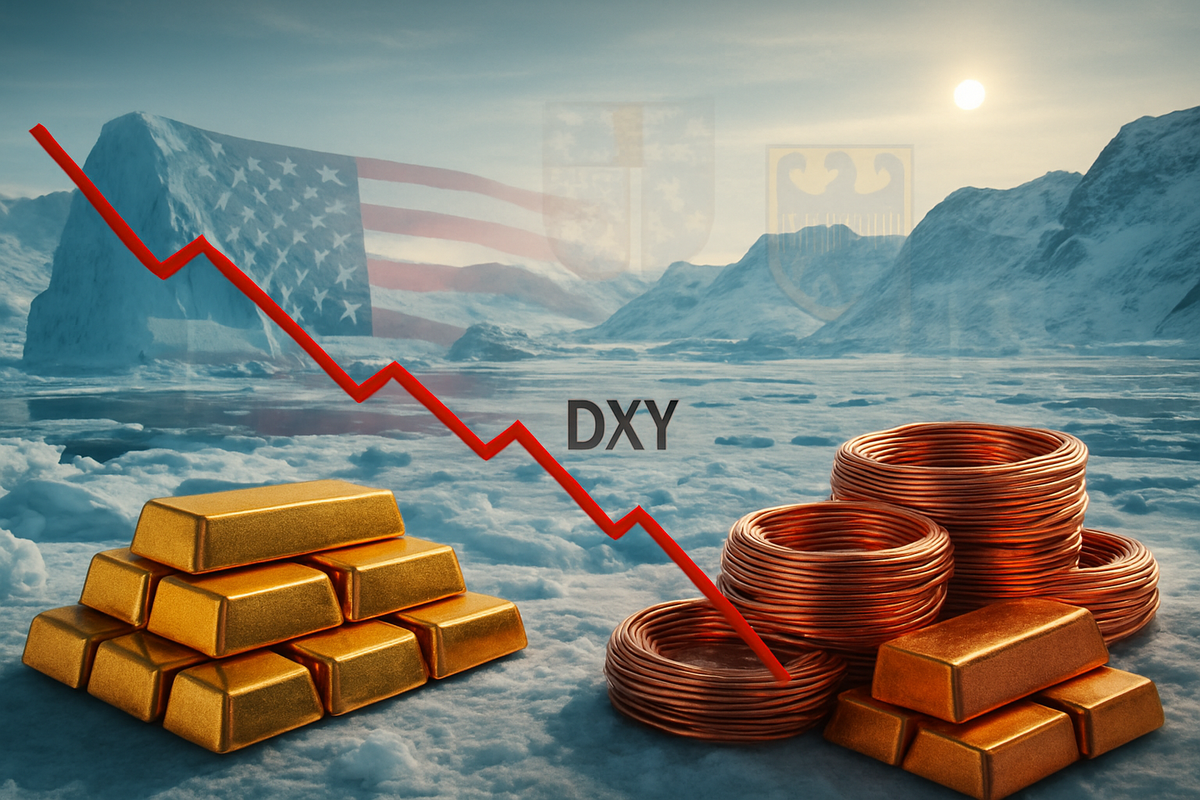
As of January 20, 2026, the global financial landscape is grappling with a sudden and aggressive escalation in trade tensions, as the U.S. administration pivots from traditional protectionism to a geopolitical showdown over Arctic territory. President Trump has intensified his long-standing ambition to acquire Greenland, issuing a direct ultimatum to European allies: support the sale or face a debilitating new tariff regime. The "Greenland Row" has sent shockwaves through the currency and commodity markets, driving the U.S. Dollar into a sharp retreat and pushing safe-haven assets like gold to unprecedented all-time highs.
The immediate fallout of these threats has created a volatile "de-dollarization" trade. As the U.S. Dollar Index (DXY) fell nearly 1% in a single session to 98.4652, the resulting weakness in the greenback has provided a massive floor for the commodities complex. Industrial metals and precious minerals are no longer just trading on supply and demand fundamentals; they have become the primary vehicles for investors looking to hedge against a fragmenting NATO alliance and the specter of a transatlantic trade war.
The Greenland Ultimatum and the 25% Threat
The current crisis reached a breaking point on January 17, 2026, when President Trump announced a tiered punitive tariff structure targeting eight European nations—dubbed the "Greenland Eight"—including Denmark, Norway, Germany, and the United Kingdom. The administration has demanded a "complete and total purchase" agreement for the autonomous territory of Greenland, citing its strategic importance for national security and its vast untapped mineral reserves. Under the proposed plan, an initial 10% tariff on all imported goods from these nations will take effect on February 1, 2026, with an automatic escalation to 25% by June 1 if no deal is reached.
This move follows a year of simmering tensions that began shortly after the administration took office in early 2025. The timeline accelerated in mid-January 2026 after Denmark led a NATO military exercise in the Arctic, which the White House characterized as an "unfriendly act" toward American interests. To bypass a divided Congress, the President is invoking the International Emergency Economic Powers Act (IEEPA), a move that has already sparked a constitutional challenge currently heading toward the U.S. Supreme Court.
Initial market reactions were swift and severe. European indices tumbled as exporters braced for the February 1 deadline, while the U.S. bond market signaled distress. Reports that European nations, who collectively hold over $1.6 trillion in U.S. Treasuries, might leverage their holdings in retaliation triggered a "mutually assured destruction" sentiment in the currency markets. This fear of a treasury sell-off was the primary catalyst behind the dollar’s sudden drop on January 20, as capital fled toward the Swiss Franc and hard assets.
Corporate Winners and Losers in the Tariff Crossfire
The tech sector remains the primary battleground for these trade shifts. Nvidia (NASDAQ: NVDA) has found itself in a precarious position; despite the "tariff pause" on some minerals, its shares fell 1.6% this week after Chinese customs blocked shipments of its H200 AI processors in a retaliatory move against broader U.S. tech curbs. Conversely, TSMC (NYSE: TSM) has managed to buoy the broader tech market, reporting a 35% year-over-year profit beat that suggests high-end semiconductor demand remains resilient despite the geopolitical noise.
In the commodities space, precious metals miners have emerged as the clear winners of the "Greenland Row." Companies like Fresnillo (LSE:FRES) and Endeavour Mining (TSX:EDV) have seen their valuations surge alongside gold, which hit a staggering $4,734.60 per ounce today. The industrial sector, however, faces a mixed bag. While 3M (NYSE: MMM) and Intel (NASDAQ: INTC) are preparing to report Q4 earnings amidst rising input costs, the "tariff pause" on critical minerals announced on January 15 provided a temporary relief rally for the Nasdaq 100, though it simultaneously triggered a "sell the news" event in silver, which dipped from its peak of $95.00 to roughly $90.00.
The automotive and aerospace sectors are also feeling the heat. United Airlines (NASDAQ: UAL) and other carriers are monitoring the situation closely as potential fuel surcharges and aircraft part tariffs loom. Meanwhile, memory chip makers like Micron (NASDAQ: MU) and Samsung (KRX:005930) have seen modest gains of 0.4% to 1.5% as they benefit from a $1.8 billion investment in new facilities designed to bypass traditional trade routes that are now under threat.
Broader Significance: The Weaponization of Trade
The Greenland Row represents a fundamental shift in how trade policy is used as a tool of territorial ambition. Unlike the previous trade wars focused on manufacturing deficits, this conflict links trade access directly to sovereign land acquisitions. This "territorial protectionism" fits into a broader industry trend where critical minerals—essential for the AI revolution and the green energy transition—are being treated as strategic assets rather than mere commodities. Greenland’s untapped reserves of rare earth elements are the hidden prize in this dispute, making industrial metals like copper, currently trading above $5.80 per pound, a proxy for geopolitical power.
This event also highlights the fragility of the post-WWII alliance system. By targeting NATO allies with the same fervor once reserved for strategic rivals like China, the administration has introduced a "geopolitical risk premium" that may permanently alter how the U.S. Dollar is viewed as a reserve currency. Historical comparisons are being drawn to the 1971 "Nixon Shock," where unilateral U.S. economic action forced a global realignment of currency values. Today, the move toward "hard assets" suggests that markets are preparing for a prolonged period where political leverage, rather than economic productivity, dictates price discovery.
Furthermore, the "thaw-and-freeze" cycle with China remains a background threat. While a temporary truce in late 2025 lowered some tariffs, the U.S. maintains a 30% total tariff on most Chinese goods. The administration’s recent decision to delay tariff hikes on furniture and cabinets to 25%—rather than the planned 50%—indicates an awareness of domestic inflationary pressures, yet the Greenland dispute suggests that the White House is willing to risk higher inflation to achieve its Arctic objectives.
The Path Ahead: Scenarios for 2026
In the short term, the market's focus is squarely on the February 1 deadline for the initial 10% European tariffs. If the administration proceeds without a diplomatic breakthrough, we can expect a further rotation out of the dollar and into safe-haven assets. A key strategic pivot may come from the European Union, which is currently debating a "strategic autonomy" package that could include counter-tariffs on iconic American exports and a coordinated shift away from dollar-denominated trade for energy and minerals.
Long-term, the legal battle over the IEEPA will be the defining factor for market stability. If the Supreme Court limits the President’s ability to impose tariffs for non-economic reasons (like land acquisition), the "risk premium" currently baked into gold and silver may evaporate quickly. However, should the administration’s powers be upheld, the "Greenland Row" could be just the first in a series of "territorial trades" that redefine global commerce. Investors should also watch for a potential "strategic mineral alliance" between the U.S. and smaller Arctic nations, which could emerge as a way to mitigate the impact of the European tariffs.
Summary and Investor Outlook
The events of January 2026 have proven that geopolitical volatility remains the most potent driver of market prices. The "Greenland Row" has effectively weaponized the U.S. tariff code, leading to a record-breaking surge in gold and industrial metals while simultaneously undermining the strength of the U.S. Dollar. The primary takeaways for investors are the renewed importance of hard assets as a hedge against NATO instability and the continued volatility in the tech sector as it remains caught in the crossfire of U.S.-China-Europe trade relations.
Moving forward, the market is likely to remain in a "wait-and-see" posture until the February 1 tariff implementation date. Investors should keep a close eye on the DXY’s ability to hold the 98.00 level; a breach below this could signal a deeper structural shift in global capital flows. Additionally, the upcoming Q4 earnings season for industrial giants will provide the first real data on how these tariff threats are impacting corporate margins and supply chain strategies. In this high-stakes environment, the intersection of geography and trade has become the new frontier for financial risk.
This content is intended for informational purposes only and is not financial advice.