
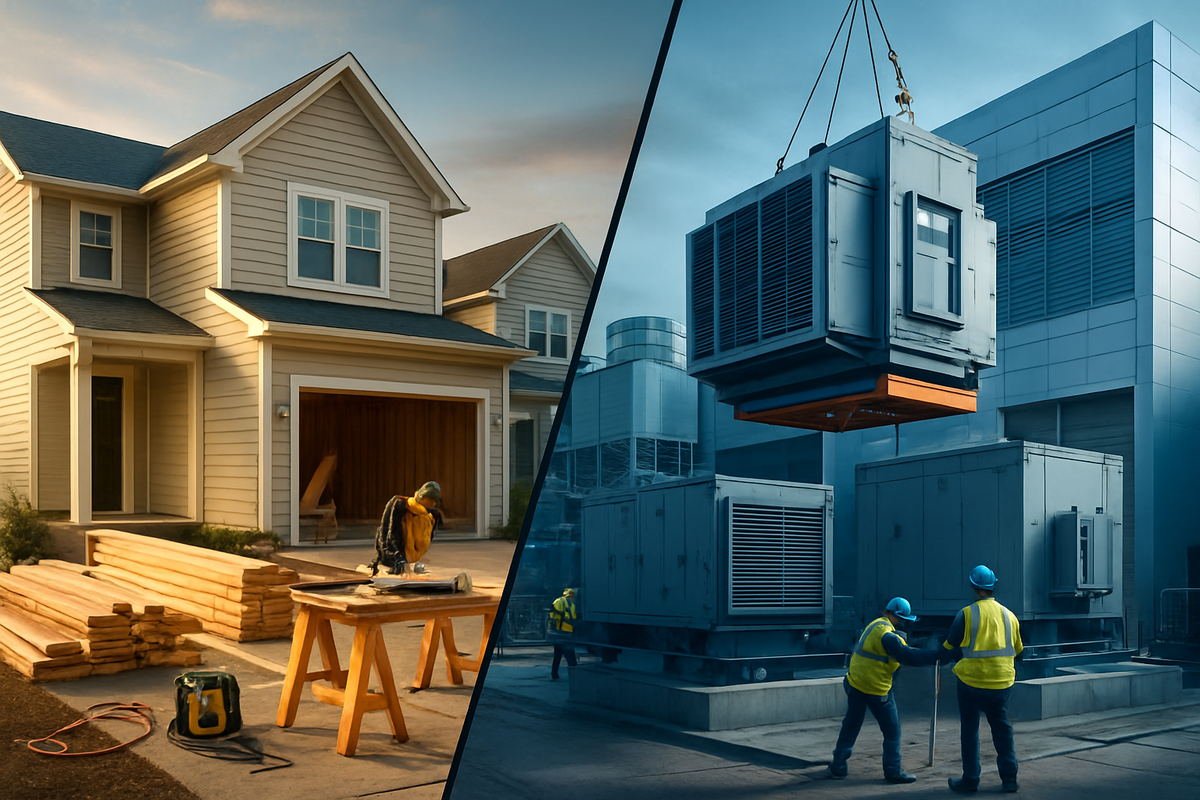
Following a turbulent period of political gridlock and fiscal uncertainty, new data released by the U.S. Census Bureau on January 21, 2026, reveals that U.S. construction spending rose by 0.5% in October 2025. This increase brought the seasonally adjusted annual rate to $2.175 trillion, a figure that caught many economists by surprise given the high interest rate environment and the shadow of a massive government shutdown. While the headline number suggests growth, a deeper dive into the metrics reveals a fractured industry where traditional homebuilding is stalling while specialized infrastructure and home renovations are experiencing a historic boom.
The immediate implications of this report suggest a resilient but highly specialized economy. As the "lock-in effect" continues to keep homeowners in their existing properties, the focus of the construction market has shifted from new developments to the modification of current assets. Simultaneously, the burgeoning "AI supercycle" is funneling billions into the industrial sector, creating a massive divergence between traditional residential builders and those providing the power and cooling infrastructure for the digital age.
A Tale of Two Tiers: The Post-Shutdown Data Flood
The release of the October 2025 construction data was delayed by over two months due to a 43-day government shutdown that paralyzed federal agencies from late 2025 through mid-November. When the data finally emerged in late January 2026, it depicted a market heavily influenced by high mortgage rates and shifting consumer priorities. Private residential construction rose 1.3% to an annual rate of $913.9 billion, but this growth was driven almost exclusively by a 4.5% surge in home improvements and renovations. In contrast, spending on new single-family projects fell by 1.3%, reflecting a cautious approach from developers as buyers struggle with affordability.
The timeline leading up to this moment was defined by extreme volatility. In early January 2026, the administration took the unprecedented step of directing Fannie Mae and Freddie Mac to purchase $200 billion in mortgage-backed securities (MBS). This intervention was designed to artificially lower mortgage rates, which had stubbornly remained in the low-6% range, and to breathe life back into the stalling housing market. However, the October data shows that before these measures took root, the market was already pivoting toward a "stay and spray" mentality, where homeowners opted to invest in their current homes rather than navigate the high-cost landscape of new purchases.
Public construction remained largely stagnant, inching up only 0.1% to $524.0 billion. While educational construction saw a modest 0.7% rise, highway and street projects were flat, likely a casualty of the funding delays caused by the government shutdown. The initial market reaction to the report was mixed; investors cheered the resilience of the total spending figure but expressed concern over the continued weakness in the private non-residential sector, which saw a 0.2% decrease as office vacancy rates in major downtown areas exceeded 30%.
Corporate Divergence: Winners in Infrastructure and Renovation
The shift in construction priorities has created a clear set of winners and losers among public companies. Homebuilding giants such as D.R. Horton (NYSE: DHI) and Lennar (NYSE: LEN) have felt the weight of the new-build slowdown. On January 20, 2026, D.R. Horton reported first-quarter earnings that beat expectations, yet the stock fell over 3% as investors focused on declining sales volumes and tightening margins. Similarly, Lennar saw its stock struggle despite dividend hikes, as its late-January 10-K report highlighted a 3.5% decrease in total revenue for 2025 due to rising land and labor costs.
Conversely, companies catering to the renovation and industrial infrastructure boom are thriving. Home Depot (NYSE: HD) has successfully leveraged its dominance in the professional contractor segment, with big-ticket renovation transactions growing significantly in late 2025. Lowe’s (NYSE: LOW) has also found a niche through its acquisition of Artisan Design Group, focusing on the "finishing" stages of construction which are less sensitive to interest rate fluctuations than early-stage ground-breaking.
The most dramatic winners, however, are found in the industrial and power sectors. Caterpillar (NYSE: CAT) reported record-high fourth-quarter 2025 revenue of $19.1 billion, an 18% jump fueled by the demand for massive natural gas engines and turbines required to power AI data centers. Vertiv (NYSE: VRT) and Eaton (NYSE: ETN) have also emerged as "pure-play" beneficiaries of the AI infrastructure race. Vertiv’s specialization in liquid cooling for high-density GPU racks and Eaton’s 65% annual growth in data center distribution business illustrate how the construction of digital "temples" is offsetting the decline in traditional commercial warehouses and offices.
The Macro Tug-of-War: MBS Purchases and AI Supercycles
The October 2025 data fits into a broader trend of "economic bifurcations." We are witnessing a market where the consumer-facing residential sector is dependent on government intervention—such as the $200 billion MBS purchase order executed by the FHFA under the leadership of Bill Pulte, grandson of the PulteGroup (NYSE: PHM) founder—while the industrial sector is being propelled by a private-sector technological gold rush. This creates a complex regulatory environment where policy is being used to fix the "old" economy (housing) while the "new" economy (AI infrastructure) scales at a pace that often outstrips existing power grids and labor supplies.
Historically, construction spending has been a reliable leading indicator of economic health. However, the current precedent is more akin to the post-war industrial shifts of the 1940s than the housing boom of the early 2000s. The ripple effects are being felt by competitors and partners alike; as Caterpillar secures multi-gigawatt deals for data center power, competitors in the heavy machinery and electrical equipment space are being forced to pivot away from traditional road-and-bridge equipment toward high-tech energy solutions.
Regulatory implications are also looming. The threat of punitive tariffs and "Sell America" sentiment in the bond market—partially linked to ongoing trade tensions—have pushed yields higher, offsetting much of the relief provided by the government's MBS purchases. Investors are now forced to weigh the benefits of domestic industrial growth against the risks of a trade-induced inflationary spike that could keep the Federal Reserve's hands tied well into 2026.
The 2026 Horizon: From Intervention to Execution
Looking ahead, 2026 is shaping up to be an "execution year" for the construction industry. The short-term focus will be on whether the $200 billion MBS intervention can successfully drive mortgage rates low enough to restart the new-home cycle. If successful, we may see a resurgence in tickers like PulteGroup (NYSE: PHM) and Lennar (NYSE: LEN) as the spring selling season approaches. However, a failure to move the needle on affordability could lead to a permanent strategic pivot toward build-to-rent models and a further consolidation of the renovation market by firms like Home Depot.
In the long term, the AI data center construction boom is projected to peak around 2029. This provides a multi-year runway for companies like Vertiv (NYSE: VRT) and Eaton (NYSE: ETN), but it also presents a challenge: the "time-to-power" bottleneck. Market opportunities will emerge for companies that can provide off-grid power solutions and modular construction techniques that bypass traditional, slow-moving utility approvals. We may see more strategic alliances, such as the one between Caterpillar and Vertiv, to create pre-designed architectures that simplify the construction of hyperscale facilities.
Navigating a Hybrid Market
The 0.5% rise in October construction spending is a testament to the resilience of the U.S. economy, but it masks a significant transition. The key takeaway for investors is that the construction industry is no longer a monolithic block. It has split into a "renovation and repair" residential market and a "high-tech infrastructure" industrial market. While the traditional homebuilding sector faces headwinds from interest rates and land costs, the industrial sector is riding a wave of capital expenditure that shows no signs of slowing.
As we move forward into 2026, the market will be characterized by this hybrid nature. Investors should watch for the impact of potential import tariffs on material costs and the availability of specialized labor, both of which could cap the upside of the construction surge. Ultimately, the lasting impact of this period will be defined by how well the industry adapts to the twin pressures of government fiscal intervention and the private sector's unquenchable thirst for digital infrastructure. The builders of tomorrow are no longer just laying bricks; they are installing the power and cooling systems that will sustain the next generation of global commerce.
This content is intended for informational purposes only and is not financial advice.