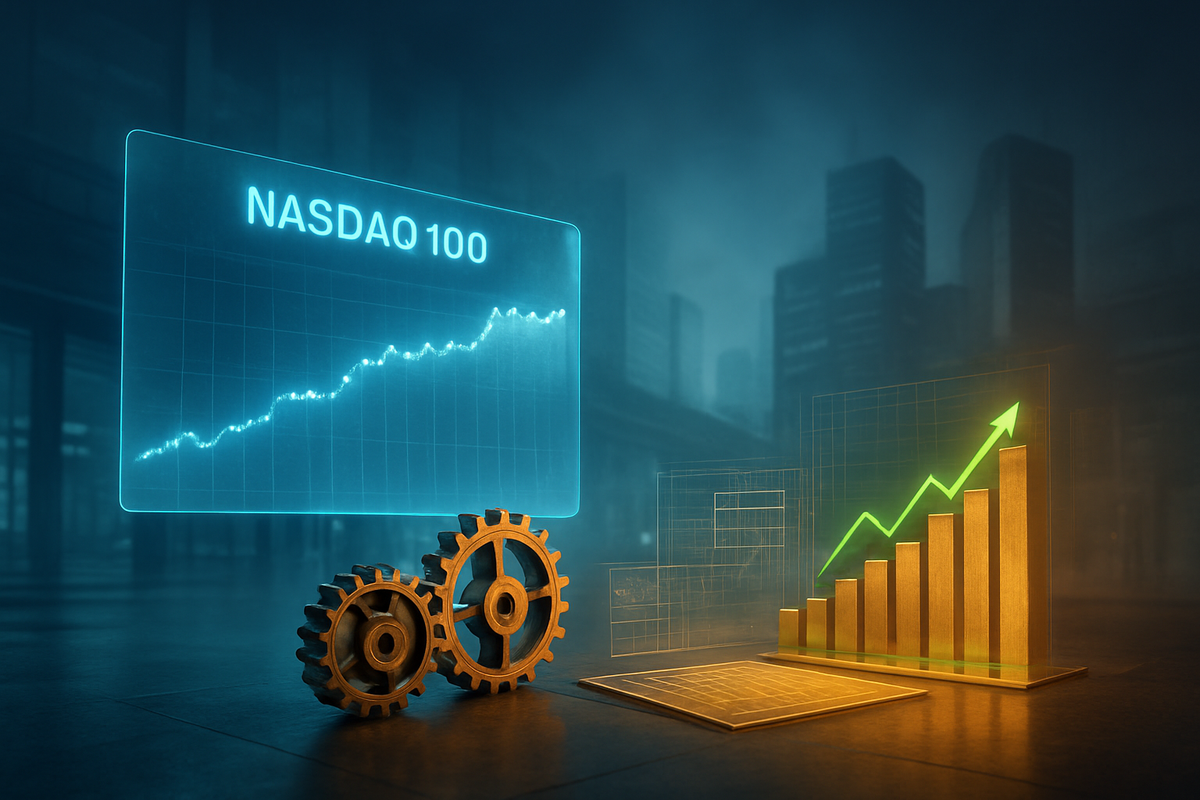
The relentless surge that propelled the technology sector to historic heights throughout 2024 and 2025 has hit a significant roadblock in the opening week of 2026. As of January 7, 2026, the tech-heavy Nasdaq 100 (NASDAQ: NDX) is showing clear signs of exhaustion, with futures flattening and the index struggling to breach a critical "valuation wall" at the 25,739 resistance level. While the year began with a brief flash of optimism, the momentum has rapidly cooled as investors pivot away from high-multiple AI darlings in favor of neglected small-cap and value stocks.
This shift marks a fundamental transition from "AI euphoria" to "AI recalibration." Market participants are no longer willing to reward "AI at any price," instead demanding tangible evidence of monetization and earnings growth to justify the extreme valuations seen in the semiconductor and software sectors. With the S&P 500's forward P/E ratio sitting at a lofty 23.8x and the Shiller CAPE ratio approaching 40—levels not seen since the peak of the dot-com bubble—the market appears to be entering a period of "post-rally digestion" that could redefine the leadership of the 2026 bull market.
A Stalled Engine: The Technical and Macro Headwinds of 2026
The cooling of the Nasdaq is not merely a technical retracement but the result of a convergence of macro-economic pressures. After a 21% gain in 2025, the index is currently rotating around a central pivot of 25,514. The initial January 2nd surge of 1.1% was quickly erased as institutional investors began a "wait-and-see" approach ahead of critical macro data, including the upcoming Consumer Price Index (CPI) and JOLTS reports. The market’s "compressed" state suggests that a significant breakout or breakdown is imminent, with the bias currently leaning toward a consolidation phase.
Adding to the uncertainty is the looming leadership transition at the Federal Reserve. With Chairman Jerome Powell’s term set to expire in May 2026, speculation regarding his successor has fractured the interest rate outlook. While the market had previously hoped for aggressive easing, the current consensus has narrowed to only one or two 25-basis-point cuts for the entirety of 2026. This "higher-for-longer" anxiety is particularly punishing for high-growth tech companies that rely on low discount rates to justify future earnings projections.
Furthermore, geopolitical shifts have introduced new variables into the market's risk-reward equation. The recent U.S. military operation "Absolute Resolve" in Venezuela has caused a spike in energy prices, with WTI crude hovering near $58. While this has provided a floor for the energy sector, it has simultaneously acted as a minor headwind for tech margins, specifically for energy-intensive data center operators. This backdrop of geopolitical tension and domestic policy uncertainty has provided the perfect catalyst for the "Great Rotation" out of tech.
Winners and Losers: The Great Rotation Redefines the Leaderboard
The primary beneficiary of the Nasdaq’s cooling momentum has been the Russell 2000 (NYSEARCA:IWM), which surged over 6% in the first week of January. This "Small-Cap Renaissance" is being led by profitable, domestic-focused companies like Gorman-Rupp (NYSE: GRC) and Energy Services of America (NASDAQ: ESOA), which are capitalizing on infrastructure redevelopment in the wake of the Venezuela intervention. Similarly, regional banks such as Huntington Bancshares (NASDAQ: HBAN) and Western Alliance (NYSE: WAL) are seeing record inflows as the yield curve steepens and M&A activity returns to the financial sector.
In the defensive space, Walmart (NYSE: WMT) and Eli Lilly (NYSE: LLY) have emerged as the new "growth-defensive hybrids." Walmart’s transition into a tech-enabled retailer with resilient margins has seen its stock rise 23% over the trailing twelve months, while Eli Lilly continues to dominate the healthcare sector with its massive market cap and a pipeline of high-demand metabolic drugs. These stocks are attracting capital from investors who are seeking safety without completely sacrificing growth potential.
Conversely, the "losers" of this rotation are concentrated in high-valuation software and "hype-driven" tech sectors. Palantir (NYSE: PLTR) and Adobe (NASDAQ: ADBE) have faced sharp sell-offs in early January, as the market grows skeptical of near-term AI payoffs in the SaaS space. ServiceNow (NYSE: NOW) has also struggled, caught on the wrong side of sentiment following a massive $7.75 billion acquisition that raised concerns about strategic drift. Even the semiconductor giants are not immune; while NVIDIA (NASDAQ: NVDA) continues to innovate with its new "Vera Rubin" architecture, the stock is currently in a consolidation phase near $187, as it struggles to maintain the breakneck pace of its 2025 gains.
The Significance of the Shift: A Return to Fundamentals
The current cooling in the Nasdaq fits into a broader industry trend of "normalization." For the past two years, the market was driven by a singular narrative: the hardware build-out for Artificial Intelligence. As we enter 2026, that narrative is evolving. The industry is moving from the "infrastructure phase" to the "application phase," where companies must prove they can turn expensive GPUs into bottom-line profits. This transition is historically volatile, reminiscent of the mid-to-late 1990s when the initial internet build-out gave way to a more discerning investment environment.
Regulatory and policy implications are also playing a role. The potential for a new Fed chair who may favor different monetary priorities is forcing a re-evaluation of risk across the board. Moreover, the "Great Rotation" is not limited to the U.S.; international markets, particularly in Japan and emerging economies, are beginning to close the performance gap. A weakening U.S. dollar is making ex-U.S. equities more attractive, further draining the liquidity that previously flowed exclusively into the "Magnificent Seven."
This event also highlights the vulnerability of the "Neocloud" and Quantum Computing sectors. Former 2025 darlings like IonQ (NYSE: IONQ) and Rigetti Computing (NASDAQ: RGTI) have seen double-digit retracements as the "hype phase" of quantum development yields to a "delivery phase." Investors are increasingly unwilling to fund speculative ventures with distant horizons when profitable domestic industrials and financials are offering double-digit returns today.
What Lies Ahead: Strategic Pivots and Market Scenarios
In the short term, the market is likely to remain range-bound as it digests the gains of the previous two years. Investors should prepare for a "stock-picker’s market" where broad index gains are muted, but individual opportunities in value and small-cap sectors remain plentiful. Tech companies will likely need to pivot their strategies toward "capital efficiency" rather than "growth at all costs." We may see a wave of consolidation in the software sector as larger players like Salesforce (NYSE: CRM) or Microsoft (NASDAQ: MSFT) look to acquire struggling high-growth peers at more reasonable valuations.
Long-term, the outlook for technology remains fundamentally strong, even if the "momentum" has cooled. Global semiconductor sales are still projected to approach a record $1 trillion by the end of 2026, driven by the continued scaling of AI infrastructure. The "Vera Rubin" architecture from NVIDIA and the "Helios" systems from AMD (NASDAQ: AMD) ensure that the technological foundation of the decade remains intact. The challenge for 2026 will be navigating the "valuation gap" until earnings can catch up with the lofty expectations set during the euphoria of 2025.
Two primary scenarios emerge for the remainder of the quarter. In a "soft landing" scenario, the Nasdaq consolidates while small-caps and value stocks lead the market higher, resulting in a healthy broadening of the rally. In a "valuation reset" scenario, a disappointing CPI print or a hawkish Fed transition could trigger a sharper 10-15% correction in tech, forcing a more painful deleveraging of AI-related positions before a new base can be formed.
Summary and Investor Outlook
The cooling of the Nasdaq in early 2026 is a clear signal that the "AI euphoria" phase of the market has reached its zenith. As investors hit the "valuation wall," the focus has shifted toward domestic growth, infrastructure, and defensive value. The "Great Rotation" into the Russell 2000 and sectors like energy and financials suggests that the 2026 bull market will look very different from the tech-dominated years that preceded it.
For investors, the key takeaways are clear: diversification is no longer optional, and valuation matters again. The market is moving into a "show-me" phase where earnings quality and capital discipline will be the primary drivers of stock performance. While the long-term prospects for AI and semiconductors remain robust, the "easy money" in the sector has likely been made for this cycle.
In the coming months, investors should keep a close eye on the Federal Reserve leadership transition and the quarterly earnings reports of the major SaaS providers. These will be the ultimate arbiters of whether the Nasdaq’s current stall is a temporary breather or the beginning of a more profound structural shift in market leadership.
This content is intended for informational purposes only and is not financial advice