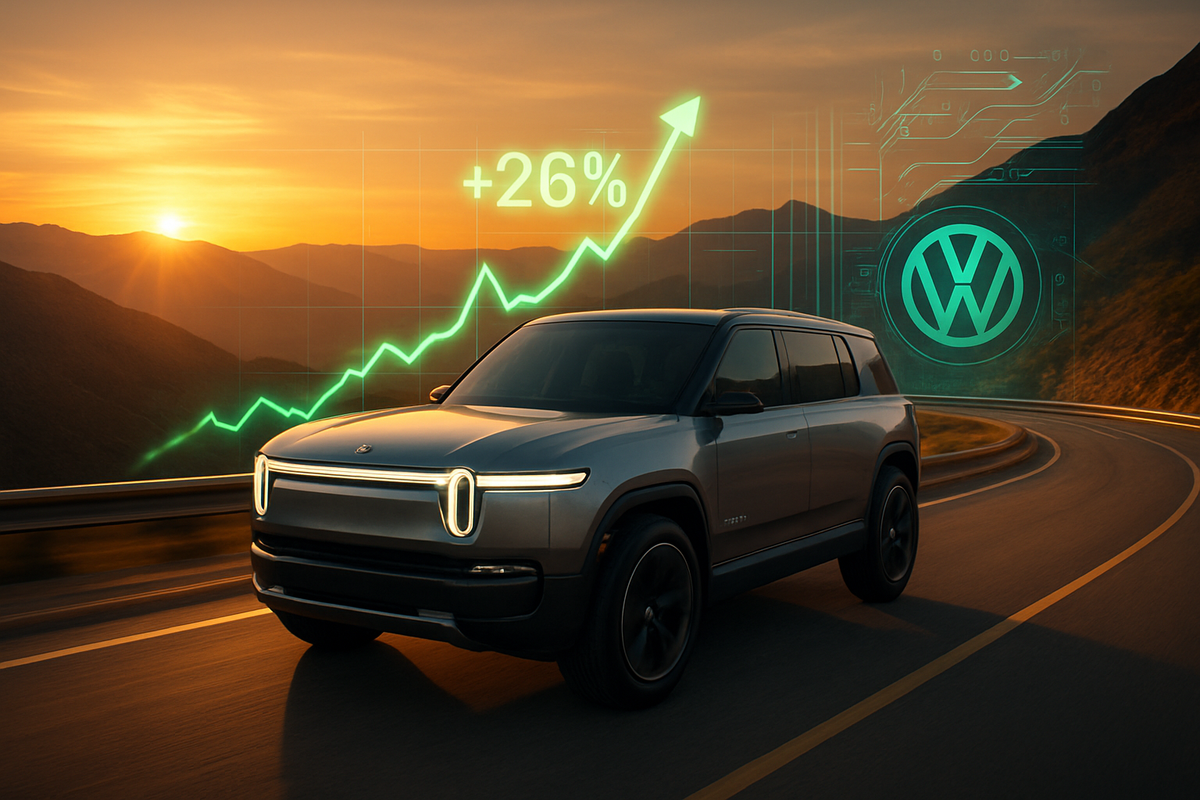
In a dramatic shift for the electric vehicle sector, shares of Rivian Automotive, Inc. (NASDAQ: RIVN) surged more than 26% following a blockbuster fourth-quarter earnings report and confirmed progress on its multi-billion-dollar joint venture with Volkswagen Group (OTC: VWAGY). The rally, which saw the stock climb to $17.73 by the close of trading on February 13, 2026, marks the company’s most significant single-day gain since the partnership was first announced in mid-2024. Investors reacted with fervor to news that Rivian has successfully met the technical milestones required to unlock the next tranche of capital—estimated between $1 billion and $2 billion—from its German partner.
The sudden breakout suggests a major "valuation reset" for the Irvine-based automaker, which spent much of 2025 navigating production bottlenecks and high cash burn. Beyond the immediate cash infusion, the joint venture’s success signifies that Rivian’s software-defined vehicle (SDV) architecture is becoming a gold standard for the industry. Analysts suggest that this surge isn't just a reaction to a strong balance sheet, but a validation of Rivian's transition from a niche luxury truck maker to a scalable technology powerhouse capable of licensing its proprietary stack to global giants.
A Technical Milestone Triggers a Market Frenzy
The 26.6% jump on February 13 was the culmination of months of behind-the-scenes engineering integration between Rivian and Volkswagen. According to the company’s Q4 2025 earnings call, management confirmed that its software platform—now a central pillar of its revenue model—is being seamlessly integrated into Volkswagen’s next-generation global fleet. This achievement triggered a "beat-and-raise" scenario, where Rivian reported Q4 revenue of $1.29 billion, comfortably exceeding Wall Street expectations. More importantly, the company issued a bullish 2026 delivery forecast of 62,000 to 67,000 vehicles, representing a 50% year-over-year increase.
The timeline of this surge is rooted in the strategic pivot Rivian made in June 2024 when it first signed the $5 billion deal with Volkswagen. Since then, the market remained skeptical about whether a startup could successfully "onboard" a legacy giant like VW onto its tech stack. By early 2026, those doubts have largely evaporated. The initial reaction from the analyst community was swift; Deutsche Bank (NYSE: DB) upgraded the stock from "Hold" to "Buy," raising its price target to $23.00. Analysts noted that Rivian’s ability to generate high-margin software licensing revenue—now accounting for over one-third of total revenue—has fundamentally altered its path to long-term profitability.
Identifying the Winners and Losers in the JV Wake
Rivian Automotive, Inc. (NASDAQ: RIVN) is clearly the primary beneficiary of this event, as the stock rally provides it with the equity cushion needed to fund the final stages of the R2 SUV launch. However, Volkswagen Group (OTC: VWAGY) also stands as a significant winner. By securing Rivian’s advanced software and electrical architecture, VW has effectively bypassed years of internal R&D delays at its own software division, Cariad. This partnership allows the German conglomerate to remain competitive against Tesla (NASDAQ: TSLA) and aggressive Chinese entrants in the European and North American markets.
On the other side of the ledger, smaller EV startups like Lucid Group, Inc. (NASDAQ: LCID) may find themselves in an increasingly precarious position. As Rivian consolidates its status as the primary "alternative" to Tesla, investment capital may continue to flee smaller players that lack a major legacy OEM partner. Traditional automakers like Ford Motor Company (NYSE: F) and General Motors (NYSE: GM) could also see increased pressure. While they have invested heavily in their own EV platforms, Rivian’s success with VW proves that the "Software-Defined Vehicle" is the new battlefield, and legacy players who fail to master this tech may be forced into similar, potentially expensive, licensing agreements.
The Broader Shift: Software Licensing as the EV Life Raft
The Rivian-VW success story fits into a broader industry trend where software competence is becoming more valuable than the hardware itself. For years, the "EV transition" was focused on battery range and charging infrastructure. In 2026, the focus has shifted to the vehicle's operating system. Rivian’s ability to monetize its software stack through a joint venture serves as a blueprint for other tech-forward manufacturers. This event marks a transition from the era of "startup survival" to an era of "platform dominance," where companies that own the OS of the car dictate the terms of the market.
Furthermore, this event highlights the potential for "co-opetition" in the automotive world. Historical precedents, such as the early cooperation between Toyota (NYSE: TM) and Tesla, were often short-lived. However, the depth of the Rivian-VW integration suggests a more permanent symbiotic relationship. Regulatory bodies in both the U.S. and the EU are also watching closely, as these shared architectures could eventually lead to more standardized vehicle-to-everything (V2X) communication protocols, influencing future safety and autonomous driving policies.
Looking Ahead: The R2 Ramp and Global Ambitions
In the short term, all eyes will be on Rivian’s Normal, Illinois, facility as it prepares for the official H1 2026 production start of the R2 SUV. The R2 is designed to be a mass-market vehicle with a lower price point, and its success is crucial for Rivian to meet its ambitious 67,000-unit delivery target. The capital unlocked by the VW joint venture provides the necessary liquidity to ensure this ramp-up occurs without the need for a dilutive secondary stock offering. If Rivian can maintain its manufacturing discipline, the stock’s current momentum could carry it toward the $25 level predicted by some bullish analysts.
Long-term, the strategic pivot toward software licensing may lead to even more partnerships. Now that the VW integration has proven successful, other global OEMs—particularly those in Japan or India—may look to Rivian to help modernize their fleets. However, challenges remain. Rivian recently announced a "quiet delay" for its R2 launch in Europe to focus on the domestic market, a move that suggests the company is still wary of overextending its operational bandwidth. Investors will need to monitor whether this domestic focus allows Rivian to achieve its first full year of GAAP net profitability by the end of 2026.
A New Chapter for the Electric Vehicle Market
The 26% rocket ride for Rivian's stock is more than just a momentary spike; it is a signal that the company has moved past its "existential threat" phase. By successfully unlocking billions in funding through a high-tech partnership, Rivian has demonstrated a level of maturity that few of its peers have achieved. The market's reaction reflects a newfound confidence that Rivian can not only build world-class vehicles but also build a sustainable, profitable business model centered on technology licensing and high-margin services.
Moving forward, investors should keep a close watch on two key metrics: the production rate of the R2 SUV and the continued growth of software-related revenue. While the joint venture with Volkswagen has provided a massive tailwind, the company must still prove it can manufacture at scale with the efficiency of a legacy automaker. If Rivian can bridge the gap between its technical prowess and mass-market production, this February rally may be remembered as the moment the company officially joined the ranks of the global automotive elite.
This content is intended for informational purposes only and is not financial advice.