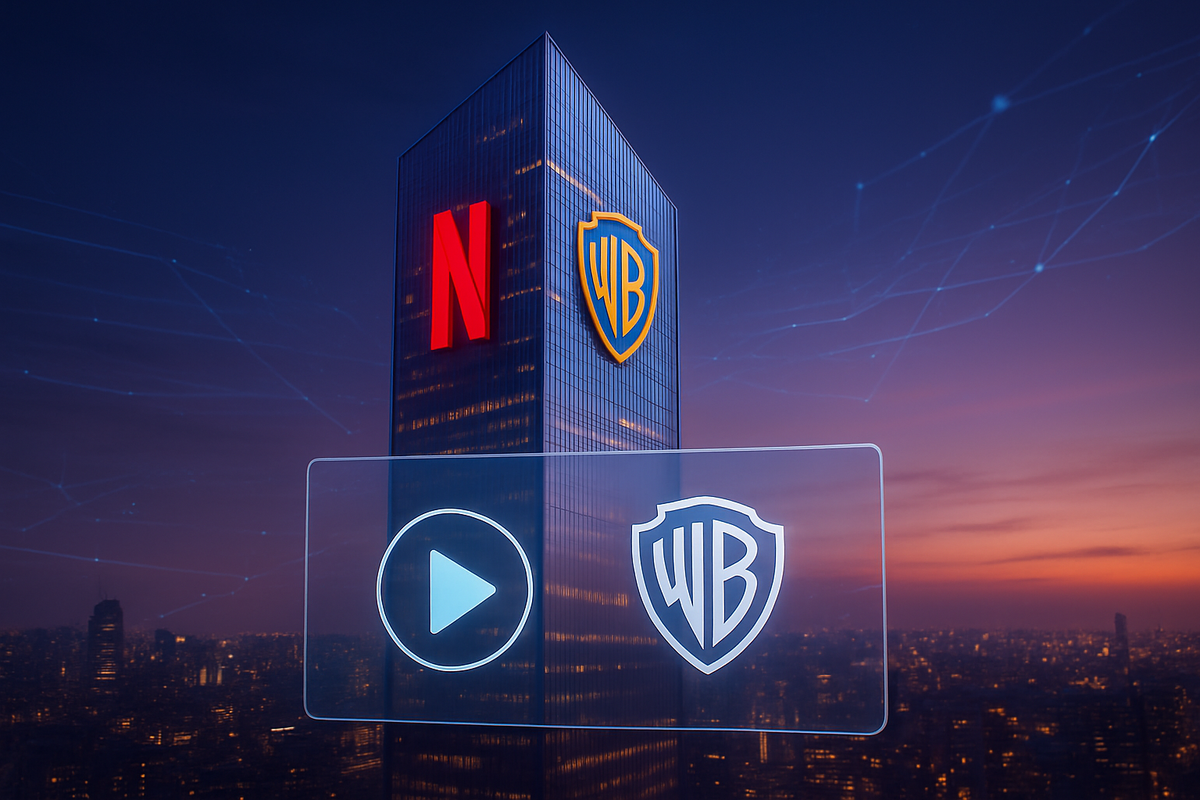
As of February 19, 2026, the media landscape stands on the precipice of its most transformative realignment in decades. Netflix (NASDAQ: NFLX) is aggressively moving forward with its $82.7 billion acquisition of the studio and streaming assets of Warner Bros. Discovery (NASDAQ: WBD), a deal that promises to unite the world’s largest streaming platform with the storied "crown jewels" of Hollywood. This merger, currently the centerpiece of a massive 2026 M&A surge, represents a strategic pivot for Netflix as it seeks to secure content dominance in an increasingly consolidated market.
The acquisition has entered a critical phase following a dramatic update to the deal terms in late January. What began as a stock-and-cash proposal has evolved into a high-stakes all-cash battle, as Netflix fights off a hostile $108.4 billion counter-bid from the newly formed Paramount-Skydance (NASDAQ: PSKY). With a crucial shareholder vote looming in March, the outcome of this merger will likely determine the "National Champion" of American media for the next decade, signaling an end to the fragmented "streaming wars" and the beginning of an era defined by massive, vertically integrated titans.
The Road to $82.7 Billion: A January Pivot and the All-Cash Offensive
The path to this multi-billion dollar tie-up began in December 2025, when Netflix Co-CEO Ted Sarandos and Warner Bros. Discovery CEO David Zaslav first shocked the market with a definitive merger agreement. However, the stability of that initial deal was short-lived. On January 20, 2026, Netflix management was forced to scrap its original "cash and stock" structure in favor of a straight $27.75 per share all-cash transaction. This move was designed to provide WBD shareholders with "value certainty" and to shield the deal from the volatility of Netflix’s own stock price, which had fluctuated as investors weighed the massive debt load required for the purchase.
Central to the deal's structure is the innovative spin-off of Warner Bros. Discovery’s legacy linear assets. Under the current terms, Netflix will absorb Warner Bros. Pictures, DC Studios, and the HBO/Max streaming ecosystem. Meanwhile, WBD’s traditional cable networks—including CNN, TNT Sports, and Discovery Channel—will be carved out into a new, independent entity tentatively named "Discovery Global." This "bad bank" for linear assets is expected to carry approximately $16 billion of WBD’s existing debt, allowing the "New Netflix" to remain a lean, high-growth digital powerhouse focused exclusively on production and streaming.
The pressure intensified in early February when David Ellison’s Paramount-Skydance (PSKY) launched a spoiler bid of $30 per share. To further entice WBD investors, PSKY introduced a "ticking fee" of $0.25 per share for every quarter the deal remains mired in regulatory review. Despite this richer offer, the Warner Bros. Discovery board has maintained its recommendation for the Netflix deal, citing a "clearer and more expedited regulatory path." As of today, February 19, the market is holding its breath as a seven-day negotiation waiver granted to PSKY is set to expire on February 23.
Winners, Losers, and the Battle for Content Supremacy
The primary winner in this consolidation appears to be Netflix (NASDAQ: NFLX), which would finally secure the prestige library it has long craved to supplement its algorithmic "Originals." By bringing the DC Universe and HBO’s premium dramas under its wing, Netflix effectively removes its most formidable creative competitor from the board. However, the victory comes at a cost; the company is taking on billions in bridge loans, and its balance sheet will be scrutinized by credit agencies like Moody’s and S&P throughout 2026.
On the other side of the ledger, the shareholders of Warner Bros. Discovery (NASDAQ: WBD) find themselves in a lucrative but complex position. While the $27.75 cash offer provides an immediate exit, those left holding shares in the "Discovery Global" spin-off will face the daunting task of managing a declining linear television business in an age of cord-cutting. For these investors, the merger is a bittersweet "escape hatch" from a struggling stock, albeit one that leaves them with equity in a legacy business that many analysts believe is destined for further consolidation or restructuring.
Meanwhile, competitors like The Walt Disney Company (NYSE: DIS) and Amazon.com, Inc. (NASDAQ: AMZN) are the clear strategic losers in the short term. A Netflix-WBD behemoth creates a content moat that will be difficult for any single player to bridge. Disney, in particular, may find itself forced into its own defensive M&A to keep pace with the sheer volume of intellectual property now concentrated under the Netflix banner. Apple Inc. (NASDAQ: AAPL), despite its deep pockets, continues to play a "wait-and-see" game, though industry insiders suggest the Netflix-WBD merger could finally provoke the tech giant into a transformative acquisition of its own.
The "National Champions" Doctrine: A New Regulatory Era
The significance of this merger extends far beyond the boardroom. It signals a fundamental shift in U.S. antitrust policy. In 2026, the Department of Justice (DOJ), led by Gail Slater, and the Federal Trade Commission (FTC), under Andrew Ferguson, have adopted what is being called the "National Champions" doctrine. Unlike the aggressive blocking of mergers seen in the early 2020s, regulators are now more inclined to permit domestic consolidation to ensure that American media companies can compete with international AI platforms and foreign-subsidized content distributors.
This regulatory pragmatism is the "X-factor" that gives Netflix the edge over Paramount-Skydance. By spinning off the linear networks, Netflix has addressed the primary horizontal overlap that would have traditionally triggered an antitrust block. During a Senate hearing on February 3, 2026, Sarandos successfully framed the merger as a matter of national economic security, arguing that a unified American "streaming champion" is necessary to protect domestic production jobs and maintain Hollywood’s global cultural influence.
This trend mirrors historical precedents like the Disney-Fox merger of 2019, but with a crucial difference: the 2026 surge is driven by a realization that "size is survival." The market has reached a saturation point where organic growth is no longer sufficient. Consequently, we are seeing a ripple effect across the industry, with smaller players like AMC Networks and Lionsgate reportedly exploring their own tie-ups as they realize they cannot compete with the $80-billion-plus scale of the new "Netflix-Warner" entity.
The Road Ahead: Integration and the March 20 Deadline
The immediate future of the deal hinges on two major milestones. First, the industry is waiting for February 23, 2026—the deadline for Paramount-Skydance to submit its "best and final" offer. If PSKY cannot significantly exceed its current $30 per share bid or provide more regulatory certainty, the path for Netflix will be wide open. Second, a special meeting of WBD shareholders is scheduled for March 20, 2026. This vote is the final internal hurdle before the deal moves into the formal regulatory closing phase.
If the merger proceeds as expected, the integration challenge will be monumental. Netflix will need to reconcile its data-driven, "culture of excellence" with the traditional, director-centric legacy of the Warner Bros. studio. There are also looming questions about the "Discovery Global" spin-off. How will a debt-laden company consisting of CNN and HGTV survive independently? Some analysts predict that Discovery Global itself will be acquired by a private equity consortium within 18 months of its creation.
For Netflix, the strategic pivot required will be massive. The company will transition from a "tech platform that makes shows" to a "global media conglomerate" that owns nearly a century of film history. This shift may require a more traditional approach to theatrical windows and licensing, potentially reversing Netflix’s long-standing "streaming-only" philosophy for major tentpole films.
Conclusion: A New Paradigm for Media Investors
The $82.7 billion Netflix-Warner Bros. Discovery merger is more than just a corporate transaction; it is the definitive end of the Streaming Wars and the beginning of the "Consolidation Era." By successfully pivoting to an all-cash offer in January, Netflix has demonstrated its resolve to own the future of entertainment at any cost. For investors, the takeaway is clear: the media sector is no longer about the number of subscribers, but about the scale and efficiency of the content engine.
As we move forward into 2026, the market will remain volatile as these tectonic plates shift. Investors should closely watch the WBD shareholder vote on March 20 and any last-minute maneuvers from Paramount-Skydance. If Netflix succeeds, it will have set the template for the next decade of media—a world where a few "National Champions" dominate the global screen, leaving smaller players to either specialize or disappear.
The lasting impact of this merger will be felt in every household. From the future of the DC Cinematic Universe to the prestige of HBO, the content that defines modern culture is about to be unified under one banner. Whether Netflix can successfully manage this $82.7 billion empire remains to be seen, but for now, they are the clear aggressors in a market that rewards nothing but size.
This content is intended for informational purposes only and is not financial advice.