
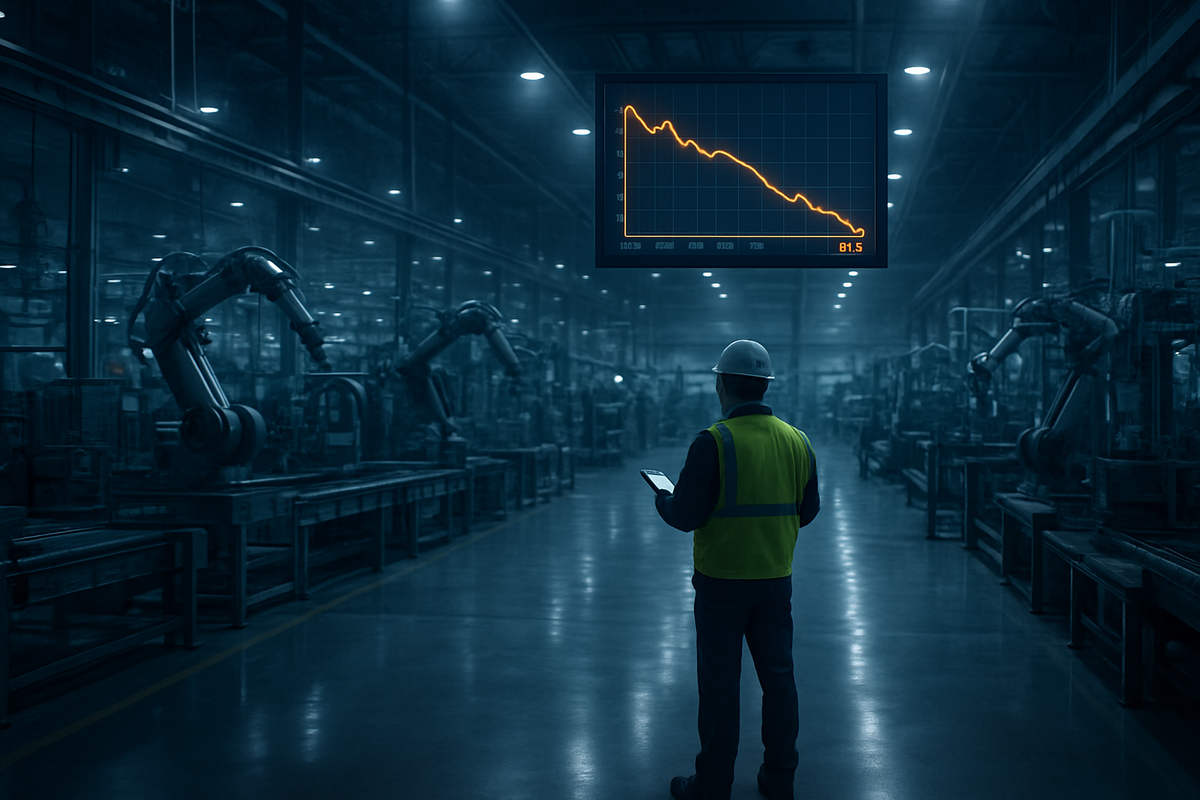
The American manufacturing sector remains mired in a stubborn downturn, as the Institute for Supply Management (ISM) reported today that its Manufacturing Purchasing Managers' Index (PMI) remained in contraction territory for the 12th consecutive month. The February reading of 48.2%—released in early March 2026—underscores a persistent slump that began in early 2025, signaling that the backbone of the U.S. industrial economy is struggling to find its footing amidst high borrowing costs and volatile trade policies.
This prolonged contraction has significant implications for the broader economy, raising fears of a "manufacturing recession" that could eventually bleed into the more resilient service sector. With the index failing to cross the critical 50.0 threshold—the line separating growth from contraction—for over a year, economists are increasingly concerned that the "soft landing" envisioned by the Federal Reserve may be turning into a stagnant "no-growth" trap for domestic producers.
A Year of Defensive Posturing: The 2025-2026 Slump
The latest data from the ISM indicates that the manufacturing sector has not seen a month of expansion since February 2025. While the February 2026 reading of 48.2% was a slight improvement from the 47.9% recorded in December 2025, it marks a year of continuous shrinkage in factory activity. The New Orders Index, a forward-looking component of the report, hovered at 47.5%, suggesting that demand remains tepid as businesses and consumers alike pull back on capital-intensive purchases.
The timeline of this decline can be traced back to the first quarter of 2025, when a combination of "sticky" inflation and the Federal Reserve’s decision to hold interest rates at multi-decade highs began to choke off investment. By mid-2025, the sector was further buffeted by a shift in trade policy, including the implementation of broader import tariffs that significantly raised the cost of raw materials. Throughout the latter half of 2025, manufacturers focused on inventory destocking, a process that saw production levels plummet as firms worked through existing warehouse supplies rather than spinning up new lines.
Key stakeholders, including the National Association of Manufacturers (NAM), have voiced increasing alarm over the report. "What we are seeing is a structural headwind that hasn't let up," noted one ISM survey respondent in the primary metals industry. "Between the cost of financing new equipment and the rising price of imported components, the math simply doesn't work for expansion right now." Market reaction to the news was swift, with industrial-heavy indices trading lower as investors adjusted their expectations for a 2026 recovery.
Industrial Giants Feel the Weight of the Contraction
The primary victims of this extended slump are the major heavy equipment and industrial conglomerates that rely on robust capital spending cycles. Deere & Co (NYSE: DE) has been among the hardest hit, as the agricultural sector faces its own downturn. Deere recently reported a significant dip in net income, noting that high interest rates have discouraged farmers from upgrading their fleets. The company’s 2025 performance was its weakest in years, and management warned that 2026 could represent the "bottom of the cycle," forcing the company to implement headcount reductions and production cuts.
Similarly, Caterpillar (NYSE: CAT), often viewed as a global economic bellwether, has seen its domestic growth stall. While Caterpillar has benefited from a record backlog in its power generation and data center segments—thanks to the ongoing AI infrastructure boom—its core construction and mining equipment sales have faced a "frozen" domestic market. The company’s ability to maintain margins has been tested by the rising "Prices Paid" index, which surged to a four-year high in early 2026, indicating that while demand is low, the cost of manufacturing remains stubbornly high.
On the flip side, some companies are finding ways to navigate the storm. Multi-industrial firms like Honeywell International (NASDAQ: HON) and 3M (NYSE: MMM) have leaned heavily into their service and software divisions to offset the decline in physical product sales. However, even these diversified giants have noted that "customer destocking" in the industrial sector was a major headwind throughout 2025. Logistics providers like FedEx (NYSE: FDX) have also felt the pinch, reporting lower freight volumes as fewer finished goods move from factory floors to retail shelves.
Broad Significance: Navigating a "K-Shaped" Industrial Recovery
The current slump is unique in its longevity, drawing comparisons to the manufacturing slowdown of the early 1980s rather than the brief, sharp shock of 2020. This event fits into a broader industry trend of "reshoring"—bringing manufacturing back to the U.S.—which is ironically being hampered by the very costs associated with building new domestic capacity. While the government's push for domestic semiconductor and green energy production provides a tailwind for some, the "traditional" manufacturing base is buckling under the weight of trade tensions and high capital costs.
The ripple effects are felt most acutely by small and medium-sized manufacturers who lack the pricing power of a Caterpillar (NYSE: CAT). These smaller firms are the primary victims of the "Prices Paid" surge, which hit 70.5 in the recent report. Regulatory and policy implications are also coming to the forefront; with 2026 being a pivotal year for economic policy, there is growing pressure on the Federal Reserve to pivot toward rate cuts to prevent a total industrial collapse, despite the risk of reigniting inflation.
Historical precedents, such as the 15-month contraction during the 2008-2009 financial crisis, suggest that the longer the ISM stays below 50, the more likely a broader recession becomes. However, the "K-shaped" nature of the current economy—where tech and services remain strong while manufacturing withers—presents a complex puzzle for policymakers who must decide whether to save the factory floor at the expense of price stability.
The Path Forward: Strategic Pivots and Scenarios
As the sector enters the second quarter of 2026, manufacturers are being forced into strategic adaptations. Many firms are shifting their focus toward "lean" operations and automation to combat rising labor and material costs. The integration of AI on the factory floor is no longer a luxury but a necessity for survival in a low-demand, high-cost environment. Companies that can pivot to support the energy transition or the AI hardware buildout are likely to find pockets of growth even if the headline ISM remains in contraction.
The short-term outlook remains cautious. If the ISM index does not break above 50 by mid-2026, we may see a wave of consolidation as larger players with stronger balance sheets acquire struggling smaller firms. Conversely, a potential scenario for recovery involves a stabilization of trade relations or a decisive move by the Fed to lower borrowing costs, which could release the "coiled spring" of pent-up demand for industrial machinery and durable goods.
Summary and Investor Outlook
The persistence of the ISM Manufacturing Index below 50.0 through March 2026 marks a sobering milestone for the American economy. A full year of contraction has pressured industrial icons like Deere & Co (NYSE: DE) and Caterpillar (NYSE: CAT), while leaving the broader market questioning when the sector will finally see a reprieve. The combination of high input prices and low order volumes creates a "stagflationary" feel for the manufacturing sector that defies simple solutions.
Moving forward, investors should watch for a sustained turnaround in the New Orders Index as the first sign of a true recovery. Furthermore, the spread between "Prices Paid" and the headline PMI will be a crucial indicator of whether manufacturers can return to profitability. While the factory sector is currently in the cold, its ability to adapt through technology and leaner operations will determine which companies emerge stronger when the cycle eventually turns.
This content is intended for informational purposes only and is not financial advice.