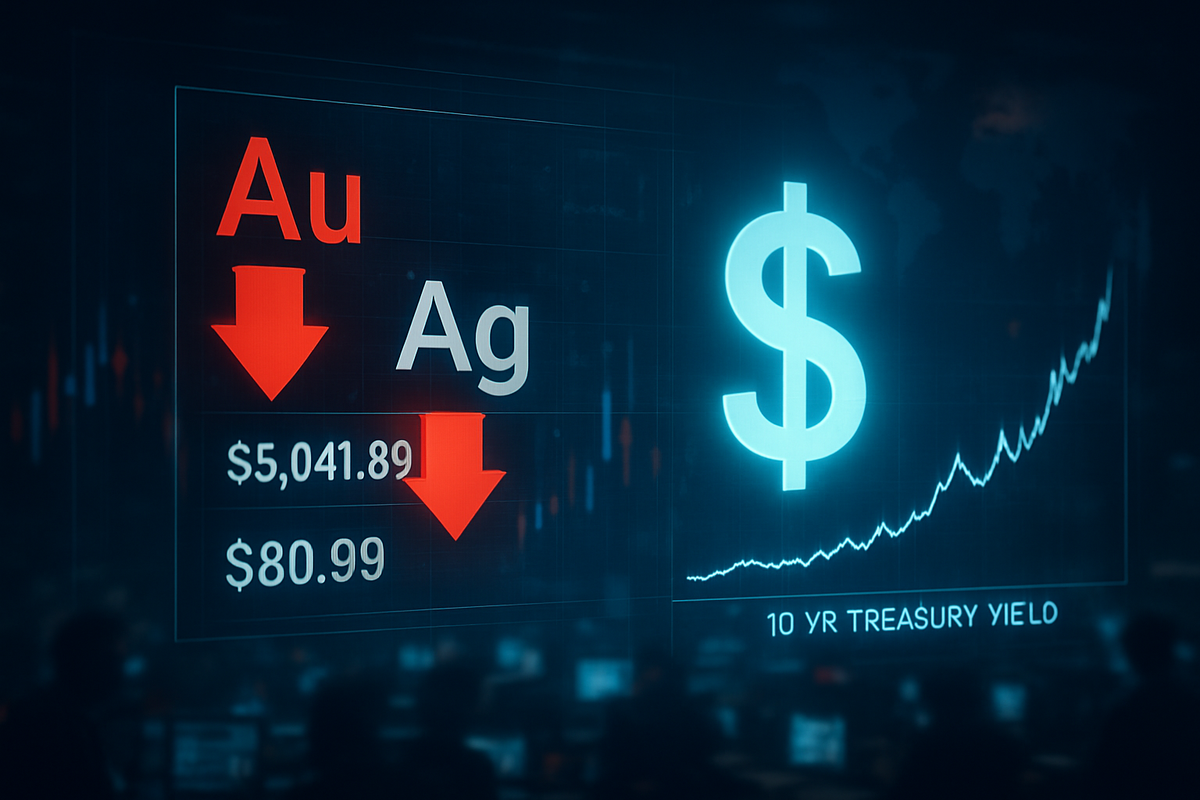
Precious metals experienced a sharp correction on Monday, March 9, 2026, as a resurgent U.S. dollar and climbing Treasury yields forced investors to lock in profits following a historic multi-month rally. Spot gold fell 2.5% to settle at $5,041.89 per ounce, while silver took a more aggressive hit, dropping 4% to close at $80.99 per ounce.
The pullback comes as a shock to a market that had become accustomed to "up-only" price action driven by systemic fears and geopolitical instability. While the long-term bullish case for hard assets remains supported by significant global friction, the immediate strengthening of the greenback and a jump in the cost of borrowing have introduced a much-needed cooling period for the sector.
The Perfect Storm: Yields, the Dollar, and Profit-Taking
The decline on March 9 was precipitated by a "double whammy" of macroeconomic indicators. The U.S. Dollar Index (DXY) surged to a three-month high of 99.69, regaining its footing as a liquidity haven despite ongoing concerns over U.S. fiscal health. Simultaneously, the 10-year Treasury yield climbed to a one-month high of approximately 4.22%. Because gold and silver are non-yielding assets, higher interest rates increase the opportunity cost of holding them, leading institutional traders to rotate capital back into fixed-income securities and cash.
This technical reversal followed a period of unprecedented gains. In early 2026, gold breached the psychological $5,000 barrier for the first time in history, fueled by a crisis of confidence in the Federal Reserve's independence and aggressive de-dollarization by BRICS+ nations. Silver similarly skyrocketed, nearly touching $100 earlier in the year before stabilizing in the $80 range. Monday's sell-off represents the largest single-day percentage drop for gold in nearly six months, suggesting that "weak hands" are being shaken out ahead of the mid-month policy shift.
Mining Giants and ETFs Face High-Volatility Reality
The correction was immediately felt across the equity markets, particularly among the "Super-Margin" miners who have seen their valuations quintuple over the last 24 months. Newmont Corporation (NYSE: NEM) and Barrick Gold (NYSE: GOLD) both saw their shares slide by over 3% in midday trading as investors weighed the impact of a sustained pullback on their record-breaking free cash flow projections. Despite the dip, these companies continue to operate with massive margins; with an All-In Sustaining Cost (AISC) averaging around $1,600/oz, gold at $5,000 still offers a profit of over $3,400 per ounce.
Silver-leveraged plays were hit even harder. Pan American Silver (NYSE: PAAS) and the streaming giant Wheaton Precious Metals (NYSE: WPM) saw declines of 5.2% and 3.8% respectively. Investors also retreated from the major exchange-traded funds, with the SPDR Gold Shares (NYSE Arca: GLD) and iShares Silver Trust (NYSE Arca: SLV) recording significant outflows as retail participants moved to the sidelines. For these companies and funds, the current volatility is a test of investor resolve after a period of vertical growth that many analysts deemed "overextended."
Geopolitical Tensions vs. Monetary Gravity
The most perplexing aspect of Monday's price action is that it occurred against a backdrop of intensifying conflict in the Middle East. Geopolitical tensions remain at a boiling point following the closure of the Strait of Hormuz by Iranian forces earlier this month, which sent Brent crude prices toward $120 per barrel. Typically, such an escalation—now referred to by some diplomats as the "US-Israel-Iran war"—would act as a massive tailwind for precious metals.
However, the current market behavior suggests that "monetary gravity" is temporarily outweighing the "war premium." Historically, in the initial stages of a massive geopolitical shock, there is often a "dash for cash" where even gold is sold to cover margin calls in the plummeting equity and energy derivative markets. Furthermore, the inflationary pressure from $120 oil has convinced the market that the Federal Reserve will be forced to remain hawkish, further boosting yields and the dollar at the expense of gold’s luster.
All Eyes on the March 18 Federal Reserve Meeting
The immediate future of the precious metals market now hinges on the Federal Reserve’s upcoming policy meeting on March 18, 2026. Market participants are split on whether the Fed will prioritize fighting energy-driven inflation with another rate hike or if it will pause to address the simmering liquidity issues in the banking sector. If the Fed signals a "higher-for-longer" stance, gold could see a deeper correction toward the $4,800 support level.
Conversely, any hint of a "pivot" or a return to quantitative easing to stabilize the Treasury market could reignite the rally, potentially pushing gold toward the $6,000 mark by summer. Analysts suggest that the current pullback might be a strategic "buy the dip" opportunity for central banks that missed the initial surge to $5,000, but short-term traders should brace for continued turbulence as the March 18 deadline approaches.
A Necessary Reset in a New Era of Metals
In summary, the March 9 pullback in gold and silver is a reminder that even the strongest bull markets require periods of consolidation. The convergence of a three-month dollar high and spiking Treasury yields provided the necessary catalyst for a correction that many technical analysts had been calling for since late January. While the drop from $5,500 highs to $5,041 may seem dramatic, it represents a standard "mean reversion" in an otherwise extraordinary market cycle.
Moving forward, investors should watch the DXY and the 10-year yield as the primary indicators of short-term direction. While the Middle East conflict provides a high floor for prices, the path to $6,000 gold and $100 silver will likely be paved with more volatility. As the world navigates this era of de-dollarization and stagflation, the role of gold and silver as the ultimate "systemic insurance" remains unchanged, even if the premiums occasionally fluctuate.
This content is intended for informational purposes only and is not financial advice.