As of January 2026, the image of the "professional trader" has undergone a radical transformation. Gone are the days when high-stakes finance was solely the province of Wall Street floor traders or quantitative hedge fund analysts staring at Bloomberg terminals. Today, the new face of alpha is Logan Sudeith, a 25-year-old former risk analyst from Atlanta, Georgia, who famously resigned from a stable $75,000-a-year job to trade the "scoreboard of reality" full-time.
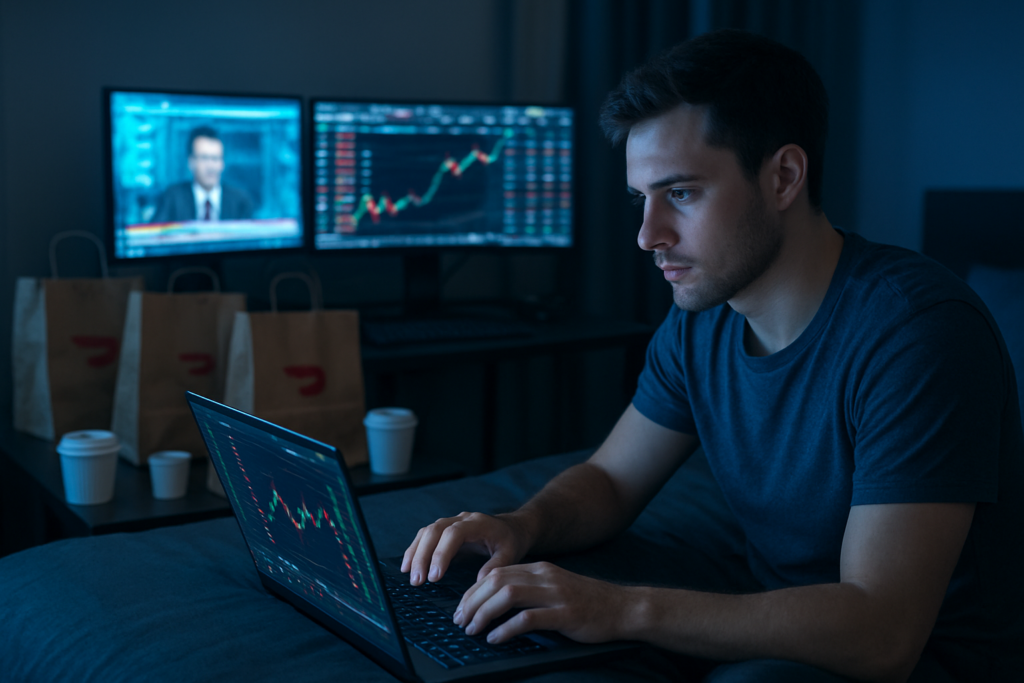
Sudeith represents a burgeoning class of "Professional Event Traders" (PMTs) who have turned prediction markets like Kalshi and Polymarket into their personal ATM machines. While many retail investors were still learning the ropes of "Information Finance" in late 2024, Sudeith was already scaling a lifestyle that defies traditional labor norms: working 100-hour weeks, "bed-lounging" with a laptop, and DoorDashing every meal to ensure he never misses a live market ticker. The results have been staggering, culminating in a recent milestone that has sent shockwaves through the community—a single $100,000 profit month.
The Market: What’s Being Predicted
The markets Sudeith and his peers navigate are far more granular than the broad indices of the traditional stock market. While a typical investor might buy shares in Apple Inc. (NASDAQ: AAPL) or Tesla, Inc. (NASDAQ: TSLA) based on quarterly earnings, Sudeith trades on the specificities of daily life. These "event contracts" allow traders to buy and sell shares in the probability of a specific outcome, ranging from Federal Reserve interest rate hikes to the specific phrasing used by political figures in press conferences.
The primary arenas for this activity are Kalshi and Polymarket. By early 2026, Kalshi has seen its valuation surge to a reported $11 billion, with weekly volumes frequently exceeding $2 billion. Meanwhile, Polymarket has completed a massive re-entry into the U.S. market following its acquisition of a CFTC-licensed exchange. These platforms offer thousands of niche markets, such as whether a certain bill will pass the Senate by Friday, the exact number of times a sports commentator will say "air ball," or the winner of the New York City mayoral race—a trade that netted Sudeith over $7,400 in profit.
Why Traders Are Betting
For Sudeith, the "edge" isn't found in guessing the future, but in identifying "mispriced probabilities." His strategy involves a blend of high-speed data mining and obsessive monitoring of live events. To win $40,236 on the Time Magazine Person of the Year contract, Sudeith didn't just guess; he meticulously analyzed historical selection patterns and tracked late-breaking media signals that the broader market had ignored.
"Professional event trading is about being faster and more informed than the person on the other side of the contract," says one peer in Sudeith's "Crypto Inner Circle" Discord. Traders now use institutional-grade tools like API integrations for millisecond execution and order flow analysis software to spot "insidered" activity—outlier bets that suggest a trader has non-public information, such as the exact release date of a new AI model. Sudeith’s 100-hour work week is dedicated to this information gathering, often focusing on high-volatility events like Donald Trump's speeches, where a single keyword—like "drill baby drill"—can move half a million dollars in a matter of seconds.
Broader Context and Implications
The rise of traders like Logan Sudeith signals a broader shift toward "Information Finance," a term popularized in 2025 to describe the use of markets to aggregate truth. Major brokerages like Robinhood Markets, Inc. (NASDAQ: HOOD) have leaned into this trend, now offering regulated event contracts to their millions of retail customers. In late 2025, Robinhood reported that its users traded over 2.5 billion event contracts, treating questions about Fed rate cuts with the same seriousness as blue-chip stocks.
This mainstreaming has been bolstered by a shifting regulatory environment. While previous administrations viewed prediction markets with skepticism, the current 2026 landscape treats them as vital forecasting tools. News networks like CNN and CNBC now display "Kalshi Tickers" alongside traditional stock prices, acknowledging that these markets are often more accurate than traditional polling or expert punditry. The "sober boom" of prediction markets has turned what was once a "gray market" into a fundamental pillar of the American financial system.
What to Watch Next
As the industry matures, the focus is shifting toward the institutionalization of event trading. We are likely to see the emergence of "Event Hedge Funds" that utilize the same high-frequency strategies Sudeith pioneered, potentially squeezing out solo retail traders. The next major milestone to monitor will be the launch of "Macro-Event ETFs," which would allow investors to hedge against broad geopolitical risks—like the outbreak of a trade war or a global pandemic—through a single diversified product.
Furthermore, keep an eye on the "rulescucks"—a slang term for traders who win on the technical wording of contracts. As the stakes rise, the precision of contract language is becoming a legal battleground. The resolution of high-profile disputes in early 2026 will set the precedent for how these markets are governed for the next decade.
Bottom Line
Logan Sudeith’s journey from a $75,000-a-year analyst to a six-figure-a-month event trader is the quintessential success story of the Information Finance era. It proves that in a world of infinite data, the ability to accurately price probability is one of the most valuable skills in the modern economy. Sudeith isn't just betting; he is participating in a global machine that rewards truth and punishes noise.
As prediction markets continue to integrate with traditional finance through platforms like Robinhood Markets, Inc. (NASDAQ: HOOD), the line between "gambling" and "investing" continues to blur. For Sudeith and the new class of PMTs, the world is no longer just a series of events—it is a series of tradeable opportunities, provided you are willing to put in the 100 hours a week to find them.
This article is for informational purposes only and does not constitute financial or betting advice. Prediction market participation may be subject to legal restrictions in your jurisdiction.
PredictStreet focuses on covering the latest developments in prediction markets.
Visit the PredictStreet website at https://www.predictstreet.ai/.