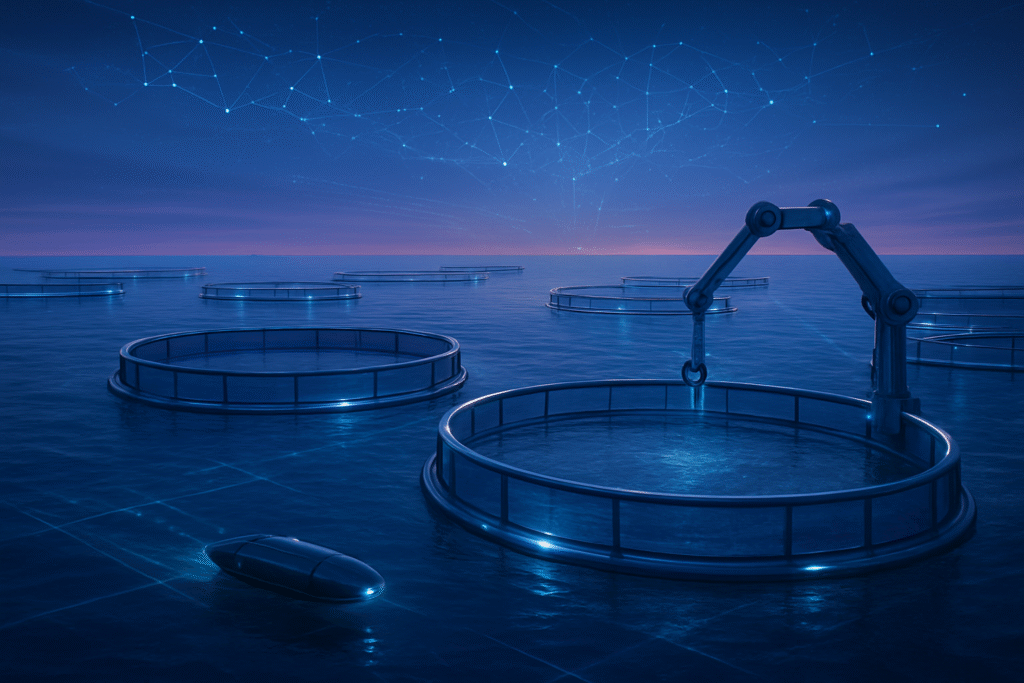
Trondheim, Norway – December 1, 2025 – The confluence of cutting-edge artificial intelligence and advanced autonomous systems is poised to redefine global food production, with a significant demonstration unfolding in the frigid waters of Norway. Students from MIT Sea Grant, embedded within Norway's thriving offshore aquaculture industry, are at the forefront of this transformation, meticulously exploring and implementing AI-driven solutions for feeding optimization and sophisticated underwater vehicles for comprehensive monitoring in Atlantic salmon farming. This collaborative initiative, particularly through the "AquaCulture Shock" program, underscores a pivotal moment in integrating high-tech innovation with sustainable marine practices, promising enhanced efficiency, reduced environmental impact, and a new era for aquaculture worldwide.
The immediate significance of this endeavor lies in its potential to accelerate knowledge transfer and technological adoption for the nascent open-ocean farming sector in the United States, drawing invaluable lessons from Norway, the world's leading producer of farmed Atlantic salmon. By exposing future leaders to the most advanced practices in marine technology, the program aims to bridge technological gaps, promote sustainable methodologies, and cultivate a new generation of experts equipped to navigate the complexities of global food security through innovative aquaculture.
Technical Deep Dive: Precision AI Feeding and Autonomous Underwater Sentinels
The core of this technological revolution in aquaculture revolves around two primary pillars: AI-powered feeding optimization and the deployment of autonomous underwater vehicles (AUVs) for monitoring. In the realm of feeding, traditional methods often lead to significant feed waste and suboptimal fish growth, impacting both economic viability and environmental sustainability. AI-driven systems, however, are transforming this by offering unparalleled precision. Companies like Piscada, for instance, leverage IoT and AI to enable remote, real-time feeding control. Operators utilize submerged cameras to observe fish behavior and appetite, allowing for dynamic adjustments to feed delivery for individual pens, drastically reducing waste and its ecological footprint. Furthermore, the University of Bergen's "FishMet" project is developing a digital twin model that integrates AI with biological insights to simulate fish appetite, digestion, and growth, paving the way for hyper-optimized feeding strategies that enhance fish welfare and growth rates while minimizing resource consumption. Other innovators such as CageEye employ hydroacoustics and machine learning to achieve truly autonomous feeding, adapting feed delivery based on real-time behavioral patterns. This marks a stark departure from previous, often manual or timer-based feeding approaches, offering a level of responsiveness and efficiency previously unattainable. Initial reactions from the aquaculture research community and industry experts are overwhelmingly positive, highlighting the potential for significant cost savings and environmental benefits.
Concurrently, the integration of AUVs is revolutionizing the monitoring of vast offshore aquaculture sites. Unlike traditional methods that might rely on fixed sensors or human-operated remotely operated vehicles (ROVs) prone to entanglement, AUVs offer the ability to execute pre-programmed, repetitive missions across expansive areas without direct human intervention. Research by SINTEF Ocean, a key partner in the MIT Sea Grant collaboration, focuses on developing control frameworks for autonomous operations in complex fish farm environments, accounting for fish behavior, cage dynamics, and environmental disturbances. These AUVs can be equipped with a suite of sensors to monitor critical water quality parameters such as conductivity and dissolved oxygen levels, providing a comprehensive and continuous health assessment of the marine environment. Projects funded by MIT Sea Grant itself, such as those focusing on low-cost, autonomous 3D imaging for health monitoring and stock assessment, underscore the commitment to making these sophisticated tools accessible and effective. The ability of AUVs to collect vast datasets autonomously and repeatedly represents a significant leap from intermittent manual inspections, providing richer, more consistent data for informed decision-making and proactive farm management.
This technological shift is not merely an incremental improvement but a fundamental re-imagining of aquaculture operations. The blend of AI's analytical power with the operational autonomy of underwater robotics creates a synergistic effect, moving the industry towards a more predictive, precise, and sustainable future. The initial reception among industry stakeholders points to a clear understanding that these technologies are not just desirable but essential for scaling offshore aquaculture responsibly and efficiently.
Competitive Currents: Impact on AI Companies, Tech Giants, and Startups
The rapid integration of AI and autonomous systems into offshore aquaculture is creating significant ripples across the technology landscape, particularly for AI companies, tech giants, and specialized startups. Companies that stand to benefit immensely are those developing sophisticated AI algorithms for data analysis, machine learning platforms, and robotic control systems. Firms specializing in computer vision, sensor technology, and predictive analytics, such as Nvidia (NASDAQ: NVDA) with its AI processing capabilities or Microsoft (NASDAQ: MSFT) with its Azure AI platform, are well-positioned to provide the foundational infrastructure and tools required for these advancements. Their cloud services and AI development suites are becoming indispensable for processing the immense datasets generated by AUVs and AI feeding systems.
For specialized aquaculture technology startups, this development presents both immense opportunity and competitive pressure. Companies like Piscada and CageEye, which have already developed niche AI solutions for feeding and monitoring, are poised for significant growth as the industry adopts these technologies. However, they also face the challenge of scaling their solutions and potentially competing with larger tech entities entering the space. The competitive implications for major AI labs and tech companies are substantial; the aquaculture sector represents a vast, relatively untapped market for AI applications. Developing robust, marine-hardened AI and robotic solutions could become a new frontier for innovation, potentially disrupting existing products or services in related fields such as maritime logistics, environmental monitoring, and even defense. Strategic advantages will go to companies that can offer integrated, end-to-end solutions, combining hardware (AUVs, sensors) with sophisticated software (AI for analytics, control, and decision-making). Partnerships between tech giants and aquaculture specialists, like the collaboration between ABB, Norway Royal Salmon, and Microsoft for AI-driven camera systems, are likely to become more common, fostering an ecosystem of innovation and specialization.
The market positioning is shifting towards providers that can demonstrate tangible benefits in terms of efficiency, sustainability, and fish welfare. This means AI companies must not only deliver powerful algorithms but also integrate them into practical, resilient systems capable of operating in harsh marine environments. The potential for market disruption is high for traditional aquaculture equipment providers who do not adapt, while those embracing AI and robotics will likely see their market share expand. This trend underscores a broader movement within the tech industry where AI is increasingly moving beyond general-purpose applications to highly specialized, vertical-specific solutions, with aquaculture emerging as a prime example of this strategic pivot.
Wider Significance: A New Horizon for AI and Sustainability
The application of AI and autonomous systems in offshore aquaculture, as demonstrated by the MIT Sea Grant initiative, fits squarely into the broader AI landscape as a powerful example of applied AI for sustainability and resource management. It highlights a critical trend where AI is moving beyond consumer applications and enterprise optimization to tackle grand societal challenges, particularly those related to food security and environmental stewardship. This development underscores the versatility of AI, showcasing its ability to process complex environmental data, predict biological behaviors, and optimize resource allocation in real-world, dynamic systems.
The impacts are far-reaching. Environmentally, precision feeding significantly reduces nutrient runoff and waste accumulation, mitigating eutrophication and improving marine ecosystem health. Economically, optimized feeding and continuous monitoring lead to increased yields, reduced operational costs, and healthier fish stocks, making aquaculture more profitable and stable. Socially, it contributes to a more sustainable and reliable food supply, addressing global protein demands with less ecological strain. Potential concerns, however, include the initial capital investment required for these advanced technologies, the need for skilled labor to manage and maintain complex AI and robotic systems, and ethical considerations surrounding the increasing automation of animal farming. Data privacy and cybersecurity for sensitive farm data also present challenges that need robust solutions.
Comparing this to previous AI milestones, the advancements in aquaculture echo the impact of AI in precision agriculture on land, where intelligent systems optimize crop yields and resource use. It represents a similar leap forward in the marine domain, moving beyond basic automation to intelligent, adaptive systems. It also parallels breakthroughs in autonomous navigation seen in self-driving cars, now adapted for underwater environments. This development solidifies AI's role as a transformative technology capable of revolutionizing industries traditionally reliant on manual labor and empirical methods, marking it as a significant step in the ongoing evolution of AI's practical applications. It reinforces the idea that AI's true power lies in its ability to augment human capabilities and solve complex, multi-faceted problems in ways that were previously unimaginable.
Future Developments: The Ocean's Smart Farms of Tomorrow
Looking ahead, the trajectory of AI and autonomous systems in offshore aquaculture promises even more sophisticated and integrated solutions. In the near-term, we can expect further refinement of AI feeding algorithms, incorporating even more granular data points such as real-time metabolic rates, stress indicators, and even genetic predispositions of fish, leading to hyper-personalized feeding regimes. AUVs will likely gain enhanced AI-driven navigation capabilities, enabling them to operate more autonomously in unpredictable ocean currents and to perform more complex diagnostic tasks, such as early disease detection through advanced imaging and environmental DNA (eDNA) analysis. The development of self-charging AUVs using wave energy or underwater docking stations for wireless charging will also extend their operational endurance significantly.
Long-term developments include the vision of fully autonomous offshore farms, where AI orchestrates all aspects of operation, from environmental monitoring and feeding to predator deterrence and harvesting, with minimal human intervention. We could see the emergence of "digital twin" farms, highly accurate virtual models that simulate every aspect of the physical farm, allowing for predictive maintenance, scenario planning, and continuous optimization. Potential applications extend beyond salmon to other high-value marine species, and even to integrated multi-trophic aquaculture (IMTA) systems where different species are farmed together to create a balanced ecosystem. Challenges that need to be addressed include the standardization of data formats across different technologies, the development of robust and resilient AI systems capable of operating reliably in harsh marine environments for extended periods, and addressing regulatory frameworks that can keep pace with rapid technological advancements. Experts predict a future where offshore aquaculture becomes a cornerstone of global food production, driven by intelligent, sustainable, and highly efficient AI-powered systems, transforming the ocean into a network of smart, productive farms.
Comprehensive Wrap-up: Charting a Sustainable Future
The pioneering work of MIT Sea Grant students in Norway, exploring the intersection of AI and offshore aquaculture, represents a critical juncture in the history of both artificial intelligence and sustainable food production. The key takeaways are clear: AI-driven feeding optimization and autonomous underwater vehicles are not just incremental improvements but fundamental shifts that promise unprecedented efficiency, environmental stewardship, and economic viability for the aquaculture industry. These technologies are poised to significantly reduce waste, improve fish welfare, and provide invaluable data for informed decision-decision-making in the challenging open-ocean environment.
This development's significance in AI history lies in its powerful demonstration of AI's capacity to address complex, real-world problems in critical sectors. It underscores AI's evolution from theoretical concepts to practical, impactful solutions that contribute directly to global sustainability goals. The long-term impact is a paradigm shift towards a more intelligent, resilient, and environmentally conscious approach to marine farming, potentially securing a vital food source for a growing global population while minimizing ecological footprints.
In the coming weeks and months, watch for further announcements from research institutions and aquaculture technology companies regarding pilot programs, commercial deployments, and new technological advancements in AI-powered monitoring and feeding systems. Keep an eye on policy discussions surrounding the regulation and support for offshore aquaculture, particularly in regions like the United States looking to expand their marine farming capabilities. The collaboration between academia and industry in global hubs like Norway will continue to be a crucial catalyst for these transformative innovations, charting a sustainable and technologically advanced future for the world's oceans.
This content is intended for informational purposes only and represents analysis of current AI developments.
TokenRing AI delivers enterprise-grade solutions for multi-agent AI workflow orchestration, AI-powered development tools, and seamless remote collaboration platforms.
For more information, visit https://www.tokenring.ai/.