
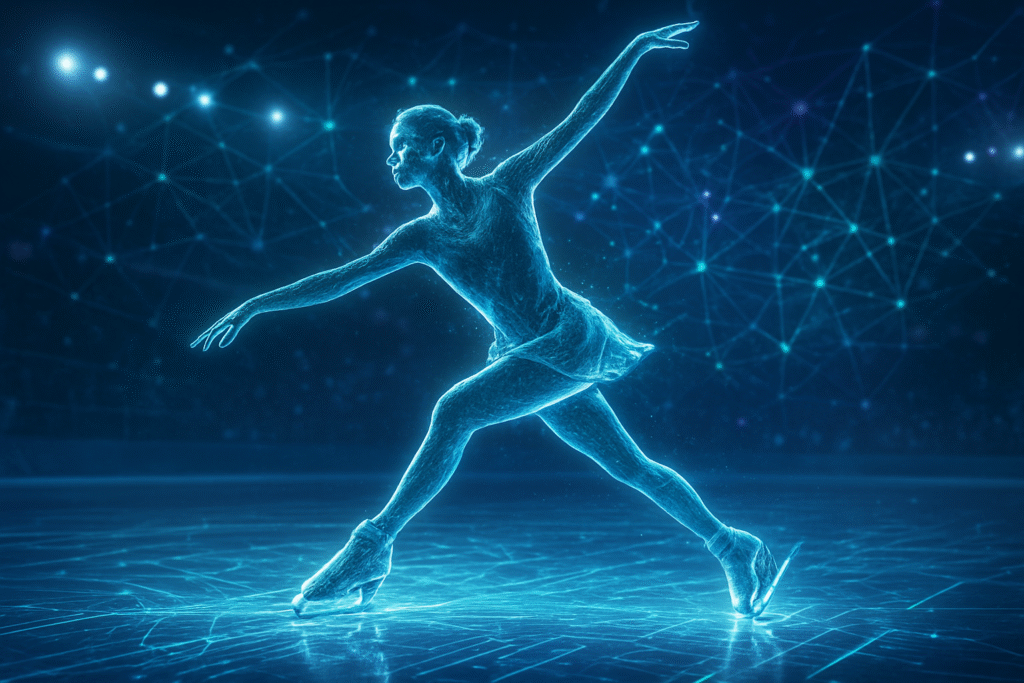
Artificial Intelligence is swiftly transforming the elegant and demanding world of Olympic-level figure skating, ushering in an era of unprecedented precision in training and unparalleled objectivity in performance evaluation. From personalized coaching regimens to real-time technical assessments, AI is not just augmenting human capabilities but actively revolutionizing how athletes train, perform, and are judged, promising a future of fairer competitions and optimized athletic development. The immediate significance of AI in Olympic figure skating is multifaceted, promising a paradigm shift in the sport, leading to unprecedented objectivity, accelerated athlete development, empowered coaching, increased fan engagement, and a new standard for excellence.
Unveiling the AI's Technical Edge on the Ice
The integration of AI into figure skating marks a significant departure from traditional evaluation methods, which have historically relied on considerable human subjectivity. AI systems leverage advanced computer vision and machine learning to introduce objective, data-driven analysis, enhancing fairness, consistency, and training insights. This fundamentally differs from previous approaches where human judges assessed both technical execution and artistic expression, leading to potential subjective interpretations, biases (such as nationalistic or reputation-based), and inconsistencies in scoring. While technical panels used video replays, they still relied heavily on human observation. AI aims to standardize evaluation, reduce bias, provide real-time analysis, and offer objective technical assessments of elements difficult for the human eye to consistently gauge.
At the core of AI in figure skating are several interconnected technologies. Computer vision is fundamental, enabling algorithms to track athletes' movements from video footage. Convolutional Neural Networks (CNNs) are a primary form of AI used to analyze and classify images, comparing skaters' movements against specified judging criteria, detecting skaters, and creating "bounding boxes" around them. Pose estimation, a subfield of AI, interprets and understands the movement and posture of athletes, capturing and analyzing their form during complex elements like spins, jumps, and footwork. For instance, it can measure body line and leg angles in synchronized skating or detect if a jump is fully rotated. Some systems, like the "Figure Skating AI Aided Scoring System 1.0" in China, even adopt a cloud computing architecture for distributed operations.
Specific capabilities include precise measurement of jump height, rotation speed, airtime, and landing quality, identifying under-rotated jumps or incorrect blade edges. AI can also automatically identify specific elements and their difficulty levels, detect unison in synchronized skating, and provide immediate, objective feedback for training. Initial reactions from the AI research community and industry experts have been a mix of optimism and caution. There's a general consensus that AI can significantly reduce human bias and improve fairness in technical scoring, and skaters and coaches see immense value in AI for detailed performance analysis and real-time feedback. However, concerns persist regarding potential algorithmic bias if training data is skewed, AI's current inability to evaluate artistic merit, the scarcity of high-quality labeled data, and the potential resistance from athletes and fans to a radical shift in judging.
Reshaping the AI Industry: Opportunities and Disruptions on the Rink
The integration of Artificial Intelligence into figure skating is poised to significantly impact various companies, ranging from specialized AI startups to established tech giants. This technological evolution promises to reshape competitive dynamics, introduce new forms of disruption, redefine market positioning, and offer strategic advantages to those who innovate effectively. The primary applications driving this impact revolve around enhancing performance analysis, improving judging objectivity, and personalizing training.
Specialized AI companies and startups are emerging as key beneficiaries by focusing on niche sports technology solutions. Companies like 4D Motion (U.S. Figure Skating's official supplier for biomechanic jump data) and Uplift Labs (markerless motion capture and 3D analysis using smartphones) are directly addressing figure skating's technical demands. The OOFSkate app, designed by computer scientists, analyzes jump metrics without requiring sensors. Other sports analytics firms such as Quantiphi, Sportlogiq, Pixellot, Veo, and Sportsbox AI can adapt their platforms for figure skating. Companies developing specialized computer vision models for accurately assessing complex elements will find a significant market, especially as the International Skating Union (ISU) explores AI for technical judging.
Tech giants also possess the resources, cloud infrastructure, and AI expertise to play a transformative role. Microsoft (NASDAQ: MSFT) with Azure AI and Copilot, IBM (NYSE: IBM) with Watsonx.ai, and Google (NASDAQ: GOOGL) with Google Cloud, Vertex AI, and Gemini, can provide the underlying AI models, machine learning platforms, and vast data storage necessary for complex video analysis, predictive analytics, and real-time processing. Their scalable solutions can support large-scale competitions, national federations, and global fan engagement platforms. These companies can also leverage their extensive R&D departments to drive advancements in computer vision and deep learning tailored for figure skating and engage in strategic partnerships, similar to Google Cloud's collaboration with Formula E.
AI will introduce new competitive dynamics within the figure skating ecosystem. Athletes and teams adopting AI early will gain a significant competitive edge through superior training insights and targeted skill development. This will necessitate a shift in coaching methodologies, with a focus on interpreting AI-generated data. While AI is unlikely to fully replace human judges, it will significantly alter their role, making technical specialists more reliant on AI-powered systems, potentially leading to a restructuring of judging panels. The overall AI in sports market is experiencing robust growth, projected to reach an estimated USD 2.61 billion by 2030 and potentially USD 60.78 billion by 2034, indicating substantial new revenue streams for companies offering these solutions.
A Broader Canvas: AI's Impact on the Sports and Technology Landscape
The integration of AI into figure skating reflects broader trends in sports technology and data-driven analysis, positioning it as a significant development within the wider AI landscape. This application of AI aligns perfectly with several overarching trends: the rise of computer vision and pose estimation for detailed biomechanical analysis, the increasing reliance on data-driven sports analytics to quantify previously subjective elements, and the concept of augmented intelligence, where AI tools complement human expertise rather than fully replacing it. Furthermore, AI's role in personalized training, injury prevention, and enhanced fan engagement in figure skating mirrors similar advancements across various sports, from basketball to soccer.
The impacts of AI in figure skating are profound. Positively, it promises increased fairness and transparency in judging by mitigating human biases, expedited judging processes, and significantly enhanced athlete development through personalized training and real-time feedback. AI can also assist in doping monitoring and security. However, potential negative impacts and concerns include the risk of algorithmic bias if training data is skewed, data scarcity for training robust models, the logistical challenges of implementation, and the ongoing debate about the potential loss of the "human element" in judging artistic sports. Ethical considerations around data privacy, algorithmic transparency, cybersecurity risks, and the lack of standardization for AI in sports also remain critical challenges.
Comparing AI in figure skating to previous AI milestones reveals a clear progression. It draws parallels with assisted judging systems like Video Assistant Referee (VAR) in football and Hawk-Eye in tennis, demonstrating AI's ability to provide objective feedback and reduce human error. The application of AI for granular player performance analysis in team sports like baseball and basketball (e.g., NBA's Second Spectrum) directly extends to individual skater movement analysis. Perhaps the closest parallel is the International Federation of Gymnastics' development of an AI-powered judging system using 3D sensors, given the similar blend of technical precision and artistic expression in both sports. This positions AI in figure skating not as an isolated breakthrough, but as a crucial step in AI's evolving role in understanding and evaluating complex human performance.
The Future's Glide: Anticipating AI's Evolution in Figure Skating
In the near term, AI in figure skating is primarily expected to focus on objective, data-driven analysis to assist human processes. This includes the widespread adoption of AI-assisted judging for technical elements, where computer vision technology will precisely assess jump rotations, identify correct blade edges, measure height and speed, and analyze ice coverage. The International Skating Union (ISU) is actively considering the use of AI for these technical judgments, aiming to standardize evaluation metrics and reduce human bias in scoring. Personalized training systems, utilizing 2D video analysis, human skeleton tracking, and pose detection, will become more prevalent, offering skaters detailed feedback and customized optimization suggestions. Smart filming and analysis tools, such as auto-tracking tripods connected to smartphones, will also become commonplace, allowing for comprehensive practice review.
Looking further ahead, AI's role is anticipated to become more deeply integrated and transformative. Long-term developments suggest highly sophisticated AI systems that could even contribute to aspects of artistic assessment, forming advanced hybrid judging systems that combine AI's consistency in technical evaluation with human judges' ability to assess artistic merit and emotional impact. Generative AI could be used to design innovative choreography and programs by analyzing past performances and scoring trends. More futuristic applications might include robotic training partners that provide real-time physical guidance on the ice or the integration of metaverse technology with 3D motion capture for highly visualized movement analysis, enhancing both objectivity and fan engagement.
Despite this promising outlook, several challenges must be overcome. The inherent complexity and subjectivity of figure skating's artistic component remain a significant hurdle for AI. Data scarcity and quality are ongoing issues, as training robust AI models requires vast amounts of high-quality, labeled video data. Addressing potential biases within AI systems, ensuring seamless integration with human expertise, and overcoming logistical and infrastructural demands will be crucial. Experts largely predict a gradual but inevitable integration of AI, prioritizing objectivity and support over complete automation. Colin Smith, Director of the ISU, confirms the governing body's exploration of AI for technical elements, indicating a phased introduction starting with technical judging. The consensus leans towards hybrid judging systems as the future, preserving the artistic essence of the sport while leveraging AI for precision.
The AI Revolution on Ice: A Comprehensive Wrap-Up
The integration of artificial intelligence into Olympic-level figure skating marks a pivotal moment, addressing long-standing issues of subjectivity and bias in judging while simultaneously revolutionizing athlete training and fan engagement. Key takeaways highlight AI's profound potential to reduce human bias, enhance the objective assessment of technical elements through advanced computer vision and pose estimation, and revolutionize training and coaching with personalized regimens and real-time feedback. AI chatbots and auto-tracking tripods are already empowering skaters with unprecedented analytical capabilities, leading to optimized performance and injury prevention.
This application of AI holds significant historical importance, representing a frontier where AI is tasked with evaluating the delicate balance between objective athletic precision and subjective artistic expression. Successfully implementing AI in figure skating could set a precedent for other performance-based sports grappling with similar judging fairness issues, pushing AI beyond purely objective data analysis into domains traditionally considered exclusive to human judgment. The ongoing development of AI-powered judging systems in sports like gymnastics further underscores this trend, positioning figure skating's advancements as part of a larger evolutionary step for AI in sports.
In the long term, AI is expected to profoundly reshape figure skating, leading to enhanced fairness and legitimacy, a significant evolution of judging systems towards a hybrid model, optimized athlete development, and increased global appeal. While the benefits are clear, the ethical and societal considerations, particularly regarding the balance between technological advancement and the sport's inherent human artistry, remain crucial. In the coming weeks and months, all eyes will be on the International Skating Union's (ISU) progress in integrating AI for technical judging as part of its "Vision 2030" roadmap. Observing the rollout and impact of AI in gymnastics, the refinement of AI scoring models, the increasing athlete adoption of AI tools, and the ongoing public discourse will provide critical insights into the evolving landscape of AI in figure skating.
This content is intended for informational purposes only and represents analysis of current AI developments.
TokenRing AI delivers enterprise-grade solutions for multi-agent AI workflow orchestration, AI-powered development tools, and seamless remote collaboration platforms.
For more information, visit https://www.tokenring.ai/.