Tutor Intelligence, a trailblazer in AI-powered warehouse automation, has announced a significant milestone, closing a $34 million Series A funding round on December 1, 2025. This substantial investment, which brings the company's total capital raised to $42 million, is poised to dramatically accelerate the deployment of its intelligent robotic workforce across North American factories and warehouses. The funding, led by Union Square Ventures (NYSE: USV), underscores a growing investor confidence in AI solutions that promise to redefine efficiency and resilience in global supply chains.
This strategic injection of capital positions Tutor Intelligence to expand its fleet of robot workers, particularly within the consumer packaged goods (CPG) sector, and to further advance its proprietary AI platform. The move signals a critical step towards a fully automated logistics future, where smart robots learn and adapt, tackling the complexities of warehouse operations with unprecedented speed and precision, and addressing persistent labor shortages in the industrial sector.
The Dawn of Adaptive Automation: Tutor Intelligence's AI Revolution
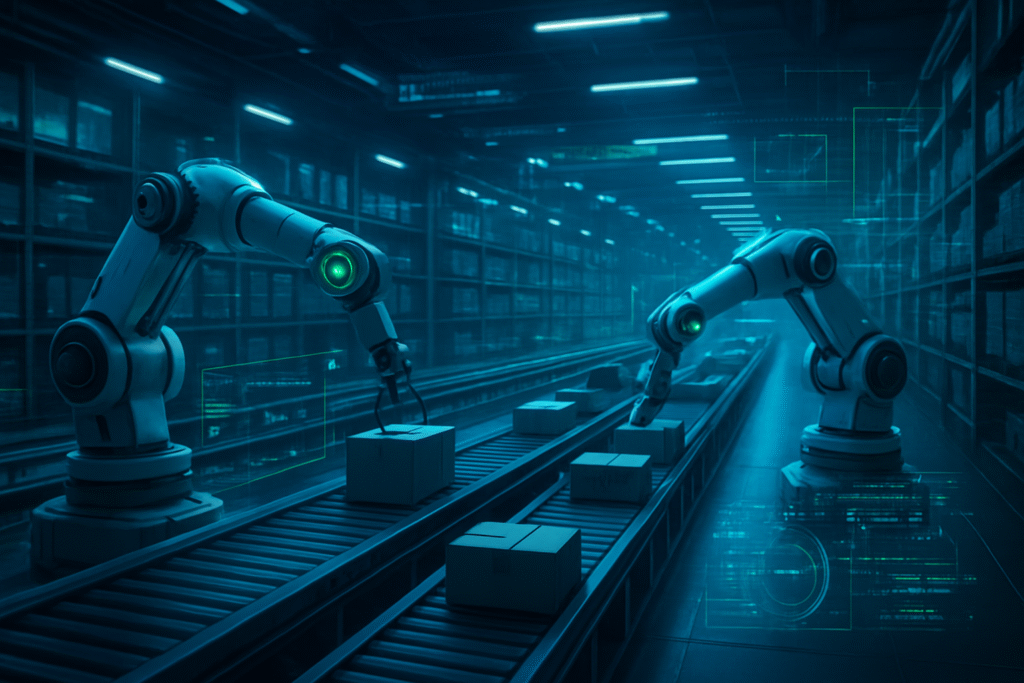
Tutor Intelligence is at the forefront of AI-powered warehouse robotics, offering advanced collaborative robots (cobots) designed to revolutionize manufacturing and packaging processes. Founded out of MIT's Computer Science and Artificial Intelligence Laboratory (CSAIL), the company's core innovation lies in its proprietary AI platform, which powers robotic arms equipped with state-of-the-art 3D AI vision. This system enables robots to make intelligent, real-time decisions within dynamic environments, a stark contrast to traditional industrial robots that rely on rigid, pre-programmed instructions.
The distinguishing feature of Tutor Intelligence's technology is its "virtuous cycle of real-world robot learning." The centralized intelligence system continuously logs thousands of hours of production experience, which is then annotated by human "tutors" to refine the underlying AI models. This hybrid human/artificial intelligence engine allows the robots to learn new tasks and adapt to diverse inventory and unforeseen situations without requiring custom programming. This means robots can seamlessly handle irregular and variable items—from produce to textiles—and adapt to changes in SKUs, patterns, orders, and volumes, a capability largely absent in previous automation approaches.
Tutor Intelligence's cobots are versatile, capable of tasks such as conveyor loading, kitting and packing of various SKUs into display shippers and retail trays, palletization, de-palletization, and case folding and sealing. What sets them apart is their accessibility and cost-effectiveness: offered through a "Robot-as-a-Service" (RaaS) subscription model, priced affordably at $12 per hour, it mirrors traditional labor costs and eliminates the need for hefty upfront capital investments. Furthermore, these systems can be delivered within 30 days and are typically operational within a single day, requiring no specialized IT staff or engineers for setup. Initial reactions from industry experts, including their inclusion in the 2025 Physical AI Fellowship, confirm Tutor Intelligence as a "game-changer" for its flexible, cost-effective, and rapidly deployable automation solutions.
Reshaping the Competitive Landscape: AI's New Frontier
Tutor Intelligence's significant funding and technological advancements are poised to create ripples across the AI and automation industry, impacting established tech giants and nascent startups alike. The company's "virtuous cycle" of real-world learning sets a new benchmark for AI companies focused on physical robotics, compelling competitors to develop more robust, adaptive, and generalizable AI for real-world applications, potentially accelerating innovation in areas like reinforcement learning and computer vision.
For tech giants, the implications are dual-edged. Companies like Amazon (NASDAQ: AMZN), with extensive logistics and warehousing operations, might view Tutor Intelligence's sophisticated and flexible warehouse robots as a potential competitive threat to their internal Amazon Robotics efforts, or as a valuable partnership opportunity to augment their existing infrastructure. Meanwhile, Google (NASDAQ: GOOGL) and Microsoft (NASDAQ: MSFT), key providers of AI platforms and cloud infrastructure, could be driven to enhance their own robotics platforms, invest in similar startups, or seek collaborations to integrate Tutor Intelligence's specialized physical AI with their broader cloud and AI ecosystems. The demand for advanced data annotation and learning infrastructure for real-world robotics also aligns perfectly with their service offerings.
For other automation startups, Tutor Intelligence's success presents both heightened competition and validation for the sector. Startups in the warehouse automation and collaborative robotics space will need to match Tutor Intelligence's flexibility, cost-effectiveness, and rapid deployment. However, the significant investment also validates the entire market, potentially attracting more funding for complementary technologies or unique AI capabilities, fostering a more dynamic and innovative environment. Tutor Intelligence is strategically positioning itself as a leader in accessible and intelligent physical automation, challenging traditional robot manufacturers with its RaaS model and adaptive AI, and aiming to become a dominant force in industrial automation.
Wider Significance: A New Era for Embodied AI
Tutor Intelligence's advancements extend far beyond individual warehouses; they represent a significant leap in the broader AI landscape, particularly in the realm of embodied AI and physical automation. The company's strategy of learning from real-world visual motor data, rather than solely simulated environments, aligns perfectly with the growing trend of developing AI that can robustly interact with and adapt to the unpredictable complexities of the physical world. This data-driven learning, coupled with its "Robots-as-a-Service" (RaaS) model, democratizes access to advanced automation, making it feasible for businesses of all sizes and driving the trend of AI-as-a-Service.
The impact on logistics and manufacturing is profound. Tutor Intelligence aims to "revolutionize every step of the supply chain" by automating complex, variable tasks like short-run packaging and kitting that have traditionally resisted automation. By providing an "infinite labor supply" of robots that work alongside human operators, the technology directly addresses chronic labor shortages while enhancing efficiency and productivity. This shift towards flexible, adaptable automation promises more resilient and agile supply chains, capable of responding swiftly to market fluctuations and disruptions.
However, this transformative potential also brings significant concerns, most notably regarding job displacement. While Tutor Intelligence emphasizes human-robot collaboration, the very notion of an "infinite labor supply" implies a reduced reliance on human labor for certain tasks. This fuels broader anxieties about job security and the need for workforce reskilling in an AI-driven economy. Experts emphasize the importance of proactive strategies like upskilling initiatives to help workers transition to new roles involving AI development, robot maintenance, and supervisory functions. Historically, technological advancements have created new opportunities, but the transition period requires careful management and ethical consideration to ensure a just and equitable future of work. Tutor Intelligence's approach, moving beyond rigid automation to adaptive, "human-like intuition," marks a significant evolution from earlier robotic systems and a critical step in AI's journey from research labs to pervasive real-world applications.
The Road Ahead: Evolving Intelligence and Expanding Reach
The future for Tutor Intelligence and the broader warehouse automation sector is one of continuous evolution, marked by advancements in robot capabilities, expanding applications, and ongoing challenges. In the near term, Tutor Intelligence plans to significantly increase its manufacturing capacity and accelerate robot deployment across the United States, particularly within the CPG sector. A core long-term strategy involves continuous investment in R&D to support a wider array of use cases and introduce new robot form factors and capabilities, pushing the boundaries of human-like intuition and dexterity in unstructured environments.
Beyond current applications in manufacturing and packaging, future use cases could extend to more intricate assembly, advanced quality control, and even highly unpredictable environments that traditionally demanded human dexterity and decision-making. The company's data-driven learning approach, akin to an "industrial boot camp," is expected to equip its robots with increasingly generalizable skills applicable across diverse domains. However, challenges remain: technological hurdles in achieving true human-level dexterity, ethical considerations around job displacement and workforce adaptation, and fierce market competition from established automation firms and emerging startups.
Experts are optimistic about Tutor Intelligence's trajectory, citing its "extraordinary speed of execution" and its ability to balance cutting-edge product development with a strong commercial focus. The broader warehouse automation market, projected to reach $41 billion by 2027, will see continued acceleration in the adoption of Autonomous Mobile Robots (AMRs), Automated Storage and Retrieval Systems (AS/RS), and collaborative robots (cobots). AI and Machine Learning will become the backbone of decision-making, enabling predictive maintenance, real-time inventory management, and optimized resource allocation. The trend is shifting from "lights-out" fully automated warehouses to human-robot collaboration, empowering workers with smart technology. Ethical guidelines, worker retraining, and safeguards against algorithmic bias will become increasingly central to ensure that technological advancements contribute to economic efficiency without compromising human dignity and social equity.
Comprehensive Wrap-up: A New Chapter in AI-Powered Logistics
Tutor Intelligence's $34 million Series A funding marks a pivotal moment in the journey of AI from theoretical research to practical, real-world deployment. By developing AI-powered fleets of warehouse robot workers that learn from actual production experience, the company is directly addressing some of the most complex and persistent challenges in manufacturing and logistics. Its "virtuous cycle" of learning, combined with an accessible "Robots-as-a-Service" model, sets a new standard for flexible, adaptable, and cost-effective automation, democratizing access to advanced robotics for businesses of all sizes.
This development holds significant weight in AI history, pushing the boundaries of "physical AI" and general-purpose robotics. It represents a crucial step beyond rigid, pre-programmed automation towards truly adaptive and intelligent systems capable of navigating the unpredictable realities of industrial operations. The long-term impact on supply chains will be transformative, leading to more resilient, agile, and efficient global networks. On the labor front, while some job displacement is inevitable, the emphasis on human-robot collaboration suggests a future where AI augments human capabilities, creating new roles and demanding a workforce equipped with evolving skills in an AI-driven economy.
In the coming weeks and months, watch for Tutor Intelligence's accelerated commercialization efforts, the scaling of its CPG fleet, and announcements regarding new robot form factors and capabilities. More broadly, the AI automation sector will continue to witness rapid advancements in hyper-automation, ethical AI frameworks, intelligent document processing, and the expansion of generative AI applications. The critical role of high-quality data and robust infrastructure for successful AI implementation will also come into sharper focus. Companies like Tutor Intelligence are not just automating tasks; they are fundamentally reshaping the relationship between humans, machines, and the physical economy, ushering in a new chapter of intelligent logistics and manufacturing.
This content is intended for informational purposes only and represents analysis of current AI developments.
TokenRing AI delivers enterprise-grade solutions for multi-agent AI workflow orchestration, AI-powered development tools, and seamless remote collaboration platforms.
For more information, visit https://www.tokenring.ai/.