
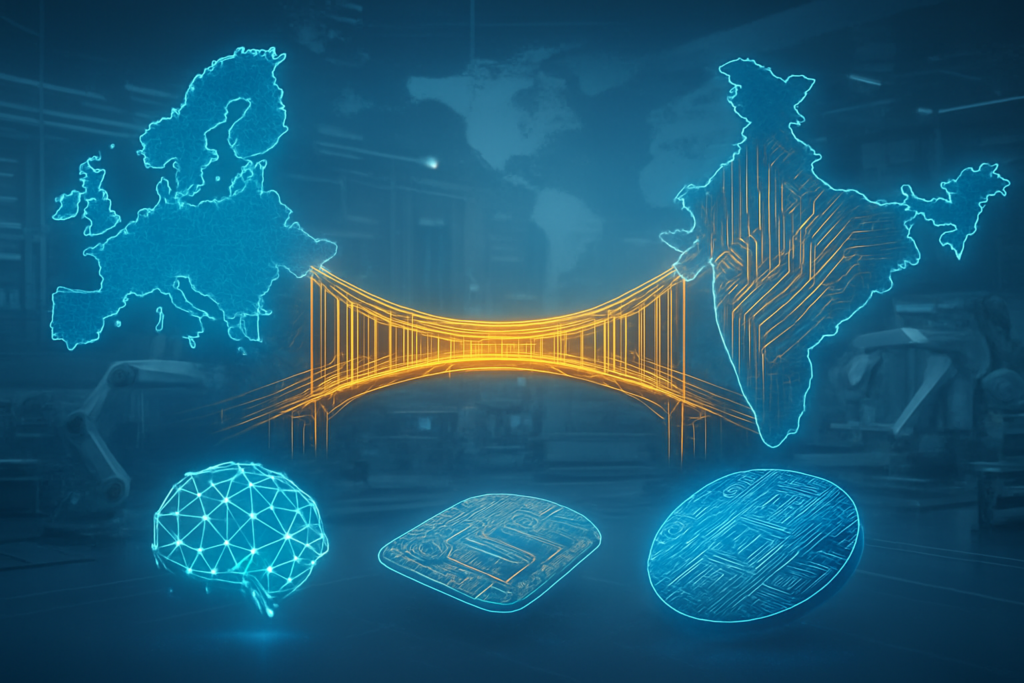
As of December 19, 2025, the global technology landscape is witnessing a historic realignment as negotiations for the India-European Union (EU) Free Trade Agreement (FTA) enter their final, decisive phase. This landmark deal, bolstered by the strategic framework of the India-EU Trade and Technology Council (TTC), is set to create a "Silicon Silk Road" that bridges the manufacturing ambitions of New Delhi with the high-tech engineering prowess of Brussels. The immediate significance of this partnership lies in its potential to create a formidable alternative to East Asian dominance in the semiconductor supply chain, ensuring that the hardware powering the next generation of artificial intelligence is both secure and diversified.
The convergence of the EU’s €43 billion Chips Act and the $10 billion India Semiconductor Mission (ISM) has transformed from a series of diplomatic MoUs into a concrete operational roadmap. By late 2025, this cooperation has moved beyond mere intent, focusing on the "Practical Implementation" of joint R&D in advanced chip design, heterogeneous integration, and the development of sophisticated Process Design Kits (PDKs). This technical synergy is designed to address the "missing middle" of the semiconductor value chain, where India provides the massive scale of design talent and emerging fabrication capacity, while the EU contributes critical lithography expertise and advanced materials science.
Technical Synergy and the TTC Framework
The technical backbone of this alliance was solidified during the second ministerial meeting of the TTC in New Delhi in early 2025. A standout development is the GANANA Project, a €5 million initiative funded via Horizon Europe that facilitates long-term High-Performance Computing (HPC) collaboration. This project links Europe’s premier supercomputing centers, such as LUMI in Finland and Leonardo in Italy, with India’s Center for Development of Advanced Computing (C-DAC). Unlike previous bilateral agreements that focused solely on academic exchange, the 2025 framework includes a specialized "early warning system" for semiconductor supply chain disruptions, allowing both regions to coordinate responses to raw material shortages or logistical bottlenecks in real-time.
Industry experts have noted that this deal differs from existing technology pacts due to its focus on "AI Hardware Sovereignty." This involves creating indigenous capacities for AI-driven automotive systems and data processing hardware that are not dependent on a single geographic region. The research community has lauded the launch of a dedicated semiconductor talent exchange program, which aims to facilitate the mobility of thousands of engineers between the two regions. This workforce integration is seen as a critical step in staffing the new "mega-fabs" currently under construction in the Indian states of Gujarat and Assam, which are expected to begin trial production by mid-2026.
Corporate Alliances and Market Shifts
The implications for tech giants and semiconductor leaders are profound. Intel Corporation (NASDAQ: INTC) has already signaled its commitment to this corridor, signing a landmark MoU with Tata Electronics in December 2025 to explore manufacturing and advanced packaging of Intel products at Tata’s $14 billion fabrication facility in Gujarat. This move positions Intel to leverage India’s growing domestic market for "AI PCs" while benefiting from the trade protections and incentives offered under the emerging FTA. Similarly, NXP Semiconductors (NASDAQ: NXPI) has commenced a $1 billion expansion in India, scouting land for a major R&D hub in Greater Noida dedicated to 5nm automotive chips and AI-integrated hardware for electric vehicles.
European powerhouse Infineon Technologies AG (XETRA: IFX) has also deepened its roots, opening a Global Capability Centre in Ahmedabad to work alongside the Automotive Research Association of India. For startups and smaller AI labs, this deal lowers the barrier to entry for custom silicon. By fostering a more transparent and duty-free trade environment for semiconductor components and design tools, the India-EU deal allows smaller players to compete with established giants by accessing specialized "chiplets" and IP blocks from both regions. This disruption is likely to challenge the market positioning of traditional leaders who have relied heavily on concentrated supply chains in Taiwan and South Korea.
Global Strategy and Geopolitical Resilience
On a broader scale, the India-EU partnership is a cornerstone of the global "de-risking" strategy. As the world moves toward an AI-centric economy, the demand for trusted hardware has become a matter of national security. This deal represents a strategic hedge against geopolitical volatility in the Taiwan Strait and a move toward "friend-shoring." By aligning their regulatory frameworks on AI and data privacy, India and the EU are creating a "Trust Zone" that could set global standards for how AI hardware is developed and deployed. This is a significant shift from the previous decade’s focus on software-only cooperation, marking a return to the importance of physical infrastructure in the digital age.
However, the path forward is not without concerns. Critics point to the remaining hurdles in the FTA negotiations, particularly regarding the EU’s Carbon Border Adjustment Mechanism (CBAM), which India fears could unfairly tax its hardware exports. Furthermore, the speed at which India can scale its infrastructure to meet the high-purity water and stable power requirements of advanced semiconductor manufacturing remains a point of debate. Comparing this to previous milestones, such as the 2022 CHIPS and Science Act in the U.S., the India-EU deal is unique in its transcontinental nature, attempting to synchronize the industrial policies of a sovereign nation and a 27-member trade bloc.
The Road to 2nm and Future Applications
Looking ahead, the next 24 months will be critical for the realization of this vision. Near-term developments are expected to focus on the "back-end" of the industry—Assembly, Testing, Marking, and Packaging (ATMP)—where India has already shown significant progress. By late 2026, we expect to see the first "Made in India" chips featuring European architecture hitting the market, specifically targeting the telecommunications and automotive sectors. Long-term, the partnership aims to break into the 2nm process node, a feat that would require even deeper integration with ASML Holding N.V. (NASDAQ: ASML) and its cutting-edge extreme ultraviolet (EUV) lithography technology.
The potential applications are vast, ranging from edge-AI sensors for smart cities to high-efficiency power semiconductors for the green energy transition. Challenges such as harmonizing intellectual property (IP) laws and managing the environmental impact of large-scale fab operations will need to be addressed through the TTC’s working groups. Experts predict that if the FTA is signed by early 2026, it could trigger a "second wave" of investment, with European semiconductor equipment manufacturers establishing permanent assembly and maintenance bases within India to support the burgeoning ecosystem.
A New Era of Technological Cooperation
In summary, the India-EU trade deal is more than just a reduction in tariffs; it is a strategic rewiring of the global semiconductor map. By combining Europe’s advanced R&D and lithography with India’s design talent and manufacturing scale, the two regions are building a resilient, AI-ready supply chain that is less vulnerable to single-point failures. The key takeaways from this development include the formalization of the Intel-Tata partnership, the launch of the GANANA project for HPC, and the clear political mandate to conclude a technology-first FTA by the end of 2025.
This development will likely be remembered as a turning point in AI history—the moment when the hardware "bottleneck" began to ease through international cooperation rather than competition. In the coming weeks and months, all eyes will be on the 15th round of FTA negotiations and the first trial runs at India’s new fabrication facilities. The success of this alliance will not only determine the future of the semiconductor industry but will also define the geopolitical balance of the AI era.
This content is intended for informational purposes only and represents analysis of current AI developments.
TokenRing AI delivers enterprise-grade solutions for multi-agent AI workflow orchestration, AI-powered development tools, and seamless remote collaboration platforms.
For more information, visit https://www.tokenring.ai/.