The global semiconductor foundry market has shattered previous records, reaching a staggering $84.8 billion in revenue for the third quarter of 2025. This 17% year-over-year climb underscores an unprecedented structural shift in the technology sector, as the relentless demand for artificial intelligence (AI) infrastructure transforms silicon manufacturing from a cyclical industry into a high-growth engine. At the center of this explosion is Taiwan Semiconductor Manufacturing Company (NYSE: TSM), which has leveraged its near-monopoly on advanced process nodes to capture the lion's share of the market's gains, reporting a massive 40.8% revenue increase.
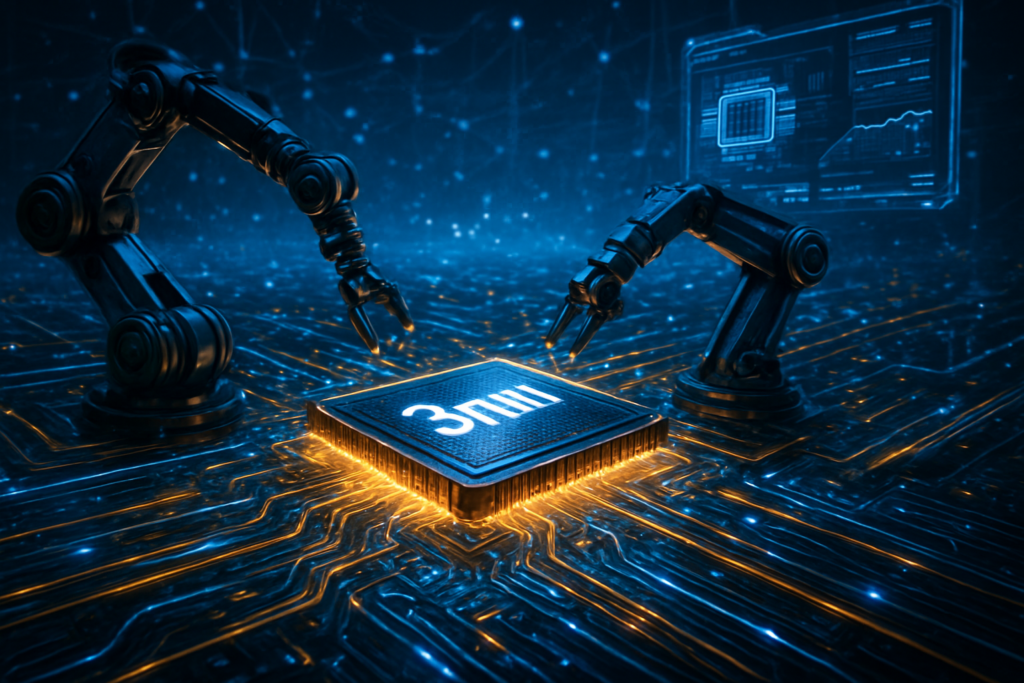
The surge in foundry revenue signals a definitive end to the post-pandemic slump in the chip sector, replacing it with a specialized "AI-first" economy. While legacy segments like automotive and consumer electronics showed only modest signs of recovery, the high-performance computing (HPC) and AI accelerator markets—led by the mass production of next-generation hardware—have pushed leading-edge fabrication facilities to their absolute limits. This divergence between advanced and legacy nodes is reshaping the competitive landscape, rewarding those with the technical prowess to manufacture at 3-nanometer (3nm) and 5-nanometer (5nm) scales while leaving competitors struggling to catch up.
The Technical Engine: 3nm Dominance and the Advanced Packaging Bottleneck
The Q3 2025 revenue milestone was powered by a massive migration to advanced process nodes, specifically the 3nm and 5nm technologies. TSMC reported that these advanced nodes now account for a staggering 74% of its total wafer revenue. The 3nm node alone contributed 23% of the company's earnings, a rapid ascent driven by the integration of these chips into high-end smartphones and AI servers. Meanwhile, the 5nm node—the workhorse for current-generation AI accelerators like the Blackwell platform from NVIDIA (NASDAQ: NVDA)—represented 37% of revenue. This concentration of wealth at the leading edge highlights a widening technical gap; while the overall market grew by 17%, the "pure-play" foundry sector, which focuses on these high-end contracts, saw an even more aggressive 29% year-over-year growth.
Beyond traditional wafer fabrication, the industry is facing a critical technical bottleneck in advanced packaging. Technologies such as Chip-on-Wafer-on-Substrate (CoWoS) have become as vital as the chips themselves. AI accelerators require massive bandwidth and high-density integration that only advanced packaging can provide. Throughout Q3, demand for CoWoS continued to outstrip supply, prompting TSMC to increase its 2025 capital expenditure to a range of $40 billion to $42 billion. This investment is specifically targeted at accelerating capacity for these complex assembly processes, which are now the primary limiting factor for the delivery of AI hardware globally.
Industry experts and research firms, including Counterpoint Research, have noted that this "packaging-constrained" environment is creating a unique market dynamic. For the first time, foundry success is being measured not just by how small a transistor can be made, but by how effectively multiple chiplets can be stitched together. Initial reactions from the research community suggest that the transition to "System-on-Integrated-Chips" (SoIC) will be the defining technical challenge of 2026, as the industry moves toward even more complex 2nm architectures.
A Landscape of Giants: Winners and the Struggle for Second Place
The Q3 results have solidified a "one-plus-many" market structure. TSMC’s dominance is now absolute, with the firm controlling approximately 71-72% of the global pure-play market. This positioning has allowed them to dictate pricing and prioritize high-margin AI contracts from tech giants like Apple (NASDAQ: AAPL) and AMD (NASDAQ: AMD). For major AI labs and hyperscalers, securing "wafer starts" at TSMC has become a strategic necessity, often requiring multi-year commitments and premium payments to ensure supply of the silicon that powers large language models.
In contrast, the struggle for the second-place position remains fraught with challenges. Samsung Foundry (KRX: 005930) maintained its #2 spot but saw its market share hover around 6.8%, as it continued to grapple with yield issues on its SF3 (3nm) and SF2 (2nm) nodes. While Samsung remains a vital alternative for companies looking to diversify their supply chains, its inability to match TSMC’s yield consistency has limited its ability to capitalize on the AI boom. Meanwhile, Intel (NASDAQ: INTC) has begun a significant pivot under new leadership, reporting $4.2 billion in foundry revenue and narrowing its operating losses. Intel’s "18A" node entered limited production in Q3, with shipments to U.S.-based customers signaling a potential comeback, though the company is not expected to see significant market share gains until 2026.
The competitive landscape is also seeing the rise of specialized players. SMIC has secured the #3 spot globally, benefiting from high utilization rates and a surge in domestic demand within China. Although restricted from the most advanced AI-capable nodes by international trade policies, SMIC has captured a significant portion of the mid-range and legacy market, achieving 95.8% utilization. This fragmentation suggests that while TSMC owns the "brain" of the AI revolution, other foundries are fighting for the "nervous system"—the power management and connectivity chips that support the broader ecosystem.
Redefining the AI Landscape: Beyond the "Bubble" Concerns
The record-breaking Q3 revenue serves as a powerful rebuttal to concerns of an "AI bubble." The sustained 17% growth in the foundry market suggests that the investment in AI is not merely speculative but is backed by a massive build-out of physical infrastructure. This development mirrors previous milestones in the semiconductor industry, such as the mobile internet explosion of the 2010s, but at a significantly accelerated pace and higher capital intensity. The shift toward AI-centric production is now a permanent fixture of the landscape, with HPC revenue now consistently outperforming the once-dominant mobile segment.
However, this growth brings significant concerns regarding market concentration and geopolitical risk. With over 70% of advanced chip manufacturing concentrated in a single company, the global AI economy remains highly vulnerable to regional instability. Furthermore, the massive capital requirements for new "fabs"—often exceeding $20 billion per facility—have created a barrier to entry that prevents new competitors from emerging. This has led to a "rich-get-richer" dynamic where only the largest tech companies can afford the latest silicon, potentially stifling innovation among smaller startups that cannot secure the necessary hardware.
Comparisons to previous breakthroughs, such as the transition to EUV (Extreme Ultraviolet) lithography, show that the current era is defined by "compute density." The move from 5nm to 3nm and the impending 2nm transition are not just incremental improvements; they are essential for the next generation of generative AI models that require exponential increases in processing power. The foundry market is no longer just a supplier to the tech industry—it has become the foundational layer upon which the future of artificial intelligence is built.
The Horizon: 2nm Transitions and the "Foundry 2.0" Era
Looking ahead, the industry is bracing for the shift to 2nm production, expected to begin in earnest in late 2025 and early 2026. TSMC is already preparing its N2 nodes, while Intel’s 18A is being positioned as a direct competitor for high-performance AI chips. The near-term focus will be on yield optimization; as transistors shrink further, the margin for error becomes microscopic. Experts predict that the first 2nm-powered consumer and enterprise devices will hit the market by early 2026, promising another leap in energy efficiency and compute capability.
A major trend to watch is the evolution of "Foundry 2.0," a model where manufacturers provide a full-stack service including wafer fabrication, advanced packaging, and even system-level testing. Intel and Samsung are both betting heavily on this integrated approach to lure customers away from TSMC. Additionally, the development of "backside power delivery"—a technical innovation that moves power wiring to the back of the silicon wafer—will be a key battleground in 2026, as it allows for even higher performance in AI servers.
The challenge for the next year will be managing the energy and environmental costs of this massive expansion. As more fabs come online globally, from Arizona to Germany and Japan, the semiconductor industry’s demand for electricity and water will come under increased scrutiny. Foundries will need to balance their record-breaking profits with sustainable practices to maintain their social license to operate in an increasingly climate-conscious world.
Conclusion: A New Chapter in Silicon History
The Q3 2025 results mark a historic turning point for the semiconductor industry. The 17% revenue climb and the $84.8 billion record are clear indicators that the AI revolution has reached a new level of maturity. TSMC’s unprecedented dominance underscores the value of technical execution in an era where silicon is the new oil. While competitors like Samsung and Intel are making strategic moves to close the gap, the sheer scale of investment and expertise required to lead the foundry market has created a formidable moat.
This development is more than just a financial milestone; it is the physical manifestation of the AI era. As we move into 2026, the focus will shift from simply "making more chips" to "making more complex systems." The bottleneck has moved from the design phase to the fabrication and packaging phase, making the foundry market the most critical sector in the global technology supply chain.
In the coming weeks and months, investors and industry watchers should keep a close eye on the rollout of the first 2nm pilot lines and the expansion of advanced packaging facilities. The ability of the foundry market to meet the ever-growing hunger for AI compute will determine the pace of AI development for the rest of the decade. For now, the silicon gold rush shows no signs of slowing down.
This content is intended for informational purposes only and represents analysis of current AI developments.
TokenRing AI delivers enterprise-grade solutions for multi-agent AI workflow orchestration, AI-powered development tools, and seamless remote collaboration platforms.
For more information, visit https://www.tokenring.ai/.