
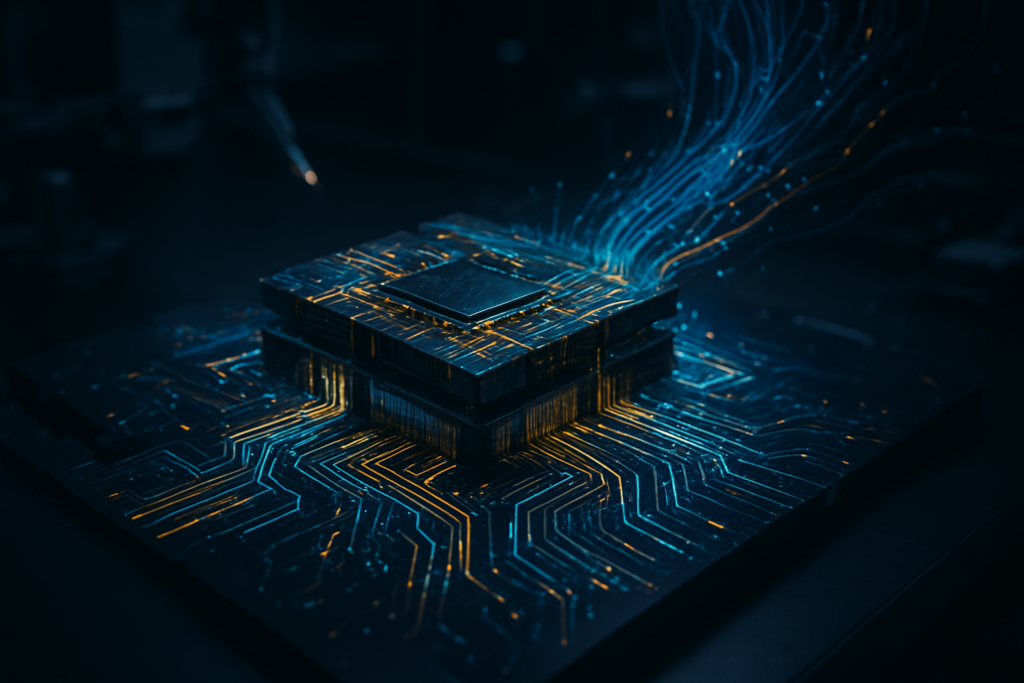
As the global AI race accelerates into 2026, the industry has hit a wall that has nothing to do with the size of transistors. While the world’s leading foundries have successfully scaled 3nm and 2nm wafer fabrication, the true battle for AI supremacy is now being fought in the "back-end"—the sophisticated world of advanced packaging. Technologies like TSMC’s Chip-on-Wafer-on-Substrate (CoWoS) (NYSE: TSM) have transitioned from niche engineering feats to the single most critical gatekeeper of the global AI hardware supply. For tech giants and startups alike, the question is no longer just who can design the best chip, but who can secure the capacity to put those chips together.
The immediate significance of this shift cannot be overstated. As of late 2025, the lead times for high-end AI accelerators like NVIDIA’s (NASDAQ: NVDA) Blackwell and the upcoming Rubin series are dictated almost entirely by packaging availability rather than raw silicon supply. This "packaging bottleneck" has fundamentally altered the semiconductor landscape, forcing a massive reallocation of capital toward advanced assembly facilities and sparking a high-stakes technological arms race between Taiwan, the United States, and South Korea.
The Technical Frontier: Beyond the Reticle Limit
At the heart of the current supply crunch is the transition to CoWoS-L (Local Silicon Interconnect), a sophisticated 2.5D packaging technology that allows multiple compute dies to be linked with massive stacks of High Bandwidth Memory (HBM3e and HBM4). Unlike traditional packaging, which simply connects a chip to a circuit board, CoWoS places these components on a silicon interposer with microscopic wiring densities. This is essential for AI workloads, which require terabytes of data to move between the processor and memory every second. By late 2025, the industry has moved toward "hybrid bonding"—a process that eliminates traditional solder bumps in favor of direct copper-to-copper connections—enabling a 10x increase in interconnect density.
This technical complexity is exactly why packaging has become the primary bottleneck. A single Blackwell GPU requires the perfect alignment of thousands of Through-Silicon Vias (TSVs). A microscopic misalignment at this stage can result in the loss of both the expensive logic die and the attached HBM stacks, which are themselves in short supply. Furthermore, the industry is grappling with a shortage of ABF (Ajinomoto Build-up Film) substrates, which must now support 20+ layers of circuitry without warping under the extreme heat generated by 1,000-watt processors. This shift from "Moore’s Law" (shrinking transistors) to "System-in-Package" (SiP) marks the most significant architectural change in computing in thirty years.
The Market Power Play: NVIDIA’s $5 Billion Strategic Pivot
The scarcity of advanced packaging has reshuffled the deck for the world's most valuable companies. NVIDIA, while still deeply reliant on TSMC, has spent 2025 diversifying its "back-end" supply chain to avoid a single point of failure. In a landmark move in late 2025, NVIDIA invested $5 billion in Intel (NASDAQ: INTC) to secure capacity for Intel’s Foveros and EMIB packaging technologies. This strategic alliance allows NVIDIA to use Intel’s advanced assembly plants in New Mexico and Malaysia as a "secondary valve" for its next-generation Rubin architecture, effectively bypassing the 12-month queues at TSMC’s Taiwanese facilities.
Meanwhile, Samsung (OTCMKTS: SSNLF) is positioning itself as the only "one-stop shop" in the industry. By offering a turnkey service that includes the logic wafer, HBM4 memory, and I-Cube packaging, Samsung has managed to lure major customers like Tesla (NASDAQ: TSLA) and various hyperscalers who are tired of managing fragmented supply chains. For AMD (NASDAQ: AMD), the early adoption of TSMC’s SoIC (System on Integrated Chips) technology has provided a temporary performance edge in the server market, but the company remains locked in a fierce bidding war for CoWoS capacity that has seen packaging costs rise by nearly 20% in the last year alone.
A New Era of Hardware Constraints
The broader significance of the packaging bottleneck lies in its impact on the democratization of AI. As packaging costs soar and capacity remains concentrated in the hands of a few "Tier 1" customers, smaller AI startups and academic researchers are finding it increasingly difficult to access high-end hardware. This has led to a divergence in the AI landscape: a "hardware-rich" class of companies that can afford the premium for advanced interconnects, and a "hardware-poor" class that must rely on older, less efficient 2D-packaged chips.
This development mirrors previous milestones like the transition to EUV (Extreme Ultraviolet) lithography, but with a crucial difference. While EUV was about the physics of light, advanced packaging is about the physics of materials and heat. The industry is now facing a "thermal wall," where the density of chips is so high that traditional cooling methods are failing. This has sparked a secondary boom in liquid cooling and specialized materials, further complicating the global supply chain. The concern among industry experts is that the "back-end" has become a geopolitical lever as potent as the chips themselves, with governments now racing to subsidize packaging plants as a matter of national security.
The Future: Glass Substrates and Silicon Carbide
Looking ahead to 2026 and 2027, the industry is already preparing for the next leap: Glass Substrates. Intel is currently leading the charge, with plans for mass production in 2026. Glass offers superior flatness and thermal stability compared to organic resins, allowing for even larger "System-on-Package" designs that could theoretically house over a trillion transistors. TSMC and its "E-core System Alliance" are racing to catch up, fearing that Intel’s lead in glass could finally break the Taiwanese giant's stranglehold on the high-end market.
Furthermore, as power consumption for flagship AI clusters heads toward the multi-megawatt range, researchers are exploring Silicon Carbide (SiC) interposers. For NVIDIA’s projected "Rubin Ultra" variant, SiC could provide the thermal conductivity necessary to prevent the chip from melting itself during intense training runs. The challenge remains the sheer scale of manufacturing required; experts predict that until "Panel-Level Packaging"—which processes chips on large rectangular sheets rather than circular wafers—becomes mature, the supply-demand imbalance will persist well into the late 2020s.
The Conclusion: The Back-End is the New Front-End
The era where silicon fabrication was the sole metric of semiconductor prowess has ended. As of December 2025, the ability to package disparate chiplets into a cohesive, high-performance system has become the definitive benchmark of the AI age. TSMC’s aggressive capacity expansion and the strategic pivot by Intel and NVIDIA underscore a fundamental truth: the "brain" of the AI is only as good as the nervous system—the packaging—that connects it.
In the coming weeks and months, the industry will be watching for the first production yields of HBM4-integrated chips and the progress of Intel’s Arizona packaging facility. These milestones will determine whether the AI hardware shortage finally eases or if the "packaging paradigm" will continue to constrain the ambitions of the world’s most powerful AI models. For now, the message to the tech industry is clear: the most important real estate in the world isn't in Silicon Valley—it’s the few microns of space between a GPU and its memory.
This content is intended for informational purposes only and represents analysis of current AI developments.
TokenRing AI delivers enterprise-grade solutions for multi-agent AI workflow orchestration, AI-powered development tools, and seamless remote collaboration platforms.
For more information, visit https://www.tokenring.ai/.