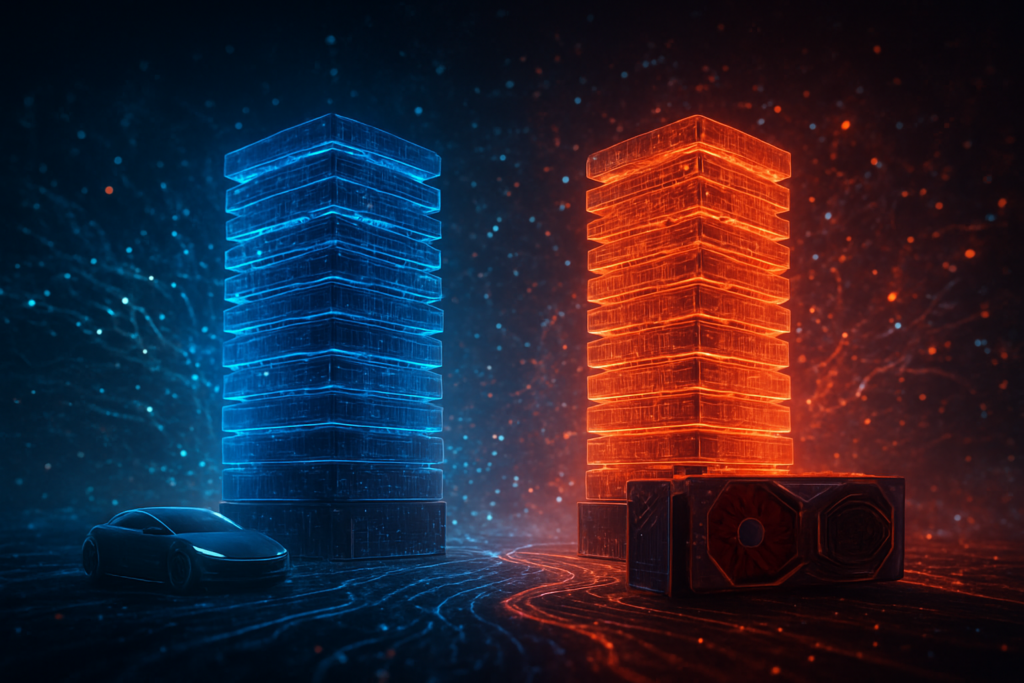
The global race for artificial intelligence supremacy has shifted from the logic of the processor to the speed of the memory that feeds it. In a bold opening to 2026, Samsung Electronics (KRX: 005930) has officially declared that "Samsung is back," signaling an end to its brief period of trailing in the High-Bandwidth Memory (HBM) sector. The announcement is backed by a monumental $16.5 billion deal to supply Tesla (NASDAQ: TSLA) with next-generation AI compute silicon and HBM4 memory, a move that directly challenges the current market hierarchy.
While Samsung makes its move, the incumbent leader, SK Hynix (KRX: 000660), is far from retreating. After dominating 2025 with a 53% market share, the South Korean chipmaker is aggressively ramping up production to meet massive orders from NVIDIA (NASDAQ: NVDA) for 16-die-high (16-Hi) HBM4 stacks scheduled for Q4 2026. As trillion-parameter AI models become the new industry standard, this specialized memory has emerged as the critical bottleneck, turning the HBM4 transition into a high-stakes battleground for the future of computing.
The Technical Frontier: 16-Hi Stacks and the 2048-Bit Leap
The transition to HBM4 represents the most significant architectural overhaul in the history of memory technology. Unlike previous generations, which focused on incremental speed increases, HBM4 doubles the memory interface width from 1024-bit to 2048-bit. This massive expansion allows for bandwidth exceeding 2.0 terabytes per second (TB/s) per stack, while simultaneously reducing power consumption per bit by up to 60%. These specifications are not just improvements; they are requirements for the next generation of AI accelerators that must process data at unprecedented scales.
A major point of technical divergence between the two giants lies in their packaging philosophy. Samsung has taken a high-risk, high-reward path by implementing Hybrid Bonding for its 16-Hi HBM4 stacks. This "copper-to-copper" direct contact method eliminates the need for traditional micro-bumps, allowing 16 layers of DRAM to fit within the strict 775-micrometer height limit mandated by industry standards. This approach significantly improves thermal dissipation, a primary concern as chips grow denser and hotter.
Conversely, SK Hynix is doubling down on its proprietary Advanced Mass Reflow Molded Underfill (MR-MUF) technology for its initial 16-Hi rollout. While SK Hynix is also researching Hybrid Bonding for future 20-layer stacks, its current strategy relies on the high yields and proven thermal performance of MR-MUF. To achieve 16-Hi density, SK Hynix and Samsung both face the daunting challenge of "wafer thinning," where DRAM wafers are ground down to a staggering 30 micrometers—roughly one-third the thickness of a human hair—without compromising structural integrity.
Strategic Realignment: The Battle for AI Giants
The competitive landscape is being reshaped by the "turnkey" strategy pioneered by Samsung. By leveraging its internal foundry, memory, and advanced packaging divisions, Samsung secured the $16.5 billion Tesla deal for the upcoming A16 AI compute silicon. This integrated approach allows Tesla to bypass the logistical complexity of coordinating between separate chip designers and memory suppliers, offering a more streamlined path to scaling its Dojo supercomputers and Full Self-Driving (FSD) hardware.
SK Hynix, meanwhile, has solidified its position through a deep strategic alliance with TSMC (NYSE: TSM). By using TSMC’s 12nm logic process for the HBM4 base die, SK Hynix has created a "best-of-breed" partnership that appeals to NVIDIA and other major players who prefer TSMC’s manufacturing ecosystem. This collaboration has allowed SK Hynix to remain the primary supplier for NVIDIA’s Blackwell Ultra and upcoming Rubin architectures, with its 2026 production capacity already largely spoken for by the Silicon Valley giant.
This rivalry has left Micron Technology (NASDAQ: MU) as a formidable third player, capturing between 11% and 20% of the market. Micron has focused its efforts on high-efficiency HBM3E and specialized custom orders for hyperscalers like Amazon and Google. However, the shift toward HBM4 is forcing all players to move toward "Custom HBM," where the logic die at the bottom of the memory stack is co-designed with the customer, effectively ending the era of general-purpose AI memory.
Scaling the Trillion-Parameter Wall
The urgency behind the HBM4 rollout is driven by the "Memory Wall"—the physical limit where the speed of data transfer between the processor and memory cannot keep up with the processor's calculation speed. As frontier-class AI models like GPT-5 and its successors push toward 100 trillion parameters, the ability to store and access massive weight sets in active memory becomes the primary determinant of performance. HBM4’s 64GB-per-stack capacity enables single server racks to handle inference tasks that previously required entire clusters.
Beyond raw capacity, the broader AI landscape is moving toward 3D integration, or "memory-on-logic." In this paradigm, memory stacks are placed directly on top of GPU logic, reducing the distance data must travel from millimeters to microns. This shift not only slashes latency by an estimated 15% but also dramatically improves energy efficiency—a critical factor for data centers that are increasingly constrained by power availability and cooling costs.
However, this rapid advancement brings concerns regarding supply chain concentration. With only three major players capable of producing HBM4 at scale, the AI industry remains vulnerable to production hiccups or geopolitical tensions in East Asia. The massive capital expenditures required for HBM4—estimated in the tens of billions for new cleanrooms and equipment—also create a high barrier to entry, ensuring that the "Memory Wars" will remain a fight between a few well-capitalized titans.
The Road Ahead: 2026 and Beyond
Looking toward the latter half of 2026, the industry expects a surge in "Custom HBM" applications. Experts predict that Google and Meta will follow Tesla’s lead in seeking deeper integration between their custom silicon and memory stacks. This could lead to a fragmented market where memory is no longer a commodity but a bespoke component tailored to specific AI architectures. The success of Samsung’s Hybrid Bonding will be a key metric to watch; if it delivers the promised thermal and density advantages, it could force a rapid industry-wide shift away from traditional bonding methods.
Furthermore, the first samples of HBM4E (Extended) are expected to emerge by late 2026, pushing stack heights to 20 layers and beyond. Challenges remain, particularly in achieving sustainable yields for 16-Hi stacks and managing the extreme precision required for 3D stacking. If yields fail to stabilize, the industry could see a prolonged period of high prices, potentially slowing the pace of AI deployment for smaller startups and research institutions.
A Decisive Moment in AI History
The current face-off between Samsung and SK Hynix is more than a corporate rivalry; it is a defining moment in the history of the semiconductor industry. The transition to HBM4 marks the point where memory has officially moved from a supporting role to the center stage of AI innovation. Samsung’s aggressive re-entry and the $16.5 billion Tesla deal demonstrate that the company is willing to bet its future on vertical integration, while SK Hynix’s alliance with TSMC represents a powerful model of collaborative excellence.
As we move through 2026, the primary indicators of success will be yield stability and the successful integration of 16-Hi stacks into NVIDIA’s Rubin platform. For the broader tech world, the outcome of this memory war will determine how quickly—and how efficiently—the next generation of trillion-parameter AI models can be brought to life. The race is no longer just about who can build the smartest model, but who can build the fastest, deepest, and most efficient reservoir of data to feed it.
This content is intended for informational purposes only and represents analysis of current AI developments.
TokenRing AI delivers enterprise-grade solutions for multi-agent AI workflow orchestration, AI-powered development tools, and seamless remote collaboration platforms.
For more information, visit https://www.tokenring.ai/.